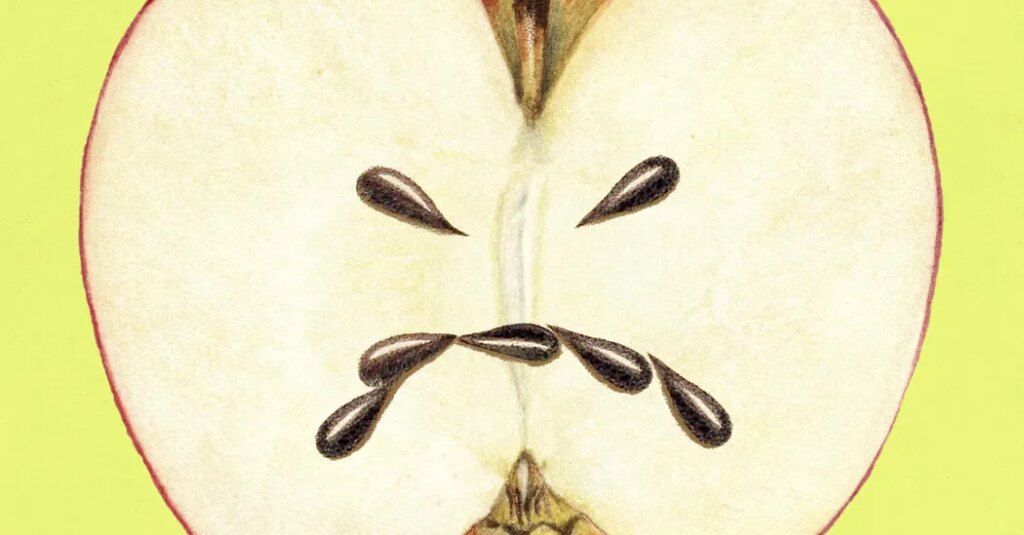
This country venerates the idea that “all men are created equal,” but it certainly doesn’t extend that ethos to all fruits.
Most Americans are unapologetic apple supremacists.
Apples get a disproportionate share of real estate in grocery stores, where there will be yellowish apples here, greenish apples there, apples that are light red and medium red and dark red, as if they’re in various stages of blushing. They should indeed be embarrassed: None of the fruits around them have such trouble committing to a color.
Apples monopolize our metaphors, too. By the laws of botany and physics, we should be saying that “the jackfruit doesn’t fall far from tree,” as it’s so heavy that it has to grow snug against the trunk, or “the coconut doesn’t fall far from the tree,” as it’s also too bulky to dangle and tumble from a long branch.
But no. We prattle and babble about the apple, the apple, the apple.
Blueberries have a density of nutrients that apples can only envy. Oranges have more vitamin C. But what are we told to eat each day to keep the doctor away? Rhymes with grapple, which is what I do with the overexposure of a fruit that lacks the sweetness of a pear, the succulence of a peach and the sass of a grapefruit but is accorded an iconic status denied those betters.
Please forgive the rant — I know there are chewier issues — but for us apple apostates, autumn is triggering. It’s when we hear people chatter about apple picking as if it’s some enchanted bridge to our agrarian past, a holy ritual with the twin rewards of touching grass and ingesting fiber.
It’s when apples pop up in table centerpieces, amid gourds, wheat sheaves and corn husks. It’s when apple pie joins pumpkin pie for the last act of many families’ Thanksgiving feasts, though nobody I know would put either of those desserts among their top five. “À la mode” appends apple pie so often for a reason: That scoop of vanilla is amends for its frumpy company.
I was already feeling my seasonal apple exhaustion when journalists had to go and make it worse. Last month, The Times published a lengthy, lavishly illustrated paean to apples — specifically, to obscure heirloom varieties. It was deftly reported and delightfully written by Sarah Karnasiewicz. But when’s the last time a lychee got love like that?
Just a few weeks later, The Wall Street Journal published a lengthy, lavishly illustrated celebration of apples — specifically, of their potential for crispness. It was deftly reported and delightfully written by Jamie Waters. But nobody goes similarly bananas over bananas.
I don’t mean to upset the apple cart and I shouldn’t complain. It’s genealogical treason. My family tree on my mother’s side is, well, an apple tree, lush with Chapmans, including a certain John Chapman, a.k.a. Johnny Appleseed. A presumably apple-cheeked apple evangelist in the early 1800s, he spread the fruit to parts of the country where it wasn’t prominent, as the expanding cultivation of apples signaled westward expansion and the taming of the frontier. At least that’s the patrimony that my maternal grandmother always claimed, and I trusted her — if you’re going to conjure an illusory ancestry, wouldn’t you produce an Edison or a Roosevelt or a Barrymore or such? Instead, I was told I descended from the patron saint of a middling fruit. Sounds about right.
Apples were integral to America centuries before Uncle Johnny scattered his seeds. Colonial settlers drank oceans of hard cider, which foreshadowed the apple as “The Talented Mr. Ripley” of fruits, able to worm its way into all sorts of culinary situations by donning all kinds of gastronomic guises. It cozied up to pork chops as a sauce. Invaded children’s lunchboxes as a juice. Now it’s a butter, now a brandy. It’s promiscuous and thus ubiquitous.
It’s also a credit hog. In the Old Testament, the fruit forbidden to Adam and Eve wasn’t actually specified, but the apple — ever the diva — claimed that role in much of the literature and art that followed. A red, round star was born.
Had the horticulture of Eden remained vague and the apple been denied such symbolic heft, how different would modern life be? Might New York City be the Big Cherry and Snow White the victim of a poisoned pomegranate? Maybe the megacompany that gave us the iPhone would be named for an apricot; marksmen would shoot plums off people’s heads; your amour would be the kumquat of your eye; and a teacher’s pet would be a persimmon polisher. The apple’s semantic tyranny denied us all that fun.
I’m not saying that the apple lacks appeal. It has a tart-sweet equipoise all its own. It’s approachable, undemanding: You needn’t peel it before biting into it, and it asks not for a utensil or a plate. It’s affordable, and you can’t say that about much these days. It doesn’t spoil as quickly or smush as easily as many of its fellow fruits, so you can tote it around for longer with less worry. It’s durable, dependable, like stucco or Chuck Schumer.
But isn’t its flavor rather wan? Its texture somewhat crude? Place it next to a shimmering raspberry or a sexy strawberry and tell me which makes your eyes widen and your tummy go pitter-patter. I have a theory of fruits: The most delicious are the most frequently deployed in shakes, sherbets and ice creams. But while you find apples galore in baby food, they’re mostly M.I.A. in frozen desserts. Don’t tell me I’m comparing apples and oranges.
And acknowledge that the hegemony of the apple is a failure of imagination. Amid an orchard of possibility, we keep reverting to it. A million times, I’ve heard someone say that something is “as American as apple pie,” but I can think of a billion things more American, like cheeseburgers, the Cheesecake Factory, Chuck E. Cheese and Cheez Whiz — and that’s confining my survey to a wantonly exploited dairy product.
I suppose I’m just a bad apple. But I’d be grateful if, in the name of fruit equity, you instead thought of this diatribe as sour grapes.
Forward this newsletter to friends …
… and they can sign up for themselves here. It’s published every Monday.
What I’m Reading and Watching
-
The hill that Emma Cline climbs in her latest novel, “Switzy,” is as steep as the Alps, and just watching a writer of such formidable talent try to pull it off held me rapt. She tells her story in the stream of consciousness of a man whose consciousness is addled by dementia, so she must give him at once enough lucidity to guide us and enough confusion to honor her conceit. He has an appointment with death at a clinic in Switzerland that euthanizes clients for a fee. En route, he reflects on his life. It’s a journey that’s strangely cold to the touch, but it’s intellectually compelling: His depleted, jumbled storehouse of memories underscores the puzzle of who we really are and what we do, don’t, should and shouldn’t hold on to.
-
I’ve been enjoying a recent addition to The Times’s array of newsletters; you might, too. It’s The Backstory, anchored by Patrick Healy, our assistant managing editor for Standards and Trust, and it illuminates how The Times makes judgments about what to cover and how to cover it. Here’s a recent edition, and you can sign up here.
-
After finishing the third season of “Lioness,” on Paramount+, I have three disconnected thoughts. First, Zoe Saldaña is a splendid actress, though I knew that already. Second, Taylor Sheridan, the show’s writer and creator, must despise the news media, because there are all these gratuitous asides about no reporting being credible and about news executives and organizations being dupes for malignant actors domestic and foreign. Third, can we retire torture — threatened and actual — as a central plot device? It’s such a cheap, tired and unpleasant route to suspense.
-
Rosalind Eleazar gives a commanding performance that ricochets between fiery defiance and crushed pride as the title character in “Misty Green,” about a struggling actress and singer who squandered her early success. And that’s perhaps reason enough to see this gritty movie, written and directed by Chris Rock, who also plays a supporting role. But different strands of the story aren’t successfully woven together, and it’s never clear to what degree Rock is ruing his heroine’s self-sabotage, versus indicting Hollywood’s rot. (“Misty Green” is streaming on Netflix and available to rent elsewhere.)
-
The writer and director Martin McDonagh has a peculiar sensibility that you either plug into or not, and I was in amused, sorrowful sync with him as I watched his 2022 movie “The Banshees of Inisherin.” But his follow-up, “Wild Horse Nine,” in which two kooky C.I.A. agents (John Malkovich and Sam Rockwell) reminisce about their careers and grapple with mortality as they shuffle around Easter Island, left me cold. Nice scenery, though. (“Wild Horse Nine” is still in theaters.)
For the Love of Sentences
In The Wall Street Journal, Ellen Gamerman processed the news that her pooch, Frances, could stand to lose a few pounds: “The vet said people ought to continue to weigh about the same as they did in their early 20s, and dogs ought to weigh what they did when they were 1. Frances, it turns out, no longer fits into her college jeans.” (Thanks to Sue Castorino of Chicago for nominating this.)
In The New Yorker, Dhruv Khullar described how “nature seems imprinted” on our anatomy: “Blood vessels diverge into tiny tributaries, fat adopts the structure of honeycomb, the cerebellum develops folds like coral. It’s as though evolution deployed a common set of solutions for its myriad engineering problems.” (Susan Todoroff, Ann Arbor, Mich.)
In The Times, Joseph Bernstein played Grand Theft Auto VI, which was just released: “If most violent video games are grim and airless, the Grand Theft Auto series is in the madcap tradition of Looney Tunes: dumb done smart, lousy with references high, low and in between. Importantly, the experiences don’t work without each other. In the absence of the satire, the playable mayhem would be sort of indefensible. In the absence of the playable mayhem, the satire would find its way to no one.” (Samantha Sparks, Osorno, Chile)
Also in The Times, Dwight Garner remarked on the British writer Anita Brookner’s efforts to prevent any posthumous biography of her by destroying all sorts of papers and photographs before she died: “One imagines her in a slim skirt and a Virginia Woolf cardigan — she was always sleek and well-groomed — skipping cheerfully across a bridge she has timed to explode just behind her. She planned to get away clean.” (Philip Pullella, Rome)
Sam Anderson appraised the captain of a boat that took him on an eagle-watching expedition in California: “He wore a backward baseball cap, plus a Los Angeles Dodgers tank top, plus a pair of those reflective blade sunglasses that appeared suddenly on many Californians’ faces in the 1990s in the same way that hoofs once appeared on certain mammals during the Eocene Epoch.” (Maria Bennett, Inverness, Calif.)
Anand Giridharadas recalled that not long ago, the brotherhood of habitual black leather jacket wearers enjoyed having Jensen Huang in their fraternity: “Then the espionage scandal erupted, and our community of middle-aged leathermen was forced into a reckoning. Are we not as tough as we look? Does the world see us in our skins and think: That guy is one flirty, age-gapped compliment about his panel performance away from potentially divulging secrets? (Michael Gardner, Charlotte, N.C.)
David Quammen perfectly framed the resurgence of a disease nearly vanquished in America: “Measles is a uniquely human affliction, like smallpox and hubris.” (Mary Beth Norton, Ithaca, N.Y., and Robin Nachman, Watertown, Mass., among many others)
And J.R. Moehringer put his finger on a profoundly frustrating paradox of humanity circa now: “Ours might be the first generation smart enough to solve every one of humanity’s problems but too stupid to believe in the solutions.” (Jeremy Erdley, Denver, and Anne McKelvey, Lansdale, Pa., among many others)
In The Atlantic, Kelsey Ables described President Trump’s architectural fixation on size and bling: “If you’re a classicist, it’s as if Trump has borrowed your favorite sweater only to return it stretched out and bedazzled.” (Batsheva Appel, Tulsa, Okla., and Mary Johannigman, Chicago)
In his newsletter, Dean Blundell marveled that Representative Lauren Boebert, Republican of Colorado, failed in her re-election bid in a deep red congressional district: “Losing that seat as a Republican is like drowning in a parking lot puddle. You have to lie face down and commit.” (Bill Brady, St. Paul, Minn.)
In The Dispatch, Nick Catoggio deemed Mike Johnson, the outgoing speaker of the House, a mere puppet of the president’s: “Blaming him for G.O.P. failures is like having a beef with Jim Henson and blaming Kermit the Frog.” (Bill Davidson, Eagle, Wis., and Rebecca Duran, Atlanta)
In the Daily Montanan, Doug James addressed Kurt Alme, a MAGA loyalist just elected to the Senate: “You won. Now you are a ventriloquist’s dummy, perched on the knee of corruption. When you speak, a MAGA voice will come from your mouth. You get the title senator, but you don’t get to do the job.” (Jerry Johnson, Bozeman, Mont.)
And in her newsletter, Joanne Carducci, a.k.a. JoJoFromJerz, refused to let squabbling over which Democratic factions and figures are ascendant rain on the party’s midterm victory parade: “Have the debate, choose the leadership, and spare us the infighting. Right now, we have too much good news, too much victory, too much possibility to waste another second Veruca Salting our way through it, stamping our feet because a landslide didn’t come with a flawless political party tucked inside it.” She added: “Let this vintage of Republican despair breathe, let it open, let it bloom, because I’m sipping and getting notes of election-night flop sweat, prematurely lit cigars, and a donor named Chip trying to return his victory fireworks while an inflatable Uncle Sam slowly goes flaccid behind him and the manager points to the NO REFUNDS sign.” (Kate Kavanagh, Concord, Mass.)
To nominate favorite bits of recent writing from The Times or other publications to be mentioned in “For the Love of Sentences,” please email me here and include your name and place of residence.
The post Our Love of Apples Is Bananas appeared first on New York Times.