San Francisco may be best known as the cradle of cutting-edge technology, but during torrential rain storms, the city looks more like a backwater — with a decidedly putrid stench.
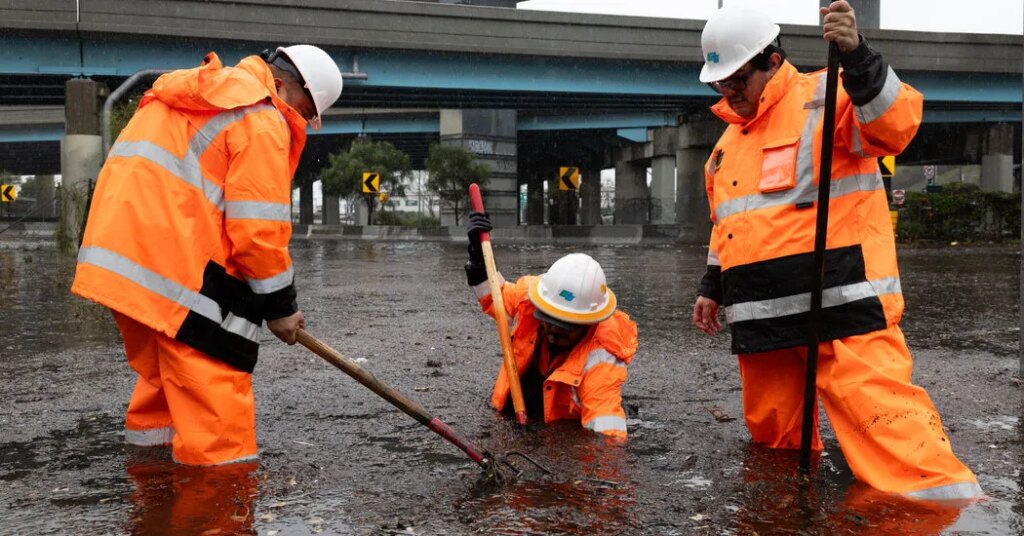
During last week’s record-breaking rainfall, flooding dislodged manhole covers, geysers containing wastewater spewed into low-lying streets, and The San Francisco Chronicle issued an alert warning residents of “poop water.”
The ick factor could grow with El Niño threatening to pack a punch over the next few months, and with the city’s sewer system, through which rainwater and sewage move together, unable to handle the onslaught. Another storm is expected to arrive on Tuesday, though the biggest concern may be coastal flooding from king tides.
Donna Marie Ponferrada, 46, was working at her home on Wednesday in San Francisco’s Mission Terrace neighborhood when her aunt, who lives one block over, called her in a panic. The flooding, which had swamped the low-lying neighborhood during previous storms, was back.
Ms. Ponferrada said she pulled on her rain boots, opened her front door and looked down to see murky water climbing up her steps. The smell, she said, was “foul.”
“If that’s not poop water, I don’t know what else to call it,” she said.
Most cities in the United States have one network of pipes to transport wastewater to a treatment plant and another one that sends storm water to a nearby stream or body of water.
But San Francisco has a combined sewer system, with the same underground pipes carrying storm water and wastewater together. And during particularly intense storms, the pipes can get overwhelmed, causing water to collect on streets and spray up though manholes.
San Francisco has one of about 700 such systems in the country; most are in the Northeast and around the Great Lakes region. San Francisco is the only one directly on the Pacific Ocean.
On rainy days that don’t break records, the San Francisco system is a benefit. It captures and cleans rainwater that has been mixed with pollutants such as oil, grease and fertilizer, which all go to a treatment plant before heading out to sea. But on days with deluges, the system overflows, and wastewater that has not yet been cleaned can spew into the streets.
Last week, manhole covers in the Mission Terrace neighborhood popped open, creating geysers in the middle of the streets. Ms. Ponferrada said she tried to walk to her aunt’s house but had to turn back when the water rose past her knees.
She said that during previous storms, she lost two cars and neighbors’ pets had drowned or been electrocuted. This time, she said, several neighbors, including her aunt, had their basements wrecked and were left with “black sewage debris that smells.”
She and other neighbors, as well as residents in other flood-prone parts of the city, are part of a citizens group called Solutions Not Sandbags, which advocates better management of the city’s sewer system.
Sejal Choksi-Chugh, the executive director of San Francisco Baykeeper, an environmental nonprofit, has urged the city to upgrade its infrastructure.
“At least 10 percent of the water that’s spilling into the street and popping out of manhole covers is untreated sewage,” she said. “It’s not good for human exposure, so you don’t want people to walk in those floodwaters and then eat a sandwich.”
Baykeeper recommends not swimming in the Pacific Ocean or the San Francisco Bay for two to three days after a rainstorm because of these issues. Ms. Choksi-Chugh said that people should also avoid contact with floodwater in the city streets.
Nancy Crowley, a spokeswoman for the San Francisco Public Utilities Commission, said last week’s storm would have been a challenge for any urban sewer system. On Nov. 18, San Francisco officially recorded 2.64 inches of rain, a record for that date and, in only one day, more than the city’s average rainfall for the entire month of November.
“San Francisco was hit by a historic storm that brought an average of three inches of rain across the city, with half of that downpour coming in one three-hour period,” she said in a statement. “We saw local flooding at several different low-lying spots around the city, as did cities across the Bay Area.”
She said more than 95 percent of the floodwater was rain but acknowledged the rest was wastewater.
The city has three treatment facilities, two dating back to the 1950s and one built in 1994, that can clean a combined 570 million gallons of rainwater and wastewater every day. That is the equivalent of roughly 860 Olympic-size swimming pools.
San Francisco also has 22 miles of underground storm water storage structures that can hold 200 million gallons. But in downpours, that system can reach capacity, and there can be nowhere for the extra water to flow but into the streets.
Homes and businesses in the low-lying areas have been flooded and contaminated in San Francisco for decades. Jan Null, a Bay Area meteorologist, said he had seen it occur again and again in the city’s low-lying areas throughout the 52 years he has been watching the region’s weather.
“It happens along old creek beds and in lowlands and where the soil is getting compacted down and receding,” he said. “It’s been a front-page issue for years.”
Ms. Crowley said the city was investing billions into its sewage system, including modernizing its biggest treatment plant to withstand a three-foot rise in sea level and a 7.8 magnitude earthquake. Smaller projects in the city’s low-lying areas should help with the system’s capacity and reduce the risk of flooding, she said.
But the work may not be enough to withstand storms that are expected to get even fiercer with climate change. Ms. Choksi-Chugh of Baykeeper found it interesting that in a fast-moving city dominated by technology — where Anthropic had a record $1.7 trillion initial public offering on Thursday — focusing on modernizing the sewage treatment system has never been a political priority.
“A.I. is sexy. Data centers are the issue du jour,” she said. “Nobody wants to talk about outdated sewage systems and storm water pipes.”
Amy Graff contributed reporting.
The post The World’s Tech Capital Can’t Keep Sewage Off the Streets in a Deluge appeared first on New York Times.