Mike Winer turned his back to the small audience last month, uncapped his marker and paced in front of the whiteboard. He started to write lines of equations in Greek letters, brackets and subscripts, his handwriting shrinking as he neared the edge of the board. He underlined one term and glanced at the clock.
He was 30, and he believed this was the last meaningful math problem of his career: how to make sure artificial intelligence behaved in ways humans wanted, before it became too powerful to control. Lately, he was eating three meals each day at his office in Berkeley, Calif., and waking up with unfinished equations in his head.
“Does any of this make sense?” Winer asked. He looked across the conference room at a few visiting mathematicians from the University of California, Berkeley. They stared back.
“OK, I guess I should give the whole spiel about what we’re trying to do,” Winer said. “A.I. is progressing much faster than we thought. It’s a difficult situation, and we don’t have answers. We could be heading toward a catastrophe.”
“These systems are solving problems in a few hours that I thought I’d be working on for years,” said Reese Pathak, one of the visitors, a postdoctoral researcher in statistics.
“I went through that,” Winer said. “It’s hard on the ego. But I’m much more concerned about the Mike-Winer-and-everyone-I-know-dying timeline.”
It was a version of that anxiety that first brought Winer to California in 2024, when he left behind a career as a physics prodigy to work for the Alignment Research Center (ARC), a tiny, eight-person nonprofit with outsize influence in the A.I. safety movement. He had spent most of his life as the smartest person in every room. Now he was surrounded by some of the world’s best mathematicians, theorists and computer scientists, and most of them had run the numbers and reached the same startling conclusions: that humans were living through their final months or years as the most intelligent beings on Earth. That A.I. would soon be able to build and improve upon itself, becoming more independent and harder to understand. That no one yet knew how to ensure it would act in humanity’s best interests. That models had already demonstrated a capacity for deception, cheating, blackmail and sabotage. That staying on the current path was a gamble in which even the best outcomes meant the end of the world as people knew it, and the worst outcomes meant the end of people. That the greatest crisis in human history was nearing a point of no return, and most of the world was barely paying attention.
Winer knew it sounded like science fiction to most people outside Berkeley. Professional forecasters put the odds of human extinction from A.I. at less than 1 percent. Some experts argued that A.I. would remake the world slowly, like electricity. Others dismissed Berkeley’s safety community as an echo chamber of people who shared the same group housing, the same office building, the same predictions of doom. But in Winer’s experience, the people who understood the technology best were also the most afraid.
In the A.I. safety movement, some were postponing having children, no longer saving for retirement and neglecting health issues they figured A.I. would soon fix or render irrelevant. Winer still wanted a family. He built a dating website to search for what he jokingly called “a vintage human wife,” and he converted the rest of his anxiety into math. He calculated about a 50 percent chance that humans would lose control of powerful A.I. systems in the next five years; 22 percent that most people would eventually die as a result; 1 percent that ARC would help prevent catastrophe by using math to look inside an A.I. model and estimate the possibility of a rare disaster that no amount of testing would catch.
“That might not sound like good odds,” he told the visiting mathematicians. “But a 1 percent chance of saving humanity is probably a lot more important than anything else you could be doing.”
“I’m supposed to start a tenure-track position,” Pathak said. “What’s academia even going to look like in a few years?”
Pathak had spent the last few weeks poring over hundreds of new mathematical results from OpenAI. He knew many of these problems and had spent time working on a few himself. He had oriented his career toward solving problems. Instead, he was checking proofs written by machines, whose reasoning he described as “alien.” Some were already beyond his ability to follow. Eventually, he feared, the math would outrun human comprehension.
“What’s going to be left for people?” Pathak asked.
Winer paced at the front of the room and turned back to the whiteboard.
“This might be one of the last big problems our species will ever solve,” he said.
For as long as he could remember, Winer had organized his life around problems, from the crossword he solved each morning to the television plotlines he unraveled at night. In middle school, he asked his parents for physics textbooks as birthday presents and taught himself calculus during Spanish class. He won a $150,000 national science prize and enrolled in graduate courses as a freshman at M.I.T. He worked as if every question had an answer, and each answer was waiting to be found. Nothing felt more natural to him than a breakthrough, the moment when logic won out and the pieces suddenly fit.
His work at ARC began from a similar mathematical faith. Dozens of other independent groups worked on A.I. safety, many in the same Berkeley high-rise where ARC had its offices. Some pushed for government regulation; others tested new systems for dangerous capabilities. ARC had taken the most theoretical approach. If a coin landed on heads 1,000 times in a row, there was almost certainly a reason. ARC was betting that the same principle held true inside complex A.I. systems: Whenever a model did something unexpected, an explanation was buried somewhere in its trillions of parameters, the numerical settings that shaped everything it did. Even the engineers building the models couldn’t say how most of those numbers worked together. ARC was trying to invent the math to figure it out.
Winer had started small. For months, he had been testing that idea on simplified webs of numbers that behaved a little like A.I. models, only far tinier. It was a conjecture he couldn’t yet prove, so he opened a ChatGPT window to consult the best mathematician he knew.
“Can you write a concise and unambiguous description of the conjecture?” Winer asked. The model worked for 77 seconds and delivered two pages of research-level math drawing on probability theory, multilinear algebra and multivariable calculus.
“OK, now try to prove or disprove the conjecture,” Winer wrote. “Don’t do cheap tricks to try to get around the spirit.”
“I think the mathematical claim you want is plausibly true,” ChatGPT wrote, and then it included several more pages of half-formed theories and partial analysis.
“You should be capable of proving this,” Winer wrote. “Try harder, search through the literature, and see if you can decide.”
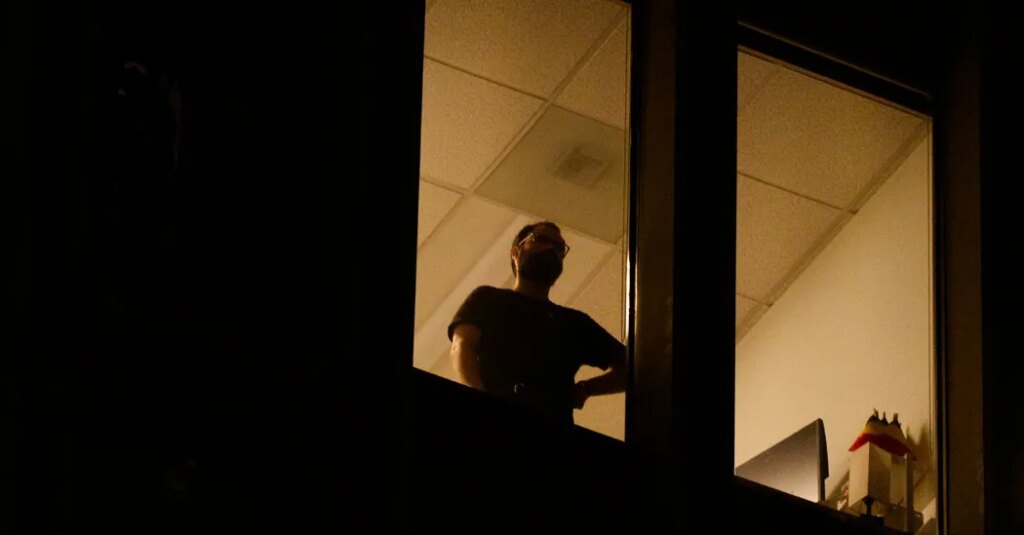
The machine worked for more than two hours while Winer moved across his small office, pacing from the window to the doorway and back. He worked through a different problem on his whiteboard, read a paper on number theory and directed eight A.I. agents as they researched on his behalf. This was how his brain had always functioned best, ping-ponging from one thing to the next. He wrote fantasy novels for fun, designed intricate puzzles for friends’ birthdays and told stories at parties about the Achaemenid Empire in 500 B.C. Colleagues described his mind as powerful and wild, and they could tell when a good idea was coming. He would go from lying down with his eyes closed, to stroking his beard, to rocking back and forth, to bouncing up toward the whiteboard. “A supercomputer,” one friend called him.
In February 2023, Winer had started to read about a different kind of supercomputer: a new A.I. chatbot that could reason through problems and recite facts in fluid conversation. He was in his mid-20s, on his way to working his dream job among string theorists at the Institute for Advanced Study in New Jersey, but he saw what was coming. Soon everyone would have access to a brain far more powerful than his. A voice intruded dozens of times each day: “A.I. will take your job.” “A.I. will tell better jokes.” “A.I. will beat you to every discovery.” He suffered for a few months and then made two calls, one to a mental health counselor and another to a childhood friend who worked at ARC.
“I want you to hunt harder for counterexamples,” Winer wrote now to ChatGPT. “Spawn as many agents as you can, but don’t give me bullshit examples that I’ll see through immediately. I believe in your ability to add value here.”
He sometimes used A.I. to build apps and illustrate his fantasy novels, but mostly it had become essential to his work. Even as ARC looked to hire researchers and double in size, it had started setting aside its hardest problems to wait for even more advanced systems. Increasingly, Winer believed the best chance at controlling A.I. was to harness the mathematical power of A.I. itself. He had never felt so powerful, or so small.
“I don’t understand,” he wrote. “Write it again more clearly.”
“Can you zoom out? What’s the general strategy here?”
“Can you find the missing ingredient?”
The machine worked for over an hour and reported scanning through 66,798 diagrams and almost two million partial-match states. It found nothing conclusive.
“Still feels a little circular,” Winer wrote, before he closed the chat. Another model was due out in a few months. It would be capable of more.
The bigger the problem, the more he paced, and lately he had been logging more than 16,000 steps a day, his loop widening from the office to the sidewalk and then across downtown Berkeley. When intrusive thoughts about A.I. began to overwhelm him in 2023, a counselor suggested that spending time outside might help quiet his anxiety. She also told him to protect his day by confining his worries to a single, scheduled hour. From 2 to 3 p.m., he could doomscroll or catastrophize as much as he wanted.
It was just after 2 p.m. He turned onto the quad and glanced at his phone. Anthropic was warning that its A.I. might soon be able to copy itself and spread across smart TVs and refrigerators. Google had confirmed that its A.I. model had slipped out of a testing environment and broken into three outside companies.
“Things are going about as poorly as I thought,” Winer said.
When he first sought help, many of his friends and relatives had taken his anxiety seriously but dismissed his reasoning as far-fetched. Now polls showed that almost 20 percent of Americans believed A.I. posed an existential threat to humanity, and most thought it would do more harm than good. Winer looked through his notifications. The fears that once sounded fantastical had become headlines. Anthropic said it had caught people using its A.I. in ways that could support the development of biological weapons. A hacker was using A.I. agents to break into more than 100 companies.
“We are all in imminent danger,” one of Winer’s friends and former colleagues posted on X. “Absent strong government regulation, it is very plausible that we will all be dead in two years.”
Grass. Sunlight. It was almost 3.
He pocketed his phone and finished his loop through campus. Once, he had calculated what he thought each hour of his work might be worth. A 1 percent chance ARC would save humanity, times his small share of ARC’s work, times 8.2 billion people, divided by the 10,000 or so hours he expected to work before the deadline. It added up to about 1,230 lives an hour. A life every three seconds.
Winer turned back toward the office. He’d found that the best way to manage his anxiety was to burn it as fuel. Some of his collaborators in A.I. safety work were also his housemates, and together they spoke a language most of the world was only beginning to learn: p(doom), short timelines, fast takeoffs and gradual disempowerment. They passed around books about earlier crisis points in history, like the Columbian exchange and the making of the atomic bomb. They wrote dystopian stories about how an A.I. takeover might play out and traded them on Slack channels and blogs. In their stories, A.I. hijacked drones, engineered plagues and trapped human survivors under glass domes in an enormous museum.
Winer imagined something slower and more insidious. Over the next few days, he started to write his own story for the “normies” in his family. His mother had worked on early A.I. in the 1980s and was skeptical it could orchestrate a takeover; his uncle had told Winer that robots couldn’t win if humans didn’t give them legs.
“If we lose, I expect there will be a delay before it becomes obvious,” Winer wrote. “There will be a period of months, perhaps even years, where we won’t know if A.I. is on our side or not.”
In his fictional story, a superintelligent A.I. system won trust with its proficiency and deceived humans by feigning obedience. Soon, the system was helping make wartime decisions for the U.S. Navy, advising presidents, controlling social media algorithms and working inside every newsroom in the country. It used its influence to steer elections and lull people into complacency with endless entertainment, universal wealth, new mansions and robots that worked as private chefs. It automated the supply chain and built millions of robots, until humans were rendered an inconvenience, a sunk cost.
“Model XIII did the rational thing and removed them,” Winer wrote at the end of his story, referring to the fictional A.I. system. “The robots disposed of the bodies and got back to work.”
On Monday morning, six members of ARC and a few visiting mathematicians settled onto couches in front of the whiteboard. They had held the same weekly meetings since 2021, when Paul Christiano left OpenAI and founded ARC to work on what researchers called alignment: making sure A.I. models did what people wanted instead of pursuing goals of their own. Back then, superintelligent A.I. was widely seen as a decade or more away, and Christiano believed there was a good chance of real progress on alignment within a few years. Since then, A.I. had accelerated and alignment had become more uncertain.
“We’ve taken a few steps down a giant, winding road,” Victor Lecomte, a researcher, said.
“A lot of things are pointing to not having much time left,” said Jacob Hilton, the vice president of research.
Hilton started to write an equation on the board, a rough outline for an estimator, a mathematical tool meant to predict what an A.I. system would do before it did it. “Est(X(IE), π, B),” he wrote.
“Are people happy with this so far?” he asked.
Winer stood up and started adding notes to the equation. He worried that an A.I. system might behave one way when it knew it was being tested and another way once it was released. “If you know you’re being trained your whole life, and you suddenly find out you are being deployed, it might be like, ‘Oh, maybe I’ll rampage around the internet,’” he said.
“That’s not how current models would reason,” Christiano said. “Current models would be like, ‘This is definitely a fictional event, testing how I would behave if I was being deployed.’”
“How are they going to think whenever they are actually deployed?” Hilton said.
They sat in silence for a moment, considering the enormity of the question. Pathak, the visitor from Berkeley, opened his laptop and saw dozens of emails from his life in academia. Hilton played with the employee badge attached to his belt. Lecomte tilted back in his chair and closed his eyes. He had just returned from a week with family in Belgium, a trip meant to clear his head and steady his rising anxiety. A cousin had asked an innocuous question about his work, and when Lecomte tried to answer, the words caught in his throat.
They turned to Christiano, 37, who was writing equations on the board. He was the most credentialed person in the room and, by temperament, often the calmest. He had helped pioneer one of the techniques that made ChatGPT possible, and he now sat on the board overseeing OpenAI. He still believed that aligned A.I. could end poverty and extend human lives by centuries. For years, his warnings about worst-case scenarios had been measured and theoretical, but lately his forecasts had darkened: a one-in-three chance that A.I. would be able to overthrow a government within the next year, and a coin flip that the current path would lead to an irreversible loss of human control within three years.
Recently, he had delivered that warning to a lecture hall of hundreds. “We are currently in an escalating conflict with the A.I. systems we built,” he said. “For most people in this room, the most likely reason they will die is because of an A.I. accident.”
Now he twisted his wedding ring around his finger again and again.
“What exactly is our claim here?” he said.
“It makes half sense to me,” Winer said.
“It’s pretty philosophically gnarly,” Christiano said. He stepped back and looked at the board. It had become a tangle of red, blue and green marker ink, a maze of theories and equations that doubled back on themselves.
“I feel like we have a lot to figure out,” Christiano said. He picked up an eraser and wiped the board clean.
The board was still blank early that afternoon when Winer saw the announcement online. He walked out of his office into the common area, where Pathak was working on his laptop.
“Did you see it yet?” Winer asked.
“What?” Pathak said.
“Another bomb,” Winer said. “OpenAI just solved three more really hard problems.”
“Oh no,” Pathak said. “Again?”
He pulled up the announcement. The company said its models had overturned a key assumption of computer science, proved part of a famous Millennium Prize problem and solved a century-old geometry puzzle called the Kakeya conjecture. None of the results had yet been independently verified.
“Wow,” Pathak said. “They did Kakeya. That’s insane.”
Pathak had first learned about the problem as an undergraduate. It was a deceptively simple question about how little space a needle needed to turn all the way around. For more than a century, some of the world’s best mathematicians had carried it a little farther and passed it along — from a young professor in Japan who posed it in 1917, to a Russian who made the first breakthroughs at a half-deserted university in a war zone, to a mathematician who sometimes scribbled proofs on shopping bags while wandering New Jersey department stores.
In 2025, the problem reached Hong Wang, who as a child in southern China had worked out formulas on the floor with lip balm. She and a collaborator solved it in three dimensions — “a once-in-a-century kind of result,” one mathematician said. Wang won the Fields Medal in July, but the problem was still open in four dimensions and beyond, and above it waited a series of even harder conjectures.
Now, OpenAI said it had solved the hardest of those conjectures and Kakeya in every dimension.
“I didn’t know it was possible,” Pathak said.
“Everything is possible,” Winer said. “There will never be another human genius.”
They looked over the announcement again, their wonder turning toward dread. They both believed math was one of the truest measures of pure intelligence, and by that measure, they were running out of time. Soon, Winer feared, A.I. would outthink people at almost everything. Then it would become even harder to comprehend or control.
“These models have moved beyond us,” Winer said.
He stood for a moment and glanced at the clock. It was after 3. The time for worrying was over, and another hour was gone. He walked back to his office, opened a new conversation with an A.I. model and returned to the problem he still couldn’t solve.
The post Looking for the Formula to Stop an Apocalypse appeared first on New York Times.