Jeffrey Simmons was on the bed in his cabin aboard the American Heritage riverboat watching TV just before 12:30 p.m. on Nov. 13. He glanced up.
“Something just kind of told me, ‘Hey, look out the window,’” he said.
The sight brought Mr. Simmons, 69, to his feet: an enormous forest green ship veering right. Its towering, angled bow was plowing toward him.
“Am I dreaming?” he remembered thinking.
The deep, long blare of a ship horn jolted him and nearly 200 other souls on the American Heritage, which was docked in the Mississippi River in the heart of New Orleans. The Atlantic Asphalt, a 525-foot bitumen tanker without any cargo, was about to make contact with the side of the five-deck liner, which has about 80 staterooms.
What was supposed to be the end of a weeklong Mississippi River cruise was about to become a maritime disaster threatening every life on the ship.
Yet the worst outcome was avoided. No one died, and everyone eventually was accounted for.
More than a dozen witnesses — passengers, firefighters, other boat crew members, officials and local leaders — described in interviews how a monumental rescue operation turned a near tragedy into what the New Orleans mayor and Louisiana governor both called a “Miracle on the Mississippi.”
A ‘Big Bang’ and a Tilt
Joe Knab, a Navy veteran, and his girlfriend, Karol Kenzy, saw the coming impact through the sliding door of their balconied stateroom on the second deck.
Mr. Knab called it “the big bang.”
The power went out. Crew members soon thudded down hallways, knocking on doors and calling for everyone to leave.
Mr. Knab, 74, using a walker, stumbled with Ms. Kenzy, 75, and others to the ship’s third deck. Firefighters were already there, leaning a ladder against the balcony to escort passengers off.
Around that time, Vanessa Newsome, 64, and a friend were on the ship’s fourth deck, clutching their purses. They felt the boat tilt.
Clinging to a doorway, she turned to her friend and said, “We need to pray.”
When Ms. Newsome opened her eyes, she saw lounge furniture sliding as the boat took on water and began to keel.
Two decks down, Mr. Knab gripped the railing on the starboard side. “Oh my goodness!” he remembered shouting as he plummeted with the ship. When the boat finally settled into the riverbed — roughly 20 minutes after initial impact — Mr. Knab, Ms. Newsome and other passengers and crew members were in the chilly, murky waters of the Mississippi.
“I don’t want to die like this,” Ms. Newsome recalled thinking.
‘The Loudest Mayday’
Capt. Len Stewart, in his third season commanding a ship, was finishing paperwork in the Heritage’s top deck pilothouse when he heard the tanker’s horn and looked up.
Judging by the speed of the tanker, Captain Stewart said, “I thought the whole boat was going to get split in half.” He estimated he had about 20 seconds before the tanker made contact.
Running down one deck to outdoor seating where people were having lunch, he called for everyone to get away from the side of the ship.
And then “Bam!” he said. “It’s like a bomb went off.”
Captain Stewart ran back to the pilothouse and used the radio to alert the Coast Guard and other vessels.
It was “the loudest mayday” that Petty Officer First Class Mirriah Beck had heard in her years with the U.S. Coast Guard. An operations specialist, she was on duty at a command center in New Orleans when distress calls blasted through the radio.
Petty Officer Second Class Carlos Gonzalez, a boatswain’s mate who is part of a Coast Guard search and rescue unit, was in the next room and also heard the call. He was soon dispatched on a vessel to coordinate government agencies on the water.
Only five minutes earlier, Coast Guard officials upriver near Baton Rouge had heard the captain of the Atlantic Asphalt say that he had “a steering issue,” Jeff Perron, a Coast Guard vessel traffic operator, said. “He had some urgency in his voice.”
(A National Transportation Safety Board investigation is underway. Preliminary findings have indicated a “steering failure.” The tanker’s managing company, OSM Thorne, said in a statement that its crew members were safe and that their thoughts were with the passengers and those who were injured.)
Mr. Perron and his team began radioing nearby vessels to move into the area and stand by to help unload passengers from the Heritage.
At least two tugs motored in to steady the tanker.
One tug began pushing the Heritage toward the dock, Capt. Stewart said, allowing his crew members to secure a gangplank and start the evacuation.
A Swift Response
Employees at the Port of New Orleans headquarters had only to look out their dockside windows to see the crash, Melanie Montroll, the chief of the Harbor Police Department, said.
She quickly deployed two vessels and dozens of officers.
“I knew it was a bad situation,” Chief Montroll said. She estimated the average age of the passengers to be 74.
The priority was ushering passengers off the still upright ship, an undertaking that was made trickier because so many used canes, walkers or wheelchairs.
Some passengers had disembarked by the time firefighters arrived. Five of them climbed on board and began smashing windows to pull people out.
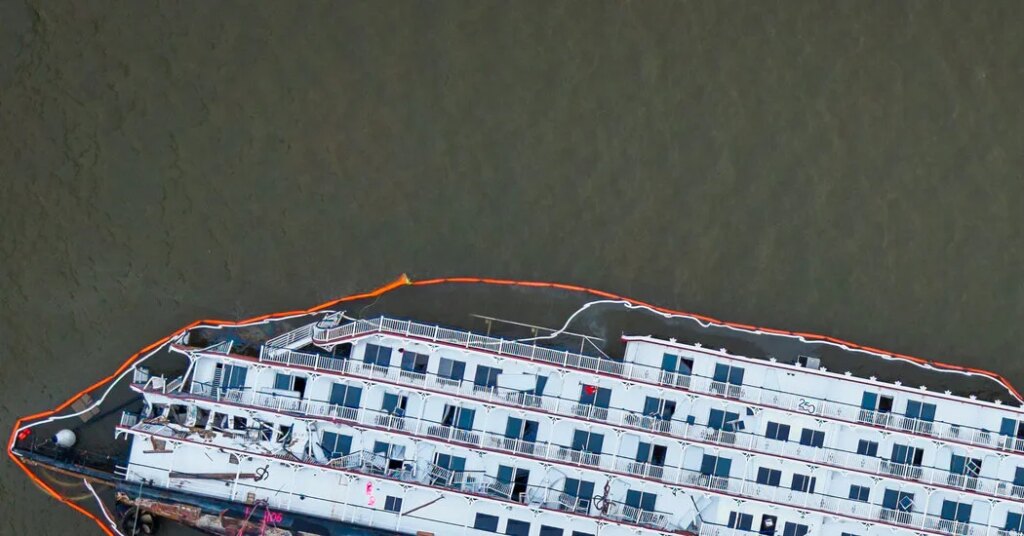
Two firefighters had just stepped off with a passenger when the boat began to roll. People clung to railings. Some screamed. Others maneuvered to stay upright as the vessel started to sink. The water is low this time of year, so the boat submerged only halfway before it hit the riverbed.
“It’s like watching a giant building just flipping in front of you,” said Capt. Grant Rodriguez of the New Orleans Fire Department, who stepped off the ship just before it sank.
The firefighters who went down with the boat stayed in the water, rescuing 16 people, Captain Rodriguez said. As many as 60 firefighters eventually reached the scene.
Out on the water, nine private vessels shifted into rescue mode.
The towboat Madison Stone used its broad bumper to hold the tipped Heritage in place and prevent it from drifting into deeper waters.
Saudi Williams, the captain of a city ferry, spotted an older woman treading water and brought her aboard. Brian Clesi, the captain of the Creole Queen, a paddle-wheeler, and his second mate, Ellis Kimball, used a smaller rescue boat to pick up around nine survivors.
Those who were injured received immediate medical care from emergency workers shuttled by the Coast Guard.
Captain Stewart remained aboard the Heritage until he couldn’t. As the boat keeled over, he slid 50 feet down the deck, crashing into objects before striking a handrail and rolling into the water.
A few minutes later, a fireboat picked him up, and he helped retrieve around nine people.
He stayed on the fireboat, he said, “until the last person was out of the water.”
Drinking the Mississippi
Ms. Newsome, floating in her life vest, watched in a daze as hunks of metal, chairs and other debris swarmed her. She spotted a man struggling without a life vest and grabbed his hand.
A firefighter on the dock lowered a ladder into the water. She climbed, her bad knee buckling, until he pulled her up.
Farther off, Mr. Knab and Ms. Kenzy were doggy paddling without flotation devices, struggling against the current and the drag of their wet clothes.
“I drank about a gallon of that Mississippi water,” Mr. Knab said. “Man, that stuff’s nasty.”
At some point, he lost sight of Ms. Kenzy.
After about 20 minutes in the chilly water, a gray boat approached with Captain Clesi at the helm and Mr. Kimball reaching out a hand.
When they got Mr. Knab to safety, he was relieved to find Ms. Kenzy already aboard.
“You having fun yet?” he asked her.
“No,” she said.
Roll Call and Relief
On the dock, some passengers were greeted by Mayor Helena Moreno of New Orleans. As she handed blankets to passengers, she was pleasantly “shocked,” she said, to find that “they were in such good spirits.”
Around two dozen passengers were taken to hospitals, and two had serious injuries. The rest were given shelter in the Port of New Orleans headquarters. A roll call began as passengers’ names were read from a sheet.
There was some tension in the air as officials tabulated the list, said Kenneth St. Charles, the regional chief executive of the Red Cross.
By 4 p.m., the final name had been called. That person answered back.
Everyone was accounted for. Everyone was alive.
The room went “crazy,” said Captain Stewart of the Heritage, who had reached the hall.
“Everybody was so thrilled, clapping and screaming and yelling,” he said.
Many of the passengers’ belongings were now lost to the river: keys to parked cars and locked homes, walkers and canes, prescription drugs, smartphones and wallets with IDs, which would be needed to board flights home to North Carolina, New York, Indiana, Kansas and elsewhere.
But Mr. Simmons, one of the last to flee the ship before it sank, said he hadn’t lost anything truly important.
“You got your life,” he said.
As evening approached, the dazed but relieved passengers boarded buses to nearby hotels for a meal, a hot shower and a good night’s sleep.
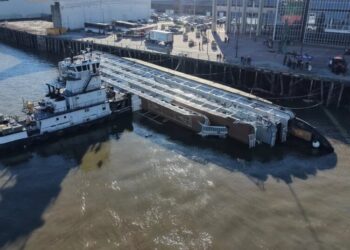
After sunset, the American Heritage could be seen by the docks, on its side, swaying with the currents.
Kirsten Noyes and Georgia Gee contributed research.
The post After a Harrowing Crash in New Orleans, a ‘Miracle on the Mississippi’ appeared first on New York Times.