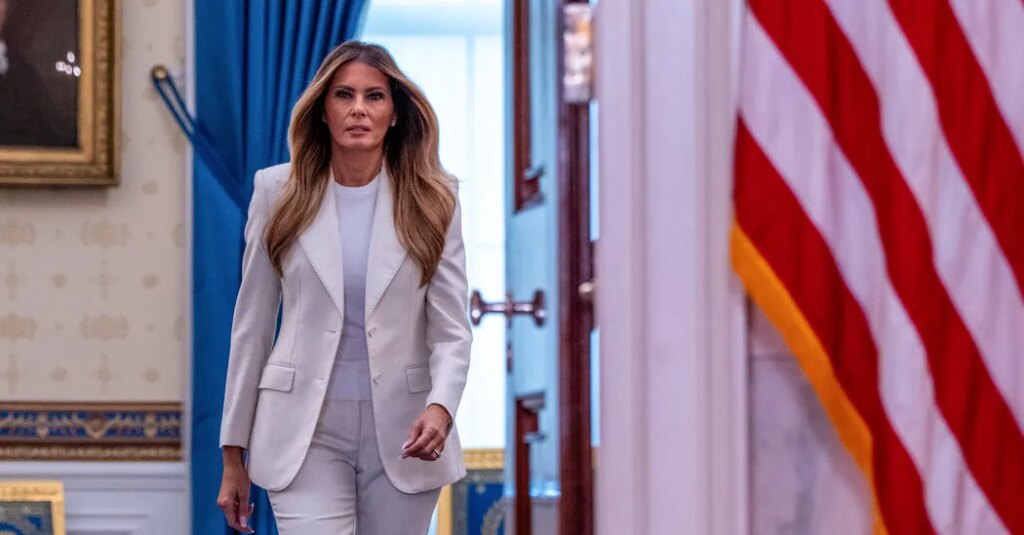
Melania Trump had an idea. As she prepared to host Russians and Ukrainians in the Grand Foyer of the White House this month to celebrate a partial cease-fire she had helped secure, she wanted to make a point with the seating chart. The first lady directed her staff to place officials from the warring nations side-by-side.
Some saw the move as outrageous and tone-deaf, implying an equivalence between invader and victim. The first lady’s agent, Marc Beckman, acknowledged her approach is “a little bit unique.” One of the Ukrainian officials who attended the event, David Arakhamia, said that a senior European official told him later that seeing the Ukrainians and Russians mingling “without killing each other” helped show people that “there is a chance for peace.”
As President Trump’s official envoys are locked in a slow-moving effort to try to end the war in Ukraine, his wife is emerging as a surprising player in the diplomatic efforts, with back channels to key figures on both sides of the conflict, according to people involved in the discussions.
It’s a very unusual role for a first lady, particularly one with little experience in international affairs. But over the past year, Mrs. Trump, a former model who grew up in communist Yugoslavia, has steadily increased her focus on the war, working with Mr. Beckman, a film producer and advertising executive who has represented her for more than 20 years and is also new to diplomatic circles.
Together, they lodged more tangible success this fall than the official White House envoys for negotiations on the war in Ukraine, Steve Witkoff and Mr. Trump’s son-in-law Jared Kushner, who have struggled to show progress after 21 months of shuttle diplomacy between Ukraine, Europe and Russia.
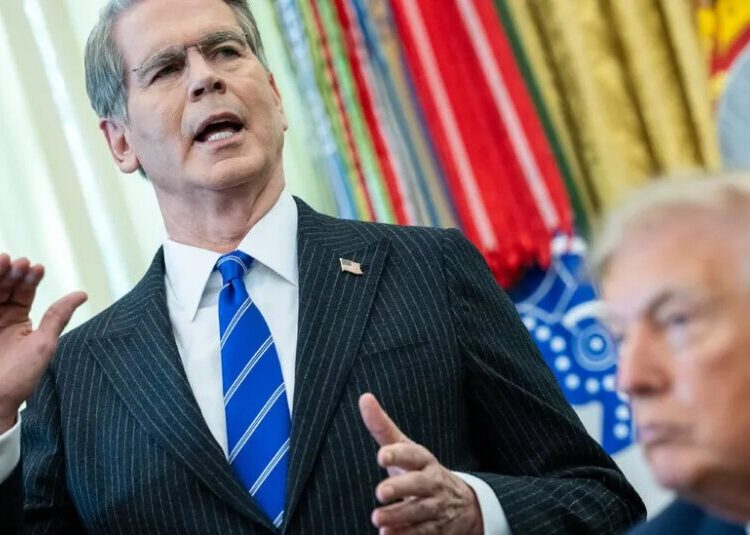
Key to Mrs. Trump’s effort is Mr. Beckman, who said he has been speaking for more than a year on her behalf with Kirill Dmitriev, a special envoy for President Vladimir V. Putin of Russia. In recent months, Mr. Beckman has also built a relationship with Mr. Arakhamia, one of the main peace negotiators for President Volodymyr Zelensky of Ukraine.
“The first lady looks at war as just useless,” Mr. Beckman said in his most in-depth interview about Mrs. Trump’s involvement with Ukraine. “She looks at it and just says, ‘What is all of this for?’”
Mrs. Trump was initially focused on reuniting children separated by the war with their families, amid widespread accusations that Russia had in effect been kidnapping Ukrainian children. She has said she has helped return roughly three dozen children so far. But in September, she got involved in something that became far more complicated: a six-day partial cease-fire that was the longest localized truce of the nearly five-year war.
Behind the scenes, intelligence and humanitarian officials from Russia and Ukraine largely negotiated the cease-fire, in the Kherson region, among themselves, according to people involved in the talks. But Mr. Beckman, working on behalf of the first lady, was also involved as a mediator, and even helped navigate a semantic impasse in the drafting of the text at one point.
“When we couldn’t come to an agreement with the Russians on our own, we called Marc,” Mr. Arakhamia said. He said he did not speak to Mrs. Trump directly during the negotiations.
During the brief cease-fire, observers were stunned to see civilians strolling the streets of the besieged city of Kherson and military forces on both sides holding their fire across thousands of square miles.
Both Mr. Putin and Mr. Zelensky have made compromises to allow Mrs. Trump to claim a rare diplomatic success. For both sides, promoting the first lady’s role helps advance their shared goal of pleasing her husband. On Fox News on Saturday, Mr. Trump said his wife had done “a really good job” in her Ukrainian diplomacy and voiced the hope that “a bigger version” of the localized cease-fire could be negotiated soon.
For her part, the first lady has moved carefully: She has avoided condemning Russia as the aggressor, even after Russian bombs killed dozens of Ukrainian civilians the week she hosted her White House event. But Ukrainian officials say they value her involvement, not only to stay in the American president’s good graces but also because she appears to hold sway with the Kremlin.
“It’s absolutely logical for them,” Mr. Arakhamia said, referring to Russian officials. “To me, this is a demonstration that they are trying to protect their relationship with Trump.”
This account of the first lady’s diplomatic work is based on details provided by several people involved in the talks, including Mr. Arakhamia and Mr. Beckman. Some of the people spoke on condition of anonymity because of the sensitivity of the talks.
The story of Oleshky, a frontline town near Kherson, sheds light on the disjointed nature of the administration’s approach to Ukraine. Mr. Arakhamia and Mr. Beckman described Mrs. Trump’s efforts as separate from Mr. Witkoff and Mr. Kushner’s negotiations. Asked about the two envoys’ involvement, the first lady’s office said in a statement that Mrs. Trump and Mr. Beckman were “the only two people who negotiated the cease-fire between Ukraine and Russia in Oleshky and the greater Kherson region.”
It also underscores one common theme: how the Trump administration has repositioned the United States as a neutral arbiter in the war, an approach that critics say has undone Western efforts to isolate Mr. Putin on the international stage.
Mrs. Trump’s diplomacy served to boost Russia’s propaganda efforts by shifting the narrative in its war of aggression, said Andrew S. Weiss, who oversees research on Russia at the Carnegie Endowment for International Peace.
By going along with Mrs. Trump’s cease-fire, Mr. Weiss said, the Russians “found a way to make themselves look like rescuers as opposed to tormentors.”
But Keith Kellogg, who served as Mr. Trump’s Ukraine envoy last year and has since criticized the administration’s approach to the war, credited Mrs. Trump with introducing “a new way of negotiations based on humanitarian standards.”
It is a far different portfolio from the one the first lady took on in her husband’s first term, when Mrs. Trump toured the nation urging children to “Be Best.”
A Town in Crisis
Ukrainian officials say they faced deadlock for months in trying to rescue civilians in Russian-held Oleshky, which had been cut off from food deliveries by road since May by drones and mines. Ukraine appealed to humanitarian groups, but the United Nations said Russia was refusing to provide safe access.
A turning point came, Mr. Arakhamia said, when Dmytro Lubinets, Ukraine’s human rights commissioner, suggested asking Mrs. Trump, noting she had been effective in reuniting Ukrainian children in Russia with their families in Ukraine.
Mr. Beckman said Mrs. Trump also heard about the plight of Oleshky separately on the sidelines of the United Nations General Assembly in New York in September.
Once Mrs. Trump agreed to help, Mr. Beckman said he leaned on Mr. Dmitriev, the Putin envoy with whom he had quietly built a relationship in negotiations over the previous year about returning Ukrainian children.
Mr. Dmitriev is under U.S. sanctions, given his status as an ally of Mr. Putin’s who also heads Russia’s sovereign wealth fund.
But Mr. Beckman praised Mr. Dmitriev, asserting that the Oleshky cease-fire “definitely would not have happened” if not for the Putin aide’s “leadership.”
Mr. Beckman said the Putin aide called him “the detail guy,” adding: “We speak regularly, sometimes three, four or five times a day.”
Mr. Dmitriev’s role in Mrs. Trump’s diplomacy shows how Russia has worked to forge ties with various figures in the Trump administration over the past two years. Mr. Dmitriev, who studied at Stanford and Harvard and worked at McKinsey and Goldman Sachs, has also led the Kremlin’s talks on U.S.-Russia business deals with Mr. Kushner and Mr. Witkoff.
A Kremlin spokesman did not respond to a request for comment.
Much of the negotiation took place directly between Mr. Lubinets, the Ukrainian human rights commissioner, and Yana Lantratova, his Russian counterpart, as well as between the intelligence agencies of both countries, according to people with knowledge of the talks.
But Mr. Beckman, a lawyer by training, said he pored over draft plans of how the cease-fire would play out. And Ukrainian officials said the first lady’s agent helped break several logjams, including on how to get Ukraine and Russia past their disagreement over how to refer to the town’s geography.
His solution was to draft different documents: One, in Russian, used the Kremlin’s terminology describing Oleshky as part of Russia; the other, in Ukrainian, described it as occupied Ukraine. But both included identical, hour-by-hour details for how the cease-fire would be carried out.
In another case, Mr. Arakhamia said, Mr. Beckman helped convince the Russians to give any resident of Oleshky the freedom to leave, without providing their names in advance.
Asked about that aspect of the deal, Mr. Beckman said the Russians were always “in full cooperation.”
A Temporary Respite
The cease-fire, which lasted from Oct. 27 to Nov. 1, allowed roughly 800 Oleshky residents to be evacuated. It also served as perhaps the most elaborate test of how the two sides could coordinate to hold their fire in Europe’s bloodiest conflict since World War II.
Russia’s F.S.B. and Ukraine’s S.B.U. intelligence agencies communicated directly during the cease-fire, acting as liaisons to their militaries, people involved with the deal said. They agreed to launch two drones on each side to observe potential cease-fire violations.
Mr. Beckman said he called Christopher Ruddy, the founder of the conservative outlet Newsmax, and convinced him to dispatch his journalists to Oleshky to help “keep everybody honest.” After a Ukrainian request, he also got Russian officials to allow a Ukrainian reporting crew to join.
On Saturday, Mr. Zelensky said that he had proposed 15 other locations along the front line for humanitarian operations similar to the one in Oleshky, praising Mrs. Trump for her efforts. Mr. Arakhamia said those operations could allow the testing of a more comprehensive cease-fire monitoring system, which U.S., Russian and Ukrainian negotiators mapped out in talks last winter. It is unclear if Russia will go along.
Mrs. Trump has seized on Oleshky as an opportunity to raise her profile as a humanitarian who, in Mr. Beckman’s words, “wants to continue to prioritize humanity above geopolitics, war, race, religion.”
“I was involved in every detail,” the first lady told “Fox & Friends” during an interview Friday.
Mr. Beckman said he briefed Mrs. Trump daily on the talks and shared “every document” with her. Mr. Arakhamia said he spoke to Mrs. Trump for the first time at the White House after the cease-fire ended.
As she prepared to host the Russian and Ukrainian officials involved in the cease-fire this month, Mrs. Trump picked “symbols of peace” out of the White House archives to show the guests, Mr. Beckman said. One was a medicine chest removed from the White House after British forces set the building on fire during the War of 1812.
It showed how “reconciliation and peace” between warring nations “could create a longstanding, great alliance,” Mr. Beckman said.
At the White House event, with Mr. Arakhamia seated next to Mr. Dmitriev in the front row before her, Mrs. Trump said she hoped “Oleshky inspires greater peace.”
To many Ukrainians, talk of reconciliation with Russia while its invasion still rages overlooks the immense death and destruction that Mr. Putin’s war has wrought.
Mr. Arakhamia said that working with Mrs. Trump on Oleshky and attending her White House event had put him “of two minds.” It was worth doing, he said, to save lives.
“You want to do a good thing, but on the other hand, you’re scared that you’re legitimizing bad things,” Mr. Arakhamia said. “At any rate, it’s all back to normal now — to regular war.”
Siobhán O’Grady contributed reporting from Kyiv, Ukraine, and Karoun Demirjian from Washington.
The post How Melania Trump Found a Diplomatic Opening in the War in Ukraine appeared first on New York Times.