“The state of a country’s civilization can be judged by their toilets.”
— Steven Soifer, secretary and co-founder of the American Restroom Association
The busiest travel season of the year means suitcases, rich meals and … public bathrooms. (Cue the groans.) Unfortunately, if our nation were judged by its facilities, we’d be far from No. 1 or No. 2 (pun intended). The most critical issue is insufficient supply, especially for those without the means to buy a coffee every time they need to relieve themselves. But poor design is also a factor, and one that matters when it comes to comfort and public health.
Here are restrooms’ most egregious features, with possible solutions, starting from the moment you feel the urge.
Ambiguous occupancy and tiny stalls
When you’ve got to go, you’ve got to go. But that’s not as easy as it sounds. Many restrooms seem to have been designed by malicious tricksters. For starters, there’s the snaking line for the women’s bathroom, ever present at highway rest stops, arenas, theaters, etc. (The standard 15-minute intermission at Broadway shows is never long enough.)
Better bathrooms begin with more facilities, including a higher proportion of stalls for women. “We often do 125 or 150 percent more [for women] if we have the space,” says Kirsten Fordyce-Wheeler, principal of aviation and transportation interiors at the global design firm HOK.
Once at the front of the queue, there’s often no way to tell whether a bathroom or stall is vacant. Like black boxes, their contents are a mystery. Determining whether they’re free requires peering under the stall, knocking or trying the doorknob. That can sometimes lead to embarrassing situations — especially if someone is in there already or has forgotten to lock the door.
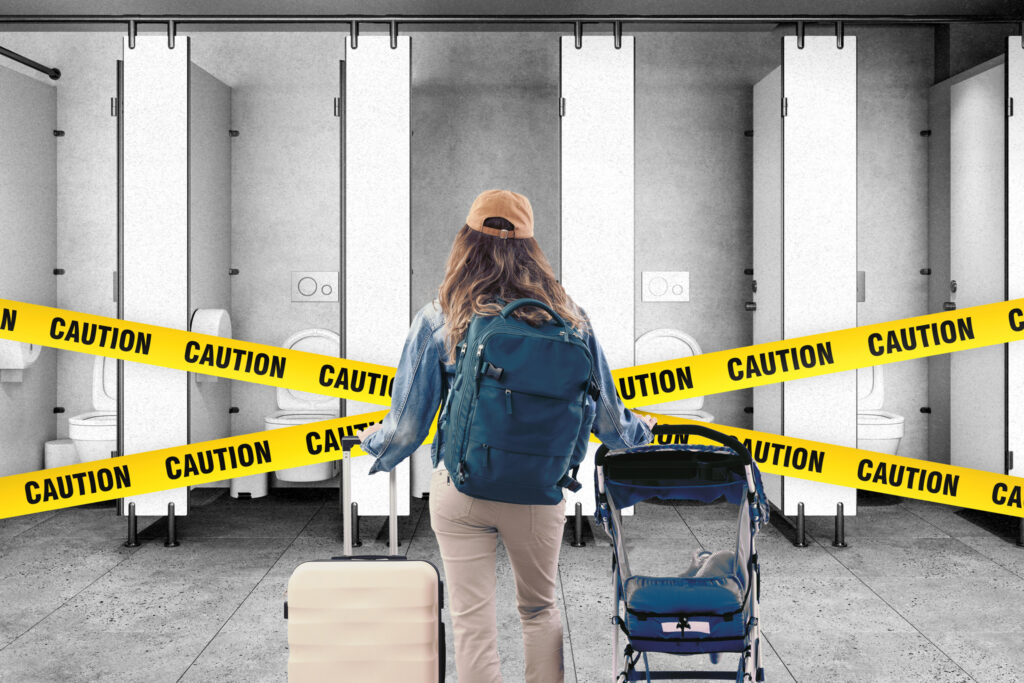
Even if you’ve chanced upon an empty bathroom or stall, cramming your body and belongings inside these often tiny spaces can approximate a game of Tetris. This is particularly true when traveling by train. The stalls in many Amtrak stations, I’ve found, barely accommodate bodies, much less luggage. When flying, the situation further devolves. While Americans have grown larger, airplane bathrooms have shrunk in favor of more seats.
The bathrooms that Fordyce-Wheeler designs for transportation hubs include wider stalls with room for belongings as well as door hooks and shelves behind urinals and toilets.
No security and privacy
When eating, having sex or relieving themselves, animals — humans included — are more vulnerable to predators. According to the “prospect-refuge” theory and the ancient Chinese practice of feng shui, humans prefer spaces where they can scan the horizon and hide. This is virtually impossible with urinals, because users must face a wall and can’t see what is behind them. For men with the social anxiety disorder paruresis (shy bladder syndrome), this is a serious issue.
Stall-only bathrooms can cause awkwardness, too. Take unisex facilities with individual stalls and shared sinks and mirrors. These group restrooms — which are common in trendy restaurants, hotels and bars, and on college campuses — require occupants of different genders to do their business (and, later, groom or adjust their outfits if necessary) right next to one another.
Even within stalls, privacy can be elusive. Like skimpy hospital gowns, stalls often feature sizable gaps along their doors. To avoid this issue, Fordyce-Wheeler selects door and hinge styles that provide seamless closure.
Pint-size walls, like saloon doors in old westerns, also are problematic. “In some restrooms, the walls don’t go higher than my head when I’m standing up,” says Stewart Hicks, an associate professor in the School of Architecture at the University of Illinois at Chicago and the host of the YouTube channel Takes on Buildings and Cities. “That feels weird, like you are being surveilled.”
Stalls with floor-to-ceiling partitions and doors are quiet and private, Fordyce-Wheeler says. But they require extra ventilation, which can be cost-prohibitive.
Elusive toilet paper and touchy toilets
Then there is the challenge of starting new toilet paper rolls. They’re often stuck so far up the dispensers that they require fishing around like a veterinarian at a calving. “In public toilets, that drives me insane,” Fordyce-Wheeler says. Even once the rolls have descended, persnickety dispensers may release only one square at a time.
Toilet paper suppliers usually provide the dispensers, Fordyce-Wheeler says. “So, owners will go, ‘Well, that’s a deal and they can look after that.’” For her projects, she sources toilet paper and dispensers from separate companies.
Another annoyance? When it’s time to flush, it’s very likely that you’ll encounter a temperamental sensor mechanism.
“Cheaper sensors can be set off even if you have pants on. It’s crazy,” Fordyce-Wheeler says. Other times, the toilet won’t flush at all, no matter how many elaborate dances you perform in front of the sensor. Then the only choice is to exit the stall abashed for having left pee in the bowl.
When sensors are temperamental, they’re probably outdated, Fordyce-Wheeler says. Newer versions, whether for toilets, sinks or soap dispensers, work much better. For hand-drying, she suggests offering paper towel dispensers and wall-mounted dryer units.
Sparse water, unsanitary hand dryers and no counter space
Manual faucets need to be touched, which is less than sanitary. But sensor-based models, like their toilet counterparts, tend to require precise gesticulation. Once you divine the right spot, too often you’ll be rewarded with a stop-and-start stream, as if the plumbing were playing peekaboo. Now you see me, now you don’t, the fixtures seem to taunt. Making matters worse, the flow can be so low as to barely register, as I recently discovered when using the facilities at Moynihan Train Hall at Penn Station in New York. The result: Washing for the 20 seconds recommended by the Centers for Disease Control and Prevention requires unusual persistence.
For drying hands, automated wall-mounted devices might seem cutting-edge. But they can harbor antibiotic-resistant bacteria and produce about 1,300 times as many viral growths as paper towels. Plus, sometimes you just need a paper towel, say, for wiping off a smear of lipstick or, if there are no tissues, blowing your nose. When grooming, counter space to set down items such as lipstick or a contact lens case is a must. Yet some restrooms, like those with one long trough-style sink instead of individual vessels, lack such a surface.
“Have it individual, not the big long trough,” Fordyce-Wheeler says. “Watching someone else’s dirty water run past you is revolting. If you create individual areas, make it a little wider with room for a mirror so you can adjust yourself.”
The post The worst things about public restrooms appeared first on Washington Post.