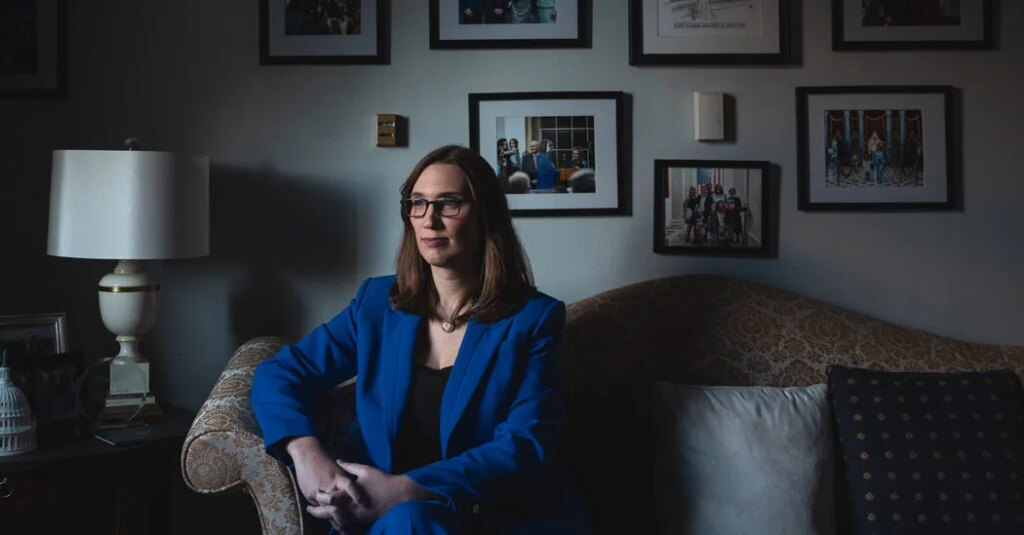
Two years ago, Representative Sarah McBride arrived on Capitol Hill as the first openly transgender member of Congress and was immediately targeted by majority Republicans who moved to ban her from using women’s bathrooms.
On Thursday, on the second anniversary of that day, Democrats elected Ms. McBride, of Delaware, to serve as one of their top leaders, in charge of helping to oversee messaging for a large new majority that has promised major changes.
Her election as a one of a trio of co-chairs of the Democratic Policy and Communications Committee, the No. 8 position in leadership, reflected a swift rise for a first-term lawmaker, and a notable shift in the culture of the Capitol that is underway as Democrats prepare to take power next year. (To wit: the bathroom ban will simply expire next year.)
Some of the Republicans who most frequently badgered Ms. McBride, misgendering her in committee hearings and on the House floor, will be gone from Congress next year. Ms. McBride, 36, on the other hand, will assume a seat at the leadership table for weekly strategy meetings in the speaker’s office.
For two years, Ms. McBride rarely engaged with the personal attacks against her, preferring to focus on policy and not be drawn into a partisan culture war. But in an interview in her office this week, she spoke in more personal terms about what the experience had been like and the significance of her ascent to a leadership position.
“Two years ago, I came into this place and was thrust into the middle of the conversation in a way that I wasn’t eager to be,” Ms. McBride said. “I’m really grateful that after two years of relentless attacks on a community I’m a part of, after two years of some in this building using me as a pawn in their efforts to get attention, after hundreds of millions of dollars spent to demonize people like me, my colleagues demonstrated their values.”
She added: “They didn’t elect me because of my identity; they elected me because of my ideas.”
Ms. McBride, a former Delaware state senator, has always presented an unflappable exterior as some Republicans tried to get a rise out of her, walking to votes and meetings with a Mona Lisa smile on her face.
“Sarah McBride doesn’t get a say,” Representative Nancy Mace, Republican of South Carolina, said in 2024 as she prepared to introduce a resolution barring Ms. McBride from using the women’s bathrooms in the Capitol complex. “I mean, this is a biological man.”
Ms. McBride’s response was to say as little as possible and focus on the kitchen table issues that got her elected.
“Good to see you all,” she greeted reporters as she made her way through freshman orientation, dodging questions about whether she anticipated needing security. Over the next year, she went out of her way to work with Republicans who wanted to collaborate on bipartisan bills.
But beneath that serene exterior, she said that being in the middle of a national news story about her identity was one of the most jarring experiences of her life.
“I remember walking into the Capitol that morning feeling like I had been hit by a truck,” she said of her first day of freshman orientation in 2024, when the Republican effort to bar her from bathrooms had made national news. She had anticipated being a target, but “I didn’t realize how much attention it would get.”
At one point, she recalled walking into a Republican lawmaker’s office for a meeting and hearing an intern taking a call from a constituent apparently complaining that the bathroom fracas was a waste of energy.
“I heard him say, ‘OK, you’re more concerned with Republican congressmen in bathrooms than you are with Sarah McBride,’” she recalled. “It was absolutely an out of body experience.”
Her goal was to be seen as a serious person, whatever amount of heat she took from professional provocateurs.
“Anyone who is ever a first,” she said, “you understand very clearly that if you respond in the way that they want you to respond, it deprives the public of the very clear visual contrast of who the aggressor is and who the person just trying to show up and do their job is.”
The flip side of it all was the well of support from Democratic colleagues. As she walked into her first caucus meeting, she smiled for the cameras because she knew that “if I have a picture where I look sad, they’re all going to use the picture of me looking sad.”
Inside the room, she was greeted with hugs, support and outrage on her behalf.
“I genuinely fell in love with this caucus then,” she said. “It’s a big reason why I wanted to pursue this position.”
In the new job, Ms. McBride has specific ideas about how Democrats can reach more voters and promote what they are doing to make life more affordable, including booking members on general interest podcasts that can penetrate communities that have no interest in politics.
“We’ve got a diversity of talents and backgrounds and interests as a caucus,” she said. “I want to make sure we’re getting that background and interest pitched in front of largely nonpolitical audiences that we often struggle to reach.”
Ms. McBride also said that given the size and ideological diversity of the Democratic caucus, she planned to provide a “bifurcated” approach to getting their message out beyond Washington — one tailored to members from competitive, conservative-leaning districts, and another for progressives who hold seats in solidly Democratic territory.
Ms. McBride’s own experience tuning out personal attacks has also shaped her view of how her party should try to govern.
“What instantly plays well with your own chorus online isn’t always the most fruitful strategy in making progress,” she said. In a world of digital noise, she added, “the algorithms can impact real life, but they are not representative of it.”
The post Sarah McBride, Barred From Capitol Bathrooms, Wins Top Post appeared first on New York Times.