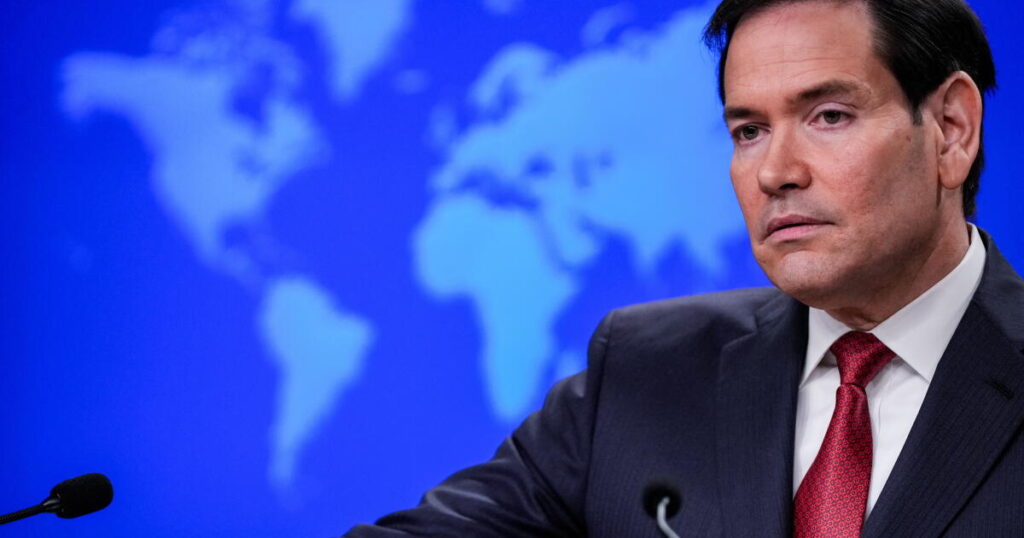
Speaking to the Federalist Society’s National Lawyers Convention earlier this month, Secretary of State Marco Rubio had a warning for the International Criminal Court. He signaled that attempts to enforce its decisions against Americans would meet an answer borrowed from the Roman general Pompey: “Stop quoting laws to men with swords.”
The United States never ratified the treaty establishing the ICC and has long disputed the court’s authority over U.S. citizens. Americans can disagree about the court’s jurisdiction, but they should recognize the dangers when their chief diplomat presents superior force as an answer to legal restraint.
Rubio placed that warning inside an extensive attack on legal objections to the Trump administration’s conduct. After listing criticism of boat strikes in the Caribbean, Nicolás Maduro’s capture in Venezuela and U.S. immigration enforcement, Rubio insisted that none of it reflected “any real higher standard of justice.” He also portrayed domestic court challenges as efforts to weaken the United States. In Rubio’s telling, those seeking to constrain the administration are opponents of the country itself.
He then offered a vision of American greatness rooted in expansion and conquest. Rubio celebrated the nation’s historic hunger “to expand, to grow, to explore, to conquer.” He equated accepting a place as “merely one nation among the many” with surrendering American ambitions and accepting “quiet decline.”
Rubio’s implication is that America’s exceptional power entitles it to exceptional freedom from restraint. That argument undermines a principle essential to both constitutional government and American leadership — possessing power does not confer unlimited authority to use it.
For decades, the U.S. helped organize an international order around sovereignty, restraints on aggression and commitments that other countries could rely on. American military strength helped sustain that order. Alliances and institutions gave other countries reason to cooperate with Washington beyond fear of what it could do to them. Even when the U.S. failed to meet those standards, we provided a basis for judging our conduct and rallying others against aggression.
In 1990, as American forces deployed following Iraq’s invasion of Kuwait, President George H.W. Bush called for “a world where the strong respect the rights of the weak.” This was once a guiding principle of Republican foreign policy. The Trump administration has abandoned it.
As a senator, Rubio explained why that principle matters. After Russia seized Crimea in 2014, he warned that allowing a powerful country to invade a neighbor without significant costs created a precedent others could exploit. He connected Ukraine’s fate to fears of Chinese aggression in Japan, the Philippines and South Korea. Coercion tolerated in one region could undermine security elsewhere.
Rubio later applied that same reasoning to China. Introducing sanctions legislation in 2017, then-Senator Rubio declared, “These ongoing, flagrant violations of international norms cannot be allowed to go unchecked.” He insisted China comply with an international tribunal’s 2016 ruling against Beijing’s maritime claims, a position he reiterated as secretary of State last summer. China’s military strength, in his argument, did not erase its neighbors’ rights.
Yet the administration Rubio now serves treats superior strength as entitlement. At the United Nations in September, President Trump celebrated the military operation that captured Maduro, as well as an ensuing oil agreement with Venezuela. “To the victor belong the spoils,” he declared.
Rubio has helped turn that worldview into policy. Last week, the Wall Street Journal reported that he and recently elevated White House Chief of Staff Stephen Miller helped engineer both the campaign against suspected drug boats and the raid that captured Maduro, jointly making their case to Trump. Officials in Rubio’s State Department raised concerns about the legality of the boat strikes and a process that left little room for dissent. His Federalist Society speech supplies the public defense, casting legal objections to policies he helped create as evidence of hostility toward America.
For Rubio, the standard changes depending on whose power the rules constrain. China must accept limits; American officials who reject them are simply defending the national interest. But the danger he identified after Crimea does not disappear when the United States is the country asserting its will.
Rubio now defends American conduct he condemns in other countries. But the danger goes beyond Rubio’s hypocrisy. When Washington treats superior force as sufficient authority, it lends legitimacy to the same arguments others use to threaten their neighbors. America’s military advantage cannot protect it from every consequence of a world in which power determines rights.
If the U.S. treats weaker countries’ rights as expendable, countries that rely on American protection have reason to question whether it will defend them. Some may seek accommodation with threatening adversaries rather than risk relying on U.S. support. Washington would then struggle to organize sanctions, secure military access or assemble coalitions against aggression, whether from Russia, China or another power. Americans would face a more dangerous world with fewer partners willing to share the costs and risks of confronting it.
The secretary of State is responsible for America’s diplomatic relationships and for the principles it advances abroad. His job includes preserving the international order that supports American security and prosperity, even when that requires challenging the president.
Rubio once explained why limits on power protected Americans. Now he helps Trump dismantle those limits and calls it American greatness. He has abandoned his own sound judgment in service to the president. Americans will bear the risks of that surrender.
Jon Duffy is a retired naval officer. He writes about leadership and democracy.
The post Marco Rubio is no statesman appeared first on Los Angeles Times.