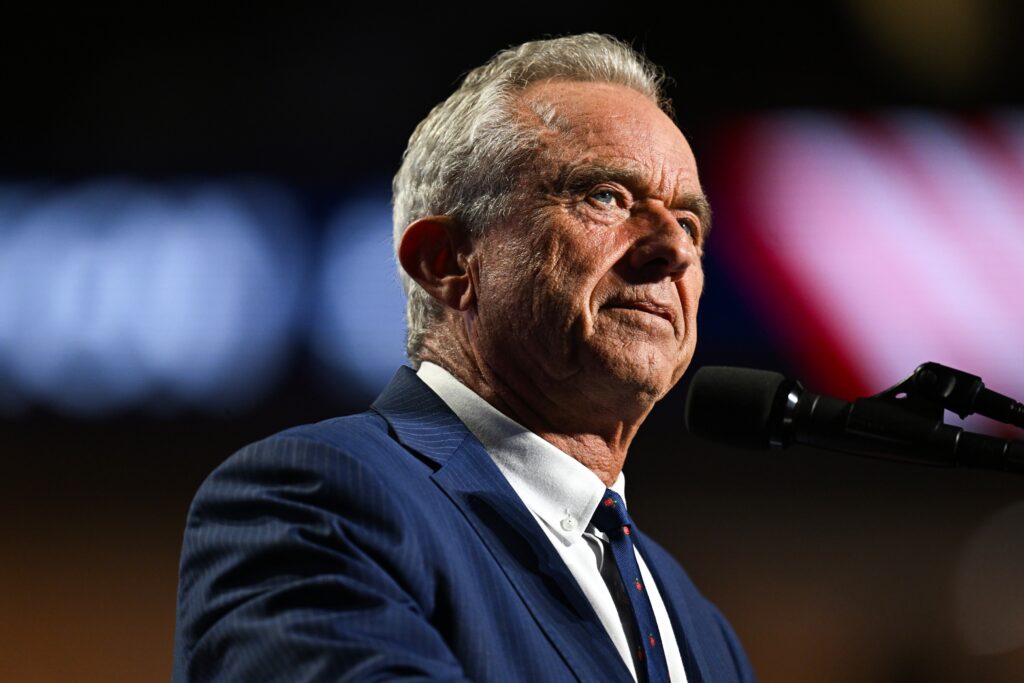
Hours after the United States lost its measles-elimination status, erasing a landmark public health victory earned 26 years ago, Health Secretary Robert F. Kennedy Jr. declared the country would fight the spread of the disease.
“We will stop measles outbreaks, protect American families, and work to regain U.S. measles elimination status,” Kennedy posted on X. “I continue to recommend MMR vaccination as the most effective way to prevent measles.”
But as federal and state governments confront the spread of one of the world’s most contagious diseases, some state and local officials question whether Kennedy and his department can bring it under control. Kennedy had sowed doubt about the safety of the measles, mumps and rubella (MMR) vaccine for years and, as the top U.S. health official, has sought major changes to childhood immunization policy, to cheers from some supporters of his Make America Healthy Again movement. Those actions, some public health experts say, have complicated efforts to persuade more Americans to get vaccinated and rebuild the population immunity needed to bring outbreaks under control.
As federal health agencies deployed resources to West Texas in 2025, Kennedy initially underestimated the resurgence of the disease, according to two people familiar with the matter who spoke on the condition of anonymity to describe internal matters.
“It took him a while to accept measles as something that wasn’t going to go away quickly,” said a former health official.
Federal health officials must now develop a corrective action plan for the Pan American Health Organization, the regional health agency that withdrew the U.S.’s measles elimination status, outlining how the country will stop continuous spread of the virus and regain its status. PAHO officials said they expect the plan in the coming weeks, although there is no formal deadline.
Even before the U.S. officially lost its designation, federal officials began taking steps toward that effort. Erica Schwartz, the director of the Centers for Disease Control and Prevention, met earlier this month with public health groups to discuss strategies for curbing the outbreaks and to identify challenges, according to two public health officials with knowledge of the meeting who spoke on the condition of anonymity to describe private conversations.
The CDC, state health officials, epidemiologists and national immunization groups are also planning regional meetings to coordinate the response, with special attention to improving outreach to vulnerable communities.
The Department of Health and Human Services said it has been aggressive in fighting measles. Since August, the CDC has made $100 million available to states to improve the response. It has provided help from CDC scientists to states battling outbreaks, including Texas, South Carolina, New York, Wisconsin and Pennsylvania.
“We will address PAHO’s findings directly,” HHS spokeswoman Emily Hilliard said in a statement. “HHS and CDC will address the findings and work with partners to document interruption of endemic transmission and meet the requirements for re-achieving elimination status.”
State and local health officials say they welcome those efforts. But stopping continuous spread of the virus requires a broader and sustained effort, including raising vaccination rates in communities where coverage has fallen before Kennedy came into office. Only the federal government can do what states cannot do on their own, such as coordinate across states, bring health and immunization officials together, and provide robust funding and expertise.
New York’s health commissioner, James McDonald, said at a briefing Thursday with reporters that PAHO’s decision was expected well in advance, and a federal plan should have already been prepared.
“I’m already concerned that Health and Human Services does not have a national plan,” McDonald said. New York, which declared a state disaster emergency in response to its outbreak, recorded a measles-related child death — its first in over 30 years — earlier this month.
Others say losing elimination status should itself prompt a strong response across all levels of government.
“I do hope it’s a wake-up call for CDC, for Congress, for HHS, for everyone,” said Claire Hannan, the executive director of the Association of Immunization Managers. “We need to be doing more.”
A growing outbreak
As the founder of a prominent anti-vaccine group, Kennedy had for years raised questions about the safety of the MMR vaccine. He previously linked the shot to autism despite decades of contradictory evidence. And he wrote in a book that measles outbreaks have been “fabricated” to “inflict unnecessary and risky vaccines” on millions of children.
As the West Texas outbreak grew in early 2025, Kennedy coupled messages encouraging vaccination with false or misleading claims about the MMR vaccine. He promoted alternative treatments and questioned whether a child who state health officials said died of measles had actually died of the disease.
His claims that vaccines contain “aborted fetus debris and DNA particles” prompted Debra Houry, the CDC’s then-chief medical officer, to send information to “help him with his talking points,” according to an email she sent to senior CDC officials on May 1, 2025.
“Even though fetal cells are used to grow vaccine viruses, vaccines do not contain these cells or pieces of DNA that are recognizable as human DNA,” she wrote to then-CDC chief of staff Matt Buzzelli and others. “Vaccines also do not contain fetal cells,” she added.
Kennedy’s statements stood in contrast to how prior health officials messaged around vaccinations by imploring Americans to get vaccinated, including during President Donald Trump’s first term. Then-Health Secretary Alex Azar said communities had been the subject of “mass disinformation campaigns. … They need to get their kids vaccinated.”
Public health experts say controlling outbreaks requires clear, repeated messages about vaccination, while acknowledging that declining trust in the CDC since the coronavirus pandemic has made federal officials less effective messengers. The CDC has not held a news briefing for reporters since Jan. 20, when the then-principal deputy director, Ralph Abraham, was asked whether losing elimination status would be significant and replied: “Not really. … You know, it’s just the cost of doing business.”
The health department has maintained that Kennedy has “repeatedly stated that MMR vaccination is the most effective way to prevent measles infection” and that “any notion that the Trump Administration is discouraging measles vaccination is absolutely fake news.” Two doses of the shot provide 97 percent protection against measles.
Over the last year, dozens of measles outbreaks have taken hold across the country, and nationwide case counts have continued to climb. In West Texas, there were 762 cases during the 2025 outbreak. In South Carolina, the outbreak totaled 997 before it was declared over in April. And in Pennsylvania, officials have recorded 1,631 cases, including eight deaths, as of Friday.
In July, the U.S. reported the most measles cases in 35 years, surpassing last year’s record total.
The resurgence, now totaling more than 5,800 cases nationwide, is posing myriad challenges for doctors and state health officials. Vaccine uptake has been declining for years amid rising skepticism. Meanwhile, outbreaks in traditionally undervaccinated communities are becoming harder to quickly extinguish.
Many doctors have never seen cases of measles, prompting health departments to educate clinicians on the basics and hospitals to quickly craft new protocols to safely isolate patients with a virus that can remain suspended in the air for up to two hours.
“Some of these outbreaks we’ve been seeing recently, for example, in Pennsylvania, it’s not just kids who are getting sick,” said Adriane Casalotti, who heads government and public affairs for the National Association of County and City Health Officials. “In fact, there’s many more adults who are contracting measles, and that shows a longer pattern of undervaccination.”
When immunizations in the broader population are high, it’s easier to protect communities with lower vaccination rates. But that’s not necessarily the case anymore, Casalotti said.
Pennsylvania has the largest measles outbreak in the country. But it’s also been the center of a bitter political feud between Kennedy and Gov. Josh Shapiro, a Democrat widely viewed as a presidential contender.
When Pennsylvania reported its first two measles-associated deaths in 35 years in August, Kennedy suggested the deaths “may even have been altogether fabricated,” and he accused Shapiro of using the moment for political gain. It wasn’t the first time Kennedy had disputed the official state account of deaths; he questioned whether measles caused the death of one of the two Texas children who died during the 2025 outbreak.
Houry said such statements by Kennedy can leave the public with the impression that “maybe the disease isn’t that deadly or that serious.”
The CDC’s Schwartz made the unusual decision to exclude those first deaths from the national tally, departing from the agency’s practice of relying on state health departments to make those determinations. The agency has since added some deaths from Pennsylvania and says it is working with outside partners to craft a new definition of deaths due to measles.
The gap between federal and state counts has persisted as the toll has grown: States have now reported at least 11 measles-associated deaths this year in Pennsylvania, Wisconsin and New York. The CDC’s tally is six.
Can the U.S. regain its status?
Kennedy’s allies argue he should not be blamed for the rising cases of measles in the U.S., pointing to a worldwide resurgence and vaccine uptake that declined amid the covid pandemic.
Other countries have lost their elimination status and regained it after years of work. Venezuela lost its status in 2018 and regained it in 2023. Brazil regained its designation in November 2024, about five years after losing it.
Canada, which lost its status last year, has since stopped the continuous spread that cost it the designation, PAHO officials said. But it must go at least 12 months without measles spreading continuously before it can regain its status.
State and local health officials say regaining elimination status will require a national strategy that accounts for widely varying conditions on the ground. States with large ongoing outbreaks, such as Pennsylvania, require a different response from places that have kept high vaccination rates and are trying to prevent the virus from gaining a foothold.
In some communities where outbreaks are occurring, such as areas with Amish and Mennonite populations, some parents aren’t necessarily opposed to vaccination or hesitant, but they don’t get their children vaccinated because they don’t routinely seek medical care.
Yet some public health experts fear the rhetoric in the second Trump administration could dissuade parents from getting their children vaccinated. Kennedy’s approach to vaccines is part of a broader push within the Trump administration to reduce and space out the shots children receive.
While the administration has continued to recommend the MMR vaccine, Trump has suggested the combination vaccine could be “lethal,” while acknowledging that he had no scientific evidence for the claim. He has said the vaccine should be broken up into three disease-specific shots, which medical groups say would offer no health benefit and could leave children vulnerable to more diseases for longer.
The changes have been embraced by some activists in the MAHA movement that helped propel Kennedy into office even as major medical organizations have condemned them. That creates a difficult dynamic as Kennedy tries to regain a public health designation that depends heavily on increasing vaccination, public health experts say.
The U.S. eliminated continuous measles transmission in 2000 through a combination of federal and state efforts, said Daniel Edney, president of the Association of State and Territorial Health Officials. States imposed vaccination requirements for schools, and the federal government created the Vaccines for Children program, which provides vaccines to about half the children in the U.S.
“Everybody was pulling together the same way,” Edney said. “There was no dissension. The medical community was in alignment with public health, who was in alignment with the CDC … and everybody was working toward the same goal.”
Caitlin Gilbert contributed to this report.
The post RFK Jr. vows to curb a measles crisis he initially underestimated appeared first on Washington Post.