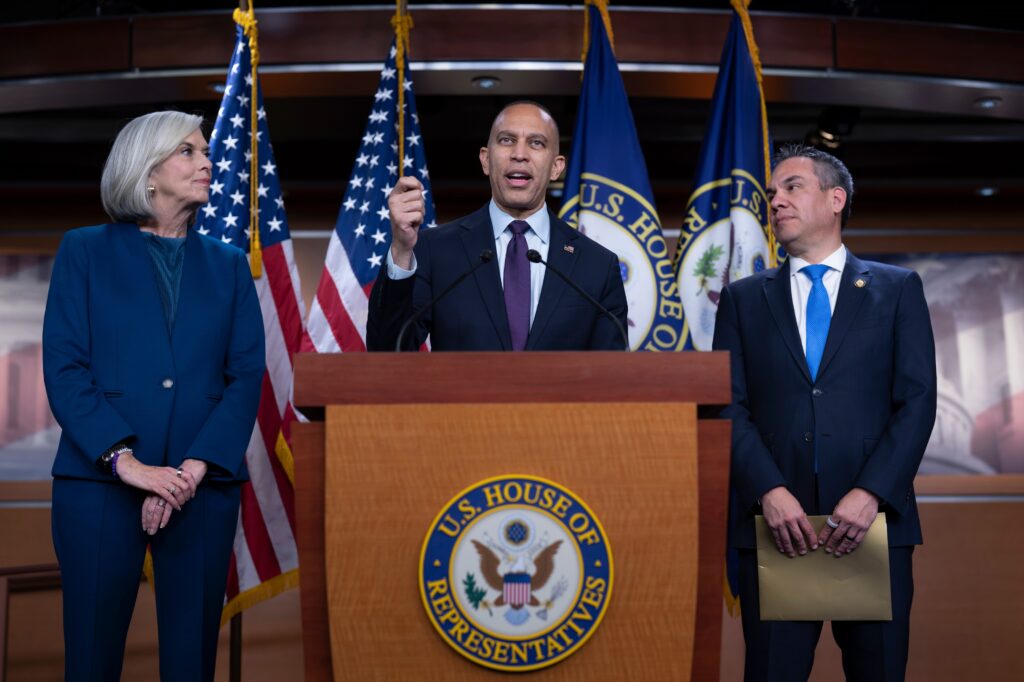
House Minority Leader Hakeem Jeffries (D-New York) was overwhelmingly nominated to be speaker of the House by his Democratic colleagues on Wednesday, propelling him one step closer to a full House vote in January that is expected to make him the first Black American to serve in that role.
If he wins that January vote, he will not be the only one making history.
Democrats also promoted Jeffries’s top deputies on Wednesday, electing House Minority Whip Katherine Clark (Massachusetts) and Democratic Caucus Chairman Pete Aguilar (California) as majority leader and majority whip for the next Congress, respectively.
Clark will be the first woman from either party to serve as majority leader. In that role, she will be in charge of managing the caucus and dictating what comes to the floor. Aguilar will be the first Latino to serve as majority whip, responsible for counting votes.
The three have led House Democrats in the minority since 2023. Come January, they will all but certainly govern the House.
When Democrats take control of the House in January, the trio will be managing one of the largest House majorities in modern history — a caucus of at least 257 Democrats, about a quarter of which will be new members.
Unlike other recent House leadership teams, Jeffries, Clark and Aguilar campaigned for their leadership positions together, and they are also seen as more willing to empower and delegate to committee chairs. Their bet is that their members will be more responsive to a consensus-building approach than to an iron fist.
Democrats’ challenges next year are likely to center on navigating the large number of ideological groups looking to shape the to-do list — and passing an agenda that will help Democrats obtain the Washington trifecta they are hoping for in 2028.
Though projecting a message of unity, one rooted in real shared policy goals, every corner of Democrats’ big tent is already lobbying for their vision to be the one embraced by the new leaders. Each faction is convinced that they have correctly interpreted the mandate that voters delivered through the party’s sweeping midterm wins.
Progressives say Democrats won power because the country wants Medicare-for-all. The fiscally conservative Blue Dogs are pushing to curb the national debt. The pragmatic New Democrats — the largest of the three — want to prioritize building 4 million new homes in 10 years, in part by cutting regulatory red tape.
The three leaders will have to decide on the agenda and successfully manage the daily business of running the House, while working with a Senate in which Democrats will need to rely on the GOP to overcome filibusters, and a White House where Donald Trump is in his final two years of the presidency.
An incident days after members returned to Washington after the election gave leadership a taste of what it could be like to be in charge in an environment where every move is broadcast on social media — not always accurately — to a liberal audience nervous about Democrats delivering, and skeptical about whether leadership is up to the task.
Last week, 11 Democrats missed a key procedural vote, sparing Defense Secretary Pete Hegseth from being impeached, at least for now. The effort would not have succeeded even with all Democrats present, a fact that was not conveyed in many of the online posts lamenting the outcome of the vote. Critics saw the outcome as evidence that Democratic leadership did not have control over the caucus.
“Social media and the press magnified far beyond their importance almost every little glitch,” said Rep. Steny Hoyer (D-Maryland), who served as majority leader on former House speaker Nancy Pelosi’s leadership team. Like Pelosi (D-California), Hoyer will retire once this Congress concludes. “Glitches are newsworthy, and good operations are not.”
Hoyer said he has confidence in the next leaders because “they have great confidence in one another. … That’s important because they all have distinct roles to play, important roles to play.”
Jeffries’s role will be to steer the caucus to legislative success in the next two years and electoral success in 2028.
He rose quickly through the ranks after entering Congress in 2013, propelled by early leadership positions and mentorship in the Congressional Black Caucus. He laid the groundwork for his leadership the old-fashioned way, colleagues say: through texts, phone calls, strategic alliances within the caucus and early meetings with members.
After the 2018 election, when Democrats reclaimed the House majority, Jeffries defeated Rep. Barbara Lee (D-California) to become chairman of the Democratic caucus, the fifth-ranking member in the chamber’s Democratic leadership. Clark became vice chair. And Aguilar was quickly becoming influential in the Congressional Hispanic Caucus. The three watched Pelosi, Hoyer and former Democratic whip James E. Clyburn (South Carolina) govern the House, and they started to think about their next steps.
Early in the summer of 2022, Jeffries, Aguilar and Clark met for dinner at a restaurant near the Capitol, Aguilar said, and discussed the future. They didn’t know when the current leadership team would step aside, but they wanted to be prepared.
“It wasn’t adversarial, like ‘Who’s doing what?’” Aguilar said. “It was like, ‘Hey, what if we do this together? What if this all happens at the same time?’”
Jeffries is known in the caucus as a highly focused strategist and an approachable leader who seeks to persuade through discussion. Colleagues say he can be cautious and deliberative — to a fault, at times. He is seen as being laser-focused on the message, with little appetite for lingering on emotions.
Clark is a former prosecutor known in the caucus for her disciplined approach to vote-counting. She also came to the House in 2013 and has been scaling the ranks of Democratic leadership since 2019. Long involved in Massachusetts politics, she is seen as the embodiment of the state’s deeply blue, progressive political establishment and has made women the center of her policy goals.
Clark will preside over a Democratic caucus that includes at least 118 women. As the Democratic Congressional Campaign Committee’s vice chair for recruitment, she helped recruit the party’s 2018 blue-wave class of House candidates, of which 17 women remain. This year, as Democratic whip, she was part of the leadership team that recruited this freshman class, which includes at least 34 Democratic freshman women.
While she remains one of the most progressive Democrats in leadership, former opponents of Clark, including a recent primary challenger from the left, have argued that she has grown too chummy with the party’s donor class. She responded, in an interview with a local news outlet, that she’s not “beholden” to anyone. She has also calibrated her public posture as she has moved further into the spotlight. Last year, she referred to Israel’s war in Gaza as a “genocide” — and then quickly retracted those remarks.
As the current whip, Clark absorbed most of the criticism from the Hegseth episode last week, and told Democrats in a meeting the next morning that they had disappointed the American people by not having all of their members present to vote for the impeachment effort.
Several colleagues described Clark as a calm and steady strategic leader.
“She doesn’t chase cameras; she counts votes, and that’s why she wins,” said Rep. Lori Trahan (D-Massachusetts).
Completing the leadership trio is Aguilar, a California Democrat who came to the House in 2015 after serving as mayor of Redlands, California. A product of local politics and the city council, he is known for being the most extroverted member of the three — a skill members said will be helpful as whip.
“Pete’s style, he is mano-a-mano,” said Rep. Rosa DeLauro (Connecticut), a longtime top Democrat on the House Appropriations Committee, a panel Aguilar worked on for nearly a decade. “He really is someone who works directly with members.”
Most importantly, DeLauro said, “he knows how to count votes.”
Aguilar, who is not as battle-tested as the other two, will have to navigate keeping members united on votes, while also ensuring that the caucus doesn’t alienate the voters who got them such a sweeping majority.
Before the election, Aguilar predicted that the Trump administration’s immigration and economic policies would cost Republicans Latino support at the ballot box. He argued then that the GOP’s gains with Latino voters in 2024 were not permanent and instead just an “artificial reaction” to rising costs and economic unease.
The lesson he learned from the midterms, he told The Washington Post, was that the Latino vote is not necessarily Democrats’ to keep. Democrats, he said, have to make sure they “get it right” with this voting bloc.
“If we can do that over the next two years, then I think we have a real shot at holding this coalition and ensuring that Latinos continue to vote for us,” he said.
On Wednesday morning, as Jeffries made history as the first Black American to be nominated for speaker, he faced some calls — particularly from the left wing of the base — to step aside in favor of a fresher-faced, more progressive candidate.
Nevertheless, he ran unopposed and won 251 votes.
Hoyer questioned those who want Democrats to pick new leaders, arguing that, even though Jeffries, Clark and Aguilar have been leading the minority for the past four years, they are still new to the very top.
“The new leadership has now had four years in the minority to hone its skills,” he said. “My response to those who say we need new leadership: You betcha, we made that decision four years ago.”
The post They promised House Democrats a new era. Now they must deliver. appeared first on Washington Post.