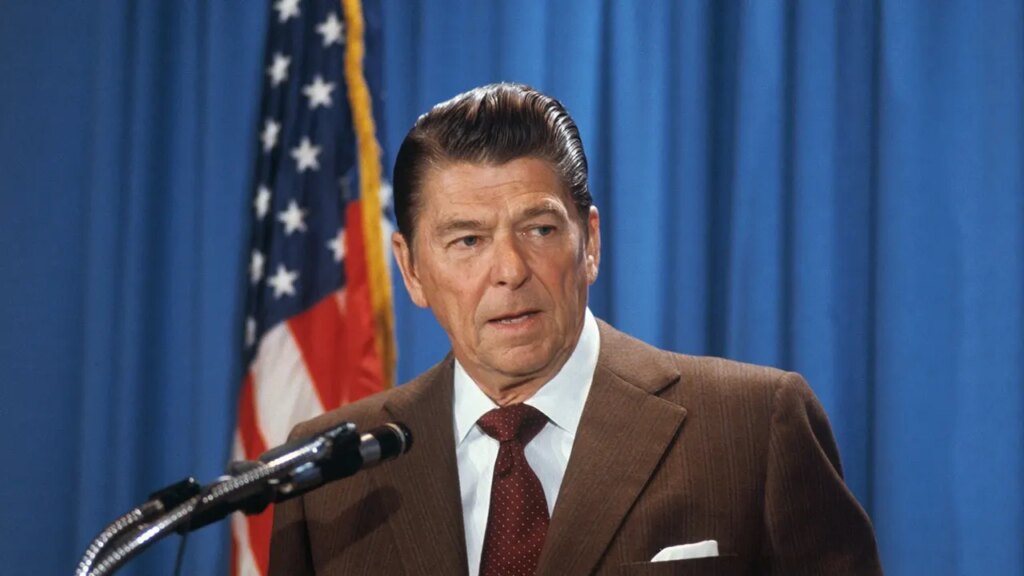
From the Cuban Missile Crisis forward, the United States faced a drive by the Soviet Union to achieve nuclear superiority over America and its allies. The Soviet buildup began as the U.S. entered the quagmire of the Vietnam War. The Russians had reached the cusp of actual superiority in nuclear arsenals when Ronald Reagan beat then-President Jimmy Carter and launched a defense buildup unmatched in the peacetime history of America.
The story of that buildup, and of how Reagan and his team of defense and national security advisers designed the policy and sold it to the public and then Congress, is told in a riveting new book by Roger Zakheim, “Peace Through Strength: How Reagan’s Military Buildup Won the Cold War.”
TRUMP HOLDS THE NUCLEAR CARDS TO PLAY AGAINST CHINA AND RUSSIA ON ARMS CONTROL
Zakheim is the director of the Ronald Reagan Institute, a position he took after careers at the D.C. law firm Covington & Burling LLP and as general counsel and deputy staff director of the House Armed Services Committee.
Zakheim brings actual Hill experience and a lawyer’s eye to the details of the more-than-a-decade-long crusade by Reagan to recover America’s military strength. That effort began almost immediately after President Gerald Ford’s defeat by Carter in 1976 and is intertwined with Reagan’s long march to the 1980 Republican Party nomination and subsequent election and eight years in office.
Those who did not live through those years will be surprised by the breadth and depth of Reagan’s commitment to rebuilding the American arsenal during his long climb to the presidency. The entire intellectual architecture of the “peace through strength” network is reviewed by Zakheim. Names that were familiar to most of the Beltway and its ecosystem four decades ago — from Richard Allen to William Van Cleave, from now-obscure figures like Fred Iklé to the still (and justifiably) famous like John Lehman — appear and play their parts. Zakheim has carefully reconstructed the drama, and all of its players are on stage for long or short periods.
All to the end that President Reagan envisioned: winning the Cold War and preserving the peace between superpowers by paying for an arsenal so complete that no hostile power dared to challenge America at home or around the world where its vital interests were involved.
REPUBLICANS NEED A REAGAN-STYLE VISION TO WIN THE BATTLE OVER AMERICA’S FUTURE
The defense buildup Reagan launched and oversaw was a complex and expensive undertaking. It succeeded only with the assistance of such stalwarts in his administration as Secretary of Defense Caspar “Cap” Weinberger and his deputy, Frank Carlucci, and on the Hill, such as Sens. John Tower, R-Texas, and Sam Nunn, D-Ga. There were defeats along the way, such as the battle over the MX missile, and incredible triumphs, such as the deployment of Pershing II missiles in Europe and the original commitment to the Strategic Defense Initiative. But both Reagan and then-President George H.W. Bush persevered, and the incredible strength and productivity of free markets and free minds triumphed.
The arsenal Reagan and Bush built, however, has a shelf life. While Congress can and has mandated, for example, that the Navy build and maintain 11 nuclear-powered aircraft carriers, it cannot simply decree that those carriers afloat continue in service beyond the years their nuclear cores are designed for, nor can Congress expedite their replacement. No part of the American arsenal is immune to the ravages of Father Time. A near-continuous refurbishing and resupply of America’s defenses is required. The entire national debt in 1981 was less than $1 trillion. Today it is more than $40 trillion.
IS THE US ALREADY LOSING TO CHINA ON INNOVATION, LOGISTICS AND RAPID RESUPPLY?
President Trump has secured the funding for the beginning of the refurbishment and renewal of the national security infrastructure, but the continuation of the rebuild is very much in doubt as the new Democratic majorities arrive in January. There is no Sam Nunn across the aisle from such Republican stalwarts of defense as Mississippi’s Sen. Roger Wicker and Arkansas’ Sen. Tom Cotton. Most of the new arrivals on Team Blue want to spend much more on social programs and much less on defense, even though Russia’s enduring enmity toward the U.S. has been matched and exceeded by that of the People’s Republic of China.
As the Republican Congress enters its final 50 days, by far its most important task is to preserve the start of the rearmament of America. Zakheim’s book has arrived just as an intense debate over a supplemental appropriation to the Pentagon is underway on the Hill.
US RAMPS NUCLEAR WEAPONS PRODUCTION TO COLD WAR LEVELS AS CHINA PURSUES ‘UNPRECEDENTED’ BUILDUP
“Peace Through Strength” is a prod to the Republicans, and especially those wrapping up long and distinguished careers, to end this Congress on a high note, recalling 1981, when President Reagan sought and received a supplemental spending bill to begin his rebuild that would go on to accomplish such great things and preserve the peace.
The book should also inform every would-be president from both parties. The 1980 campaign (which began almost immediately after the 1978 midterms) was very much focused on America’s defenses, from its hardware on hand to the then-dire state of the all-volunteer force.
HEGSETH UNLEASHES TRUMP’S ‘ARSENAL OF FREEDOM’ WITH WARNING TO DEFENSE GIANTS
The country needs another such presidential campaign as the complexity of the threats facing the country has grown ever more menacing over the past two decades.
America summoned the will to preserve the peace in the 1980s because of leadership that began with an out-of-office governor contemplating an unlikely second try for the White House and his team of advisers who helped craft his message and campaign.
CLICK HERE FOR MORE FOX NEWS OPINION
The Republicans (and hopefully the Democrats) who want to succeed President Trump in 2028 should read “Peace Through Strength” and demand their staffs and campaign advisers do the same.
Hugh Hewitt is a Fox News contributor and host of “The Hugh Hewitt Show” heard weekday afternoons from 3 PM to 6 PM ET on the Salem Radio Network, and simulcast on Salem News Channel. Hugh drives Americans home on the East Coast and to lunch on the West Coast on over 400 affiliates nationwide, and on all the streaming platforms where SNC can be seen. He is a frequent guest on the Fox News Channel’s news roundtable, hosted by Bret Baier weekdays at 6pm ET. A son of Ohio and a graduate of Harvard College and the University of Michigan Law School, Hewitt has been a Professor of Law at Chapman University’s Fowler School of Law since 1996 where he teaches Constitutional Law. Hewitt launched his eponymous radio show from Los Angeles in 1990. Hewitt has frequently appeared on every major national news television network, hosted television shows for PBS and MSNBC, written for every major American paper, has authored a dozen books and moderated a score of Republican candidate debates, most recently the November 2023 Republican presidential debate in Miami and four Republican presidential debates in the 2015-16 cycle. Hewitt focuses his radio show and his column on the Constitution, national security, American politics and the Cleveland Browns and Guardians. Hewitt has interviewed tens of thousands of guests from Democrats Hillary Clinton and John Kerry to Republican Presidents George W. Bush and Donald Trump over his 40 years in broadcasting. This column previews the lead story that will drive his radio/ TV show today.
CLICK HERE TO READ MORE FROM HUGH HEWITT
The post Reagan’s peace through strength won the Cold War. Can America do it again? appeared first on Fox News.