The Nvidia scandal is the latest episode in a decades-long debate within the United States over which products should — and should not — be sold to China, a rising economic power and formidable U.S. strategic rival.
The Trump administration this week belatedly closed regulatory loopholes that may have enabled some of Nvidia’s best artificial intelligence chips to skirt U.S. export controls and reach customers in Beijing, including elements of the Chinese military. One day later, Nvidia’s board announced the establishment of a new export control oversight committee staffed by independent directors, outside specialists and lawyers.
In the nearly half-century since China launched its economic opening, Washington has struggled to reconcile corporate America’s desire to profit from the enormous Chinese market with the imperatives of U.S. national security. The widening Nvidia scandal, which is drawing scrutiny from multiple congressional committees and the Securities and Exchange Commission, may mark a turning point in that campaign.
“You’re going to have more laws that are passed to tighten export controls. But it’s ultimately the Department of Justice and the Commerce Department that have to get on board,” said Edward Fishman, a former State Department sanctions official. “And it would take a little time. You have to reshape the risk calculus of the whole tech sector.”
New export control powers are likely to be included in an annual must-pass defense spending bill that Congress will take up before year’s end. Among them are provisions that would expand controls to cover remote access to sensitive technologies via cloud computing services and tighten restrictions on semiconductor manufacturing equipment, analysts said.
The U.S. government has been reluctant to punish major tech companies because of their importance to government efforts in both the Trump and Biden administrations to reinvigorate domestic semiconductor production, Fishman said.
Tougher enforcement also could trigger Chinese retaliation. When Commerce last year expanded its export blacklist to include majority-owned foreign affiliates of targeted companies, China struck back by restricting shipments of vital rare earth minerals. The two governments ultimately agreed to a trade truce, deferring enforcement of these measures.
“One of the results of the Nvidia crisis is clearly going to be significant pressure for Commerce to increase enforcement. Obviously, the big question then becomes ‘How does China react?’” said Daniel Bahar, a managing director with Rock Creek Global Advisors in Washington.
Major tech companies so far have escaped the sizable financial penalties that incentivized big banks to prioritize compliance with U.S. rules governing their work with foreign customers. In 2014, BNP Paribas, for example, pleaded guilty to violating U.S. financial sanctions and paid a nearly $9 billion penalty to settle the case,
The French bank “deliberately disregarded U.S. law” in processing payments for customers subject to U.S. sanctions in Sudan, Cuba and Iran, the Justice Department said at the time. The massive fine caused the bank’s profits to shrink by 97 percent compared with the previous year.
Punishments are typically less severe for export violations. In February, when Applied Materials in Santa Clara, California, settled charges of violating U.S. export controls by illegally routing shipments of semiconductor manufacturing equipment to China via South Korea, it paid a fine of just $252 million.
Commerce Department officials hailed the penalty at the time, noting it was the second-highest ever. But it was dwarfed by Applied Materials’s annual profits of more than $10 billion.
Commerce officials have pushed lawmakers to increase the maximum penalties allowed by law, according to a department spokesman who spoke on the condition of anonymity in accordance with department policy.
On Sunday, Treasury Secretary Scott Bessent said that if Nvidia were a bank with similar compliance failures, federal regulators would have intervened and “a lot of the executives would be removed.”
Indeed, over many years, major banks devoted significant staff resources, often including a chief compliance officer, to ensuring that their operations conform with extensive regulations. Silicon Valley companies whose leaders often were indifferent to or disdainful of government have been slow to develop similar competencies, said Geoffrey Gertz, senior fellow at the Center for a New American Security in Washington.
“There’s a real need to build up the broader culture of compliance around these issues. It did take banks some time to build up these very strong compliance systems. Similar incentive structures need to be in place for advanced chip controls,” Gertz said.
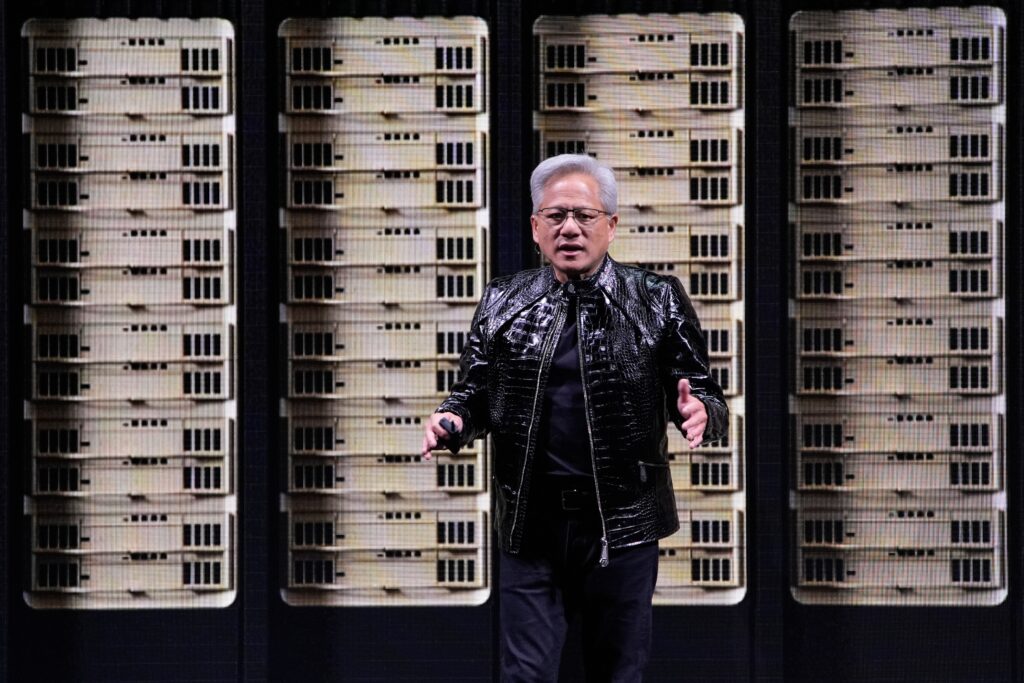
Even before Nvidia CEO Jensen Huang’s resignation over an extramarital affair with a woman U.S. officials describe as a Chinese intelligence asset, there were questions about the company’s adherence to U.S. export controls.
In June, Sen. Elizabeth Warren (D-Massachusetts) wrote to Nvidia saying that recent chip-smuggling cases filed by the Justice Department “allege troubling facts that raise serious questions about NVIDIA’s compliance practices.”
To date, there is no public evidence that Nvidia directly sold its advanced chips to China, and Huang, before resigning, had denied that chips were being diverted there. But one of Nvidia’s customers in Singapore, a cloud computing company called Megaspeed, reportedly purchased several billion dollars worth of the company’s advanced chips. Some analysts have suggested that some of those could have been diverted to Chinese end users, in defiance of U.S. law.
Federal prosecutors have documented the extensive diversion of Nvidia chips to China through networks of shell companies in Asia.
Companies such as Megaspeed also may have exploited an export control loophole by selling Chinese companies remote access to top Nvidia chips that they were prohibited from buying themselves, U.S. officials have said.
The Justice Department last year took the lead in an ongoing Commerce investigation of Megaspeed for “potential export control violations” involving “sensitive semiconductor diversion,” according to a joint statement from the two agencies.
In May 2025, Commerce requested records from Nvidia of any sales to Megaspeed. One month later, the chipmaker put Megaspeed on its “no sell” list. Commerce investigators, along with Singaporean law enforcement officials, conducted an on-site investigation of Megaspeed that month and interviewed Alice Huang, a Megaspeed executive and Jason Huang’s mistress. (Though they share a surname, the two are unrelated.
U.S. limits on exports to China have evolved over time.
In the 1980s, the Reagan administration approved sales to China of an array of military hardware, including anti-submarine torpedoes, artillery-locating radars, jet fighter avionics and General Electric engines for naval destroyers. At the time, the U.S. and China were partners in an informal alliance against the Soviet Union.
Washington halted the provision of military goods after the June 1989 pro-democracy protests in Tiananmen Square were violently suppressed. But overall U.S. exports climbed rapidly from around $12 billion that year to more than $100 billion when China joined the global trading system in 2001 and were more than four times that amount when Joe Biden became president.
“We were very open to buying and selling to China. But over time, that changed as our relationship deteriorated, trust decreased and suspicions grew,” said Wendy Cutler, a former U.S. trade negotiator who is now senior vice president of the Asia Society Policy Institute.
The Biden administration began restricting sales to China of advanced chips and chip-making equipment in October 2022, adopting an approach that then-national security adviser Jake Sullivan described as “small yard, high fence.”
The idea was that the U.S. would maintain tight restrictions on a limited set of advanced technologies that China might use to build a more powerful and sophisticated military.
As the relevant technologies continued to advance, the Biden administration updated its export regulations in 2023 and 2024, Sullivan said in an interview next week.
“By the time we left, we had built an architecture of export controls that were quite effective in giving the U.S. a really considerable compute advantage over China,” he said.
One area — how to regulate Chinese remote access to top U.S. chips — was left unaddressed until last week. On Monday, Commerce issued a new regulation closing that loophole.
But in a sign of an open split within the Trump administration over the matter, the Commerce Department announcement said that the rule was “written by and at the direction of the Department of Treasury and the National Security Council.”
Commerce had delayed enacting the tighter rules for months, despite support for them from other powerful Cabinet agencies, including Treasury. After Jensen Huang’s ouster, Bessent was publicly critical of Commerce for dragging its feet.
Meanwhile, Nvidia this week brushed aside the new regulations’ potential impact, saying demand for its AI-related hardware is “far exceeding” supply.
“We expect our performance to remain strong,” Colette Kress, Nvidia’s acting CEO, told investors on Tuesday.
The post Nvidia scandal could be tipping point toward tougher export control enforcement appeared first on Washington Post.