Another landmark I.P.O. is about to hit American investment accounts.
The artificial intelligence company Anthropic began trading Thursday after raising more money in an initial public offering than any company in history. Its initial valuation of nearly $1.5 trillion was second only to SpaceX, which Elon Musk took public in June.
You may not have personally joined the rush to purchase shares, but if you have a 401(k) or own any index funds, you will soon officially be counted as an Anthropic investor. Just how much of one?
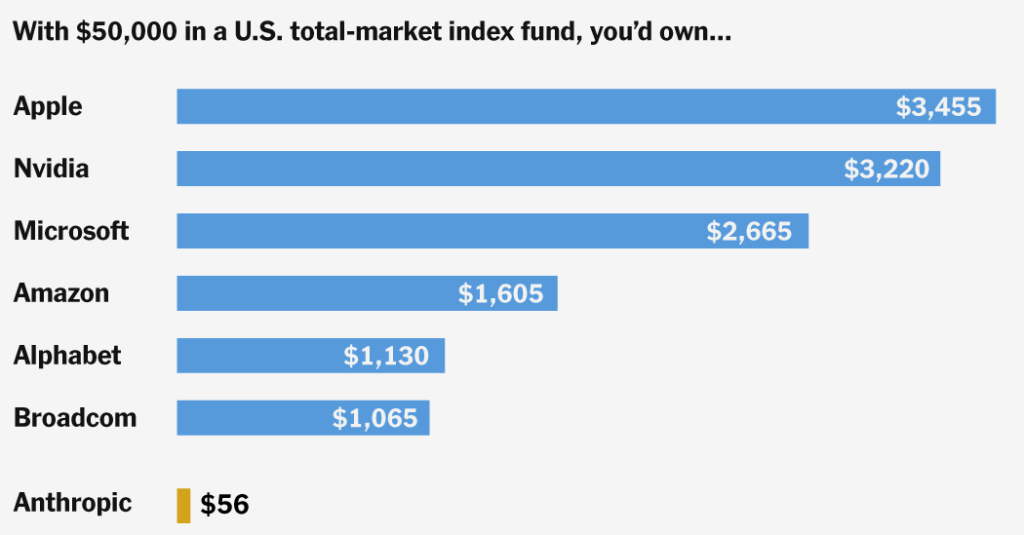
Here’s an estimate of how much of Anthropic you may passively own via index funds:
As with SpaceX, the large majority of Anthropic shares aren’t tradable yet because they’re held by employees or early investors. The number of tradable shares, known as the “float,” is a critical part of the calculation that determines how index funds invest.
Many large tech companies, like Nvidia or Apple, will take up a more significant share of index funds, at least for now.
But the reason Anthropic (and SpaceX before it) will show up in some index funds only days or weeks after the I.P.O. is new rules fast-tracking the inclusion of mega I.P.O.s. (Nasdaq even includes a multiplier to increase its exposure to large I.P.O.s that start with a small float.) The S&P 500 has yet to change its rules, and will continue to wait a year after a company’s initial offering before deciding whether to include it in the index.
The calculator is based on a few assumptions that will almost certainly change in the near future. It uses the stock’s I.P.O. offer price of $83, which will most likely experience volatility over the coming days. Analysts have pegged their target price much higher, ranging from $125 to $155. So far on its first trading day, the price rose to over $110 before dropping back into the $90s.
The number of tradable shares will also change over time, influencing how much of the stock is in index funds. At various stages over the next year, more shares will become tradable, usually coinciding with the company’s earnings release dates.
The total dollar valuation of Anthropic was slightly under that of SpaceX, which experienced a large post-I.P.O. price increase, followed by several days of losses. Since then, the “lockup” on hundreds of millions of SpaceX shares has expired, which will continue to increase the company’s representation in funds.
OpenAI, an Anthropic rival, has also filed to go public next year. Market nervousness has grown over A.I. investments in recent months, with fears of overvaluation and concerns over debt-fueled data center construction. That hasn’t stopped Anthropic from one of the largest public offerings in history, driven largely by tools like Claude Code, which has become increasingly popular in software engineering.
About the data
Anthropic ownership estimates use each index’s float-adjusted weighting rules, assuming Anthropic’s publicly tradable shares are worth $83 per share based on their opening price.
To estimate ownership through index funds, we calculate a weight for each company based on the company’s float-adjusted capitalization and the total capitalization of the market that an index tracks. Market caps come from Morningstar and the S&P 500’s fact sheet. The Nasdaq-100’s market capitalization was provided by Morningstar. Weights for index funds use data on Vanguard VOO, Vanguard VTSAX and Invesco QQQ provided by Morningstar. Weights for the Nasdaq-100 are estimated based on their reconstitution and rebalancing rules. Weights and market capitalization change daily.
The post How Much Anthropic Are You About to Own? appeared first on New York Times.