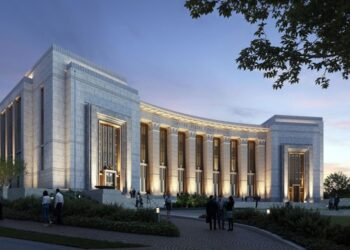
Donald Trump’s ambition to deck out the government in columns and golden hues goes well beyond the capital. Last month, more than 500 miles from Washington, D.C., the General Services Administration broke ground on a new federal courthouse in Chattanooga, Tennessee—the first of seven projects subject to an August 2025 executive order on “Making Federal Architecture Beautiful Again” that designates traditional architecture as the government’s preferred style.
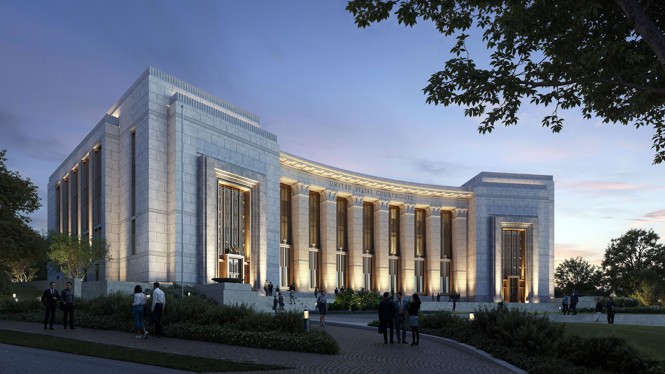
Mixing classical and Art Deco design elements, the templelike courthouse gives off Gatsby-goes-Greek energy. Although the brawny civic structure shares some DNA with the building projects that seem to take up much of the president’s attention these days, it’s gotten praise that Trump’s D.C. proposals have not.
For many admirers of classical architecture, this “Greco-Deco” courthouse marks a welcome return to tradition after several decades in which the government leaned toward contemporary and modern commissions. A particularly vocal faction of architecture watchers on the political right has worked with the Trump administration, in both terms, to sway the federal government’s look. But however satisfying the Chattanooga project may be for the classically inclined, it represents a Pyrrhic victory of sorts. You can’t have the proud courthouse without the bloated arch and ballroom. Both breeds of classicism will coexist as Trump’s architectural legacy.
To be a classicist in Trump II is to be cast in a tragicomedy of sorts, caught between two architectural realities. The president outwardly proclaims an affinity for architecture derived from Western antiquity. He signs an order saying so. He plans a monument and buildings with such aesthetics: a “neoclassical” ballroom with massive columns and porticos, and an arch that echoes the Arc de Triomphe and arches of the ancient world. Yet as he endorses the style, he also butchers it. His projects balloon in size, cost, and gilding, becoming something more like Neo-Vegas-ism. If you’re a classicist, it’s as if Trump has borrowed your favorite sweater only to return it stretched out and bedazzled.
Perhaps this is why discontent with the president’s pet projects in D.C. can be found deep inside the classical camp: The first architect of Trump’s ballroom, James McCrery II, resigned after, among other things, reportedly clashingwith the president over the size of the structure, whose interior volume will be nearly three times that of the White House’s main building. One of the plaintiffs in a lawsuit challenging the arch is Calder Loth, a historian of classical architecture. Catesby Leigh, an architecture critic who argued for an arch in a conservative publication last year, has since spoken out against Trump’s plan, telling The New York Times that it’s “way too big for that site.”
Still, some prominent proponents of classical architecture have been notably quiet on those Trump projects. The Chattanooga courthouse “demonstrates that classicism is alive and well. It can be done in a way that is not a Xerox of the past,” Justin Shubow, the president of the National Civic Art Society, an advocacy group, told me. Shubow, who served on the U.S. Commission of Fine Arts during Trump’s first term and the start of Joe Biden’s (including briefly as chairman) and helped write last year’s executive order, declined to comment on the ballroom and the arch during a recent interview. (The Trump administration has enlisted several people close to the National Civic Art Society to work on the Garden of American Heroes, a patriotic statue garden that Trump wants to build in D.C.) Mark Ferguson, the dean of architecture at the Catholic University of America, also did not comment on the Trump projects but praised the courthouse for successfully employing a visual language that “has been so developed and cared for over centuries” and not prioritizing novelty over continuity.
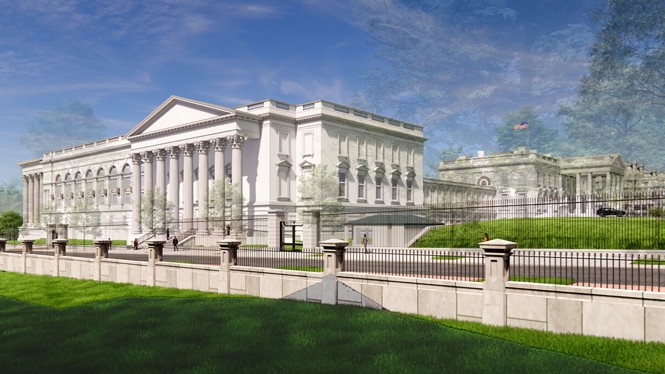
Trump’s big projects, meanwhile, function like interruptions. Peter Miller, the president of the Washington Mid Atlantic chapter of the Institute of Classical Architecture and Art, an educational nonprofit, called the Chattanooga courthouse beautiful, even as he nodded to concerns that the executive order infringes on design freedom. But he was less enthused about Trump’s D.C. ideas. “I tell architects here, Just because you didn’t vote for Trump doesn’t mean you should be against what he wants to build, but then, when we see the plans and we see that it’s a 90,000-square-foot monster, it’s like, well, we don’t want that,” he told me.
[Maxwell Taylor Kennedy: Trump’s arch must be stopped]
Civic architecture represents one of the most direct and lasting ways the government communicates what the country is and what it aspires to be. How the buildings should look has always prompted debates. These structures can ask questions about national identity, as a modern construction might, or they can underscore stories tying the nation to Western civilization with pediments and entablatures. Whether you believe that classicism is the ideal mode to disseminate values to the public, arguing with the fact that it is an especially recognizable, legible, and even appealing form of federal architecture is difficult. By usurping the style to serve a bigger-is-better ethos, Trump is undermining a discipline known for its rules and balance. He’s co-opting a style that has long strove to say something about the nation in the hopes that it can say something about him.
Trump has publicly celebrated his building spree across the capital for months. The day after his party’s worst midterm defeat in decades, he chose to address the public for the first time from the construction grounds of his new ballroom, sending a clear message about his priorities. Elizabeth Macaulay, a classical archaeologist and architectural historian at CUNY Graduate Center, told me that whereas innovative design represents a form of confidence, classical architecture can serve as a crutch during unsure historical moments. “It’s like a security blanket in marble form,” she said. The scaffolding holding the president’s coalition together might be shaky. But the beams in the neoclassical ballroom are going up.
Government buildings and memorials have long imitated the look of antiquity, be it the Greek Revival Lincoln Memorial, the neoclassical White House, or the many domed buildings dotting state capitals—the examples are virtually endless. Such styles have been embraced on and off since the country’s early days, when the Founding Fathers adopted aesthetics that reflected the ancient societies that guided their approach to government. Classical designs, at their best, negotiate between decoration and restraint, prioritize order, and evoke core national values. They embrace the design principles of the Roman architect Vitruvius, among them symmetry, economy, and harmony. This is a mode in which beauty is born from precise, even mathematical, attention to rules.
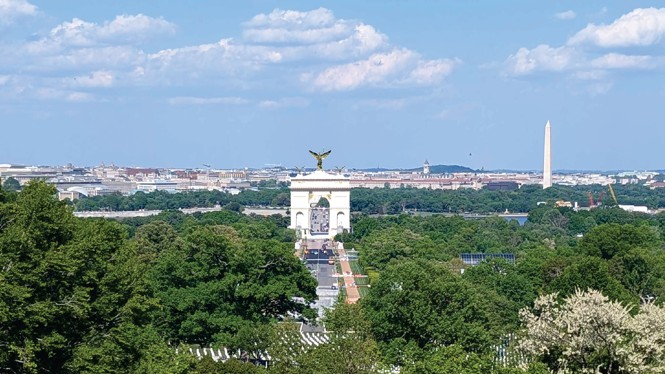
The main criticisms of Trump’s D.C. projects cut through these tenets. The 250-foot arch as planned would loom over Arlington National Cemetery, casting shadows on graves and interrupting historic sightlines. The gilded, Corinthian-columned ballroom, which is currently under construction, overwhelms the warm, humbler design of the executive mansion. Even if the Chattanooga courthouse (designed by the firm HOK) seems different from Trump’s personal projects, it was the result of a top-down government order that upends the very democratic values that classicism is meant to embody.
Last year, when Trump’s executive order on architecture effectively overturned Daniel Patrick Moynihan’s 1962 design guidelines for the GSA, it foreshadowed what was to come. Moynihan drafted the rules when he was an assistant labor secretary in the Kennedy administration, working on a report about federal office space. His “Guiding Principles for Federal Architecture” reshaped federal real estate, placing design authority in the hands of the architecture profession, warning against a federal design style, and envisioning government buildings that would “embody the finest contemporary American architectural thought.”
These ideas led to such structures as the vigorous Robert C. Weaver Federal Building (headquarters of the Department of Housing and Urban Development), with its sweeping, sculptural concrete form, as well as the drab Frances Perkins Building (home to the Department of Labor), which has all the trappings of brutalism and none of the confidence. In recent decades, Moynihan’s creed has lived on in a geometric, Acadian-inspired port of entry in Maine; a woodsy office for the U.S. Army Corps of Engineers in Seattle; and other projects. With experiment comes risk: A striking, glassy courthouse in Utah, for instance, was designed for sustainability but has earned the nickname the “Borg cube.”
Trump, in contrast, has reached for the past as a shorthand for greatness. He’s also demoted the experts. The Washington Post reported earlier this year that he told McCrery, the ballroom’s first architect, during a feud over potential violations of building codes, “I am the code.”
[Read: Trump may come to regret his rush job on the arch and ballroom]
In his executive order, the president wrote, “Design must flow from the needs of the Government and the aspirations and preferences of the American people to the architectural profession, and not vice versa.” The directive requires GSA architects evaluating proposals to have a classical or traditional architecture background and asks that the president be notified if the GSA administrator proposes to approve a design for a federal building that goes against the designated preference. Trump has effectively made himself the modernism police.
Even the early American architects who employed older modes of classical design would challenge Trump’s thinking, Bryan Norwood, an architectural historian at the University of Texas at Austin and the author of a forthcoming book about the professionalization of American architecture, told me. The Trump administration calls for iterating on styles of the past, but “one of the biggest insults that these architects all lob at each other in the early 19th century is the insult of You’re just a copyist,” Norwood said. They valued the progress and innovation that mandating style—or copying, pasting, and enlarging an arch from France—can squash.
A common modernist critique of classicism goes similarly, alleging that traditionalist architecture today is pastiche and makes it difficult to distinguish the eras in which particular buildings were made. I’d push back against that last part here, though. Perhaps Trump’s greatest slight to classicism is that these structures will fool no one. When and if future Americans come upon a vertigo-inducing arch on the Potomac with Golden Age of America emblazoned atop, they’ll know precisely which era of American history created it.
*Illustration sources: Sepia Times / Universal Images / Getty; Photo12 / UIG / Getty; Dea / Biblioteca Ambrosiana / Getty; DeAgostini / Getty.
The post How Trump Embraced, Then Debased, Classical Architecture appeared first on The Atlantic.