When China’s then-paramount leader, Deng Xiaoping, toured Shenzhen in 1992, he used the southern Chinese city to signal an embrace of open markets, setting off decades of rapid growth that would make his country the world’s factory floor.
Since then, Shenzhen has grown from a sleepy town into a gleaming metropolis that dwarfs its more established neighbor, Hong Kong. Apple’s main assembler, Foxconn, runs a sprawling campus there, and Walmart manages its China business from the city. It is home to many Chinese brands like Huawei, BYD and the drone maker DJI.
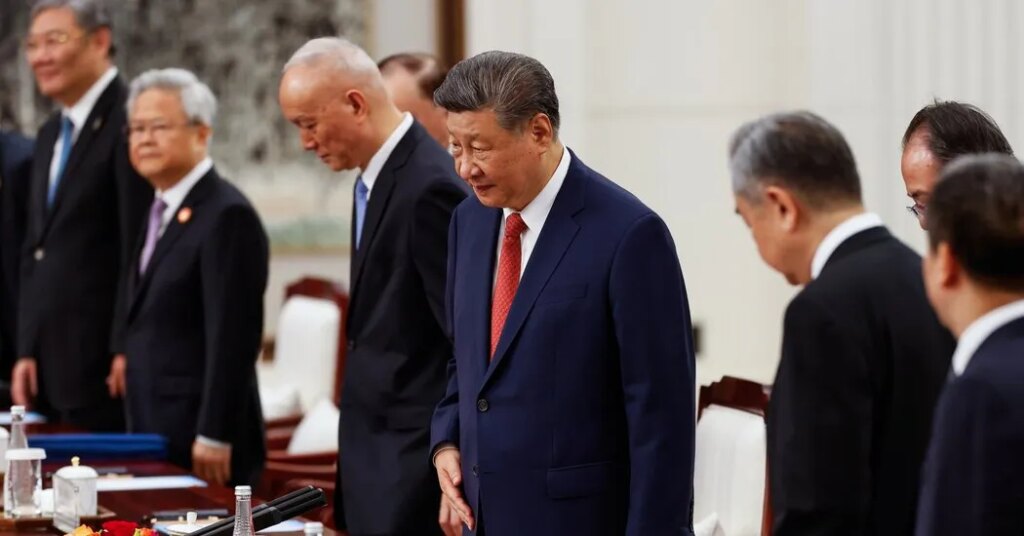
This week, China’s leader, Xi Jinping, is hosting a regional economic summit in the same city, using it to make the case that China’s growth can benefit the world. Shenzhen has been primped for the occasion, with bus shelters plastered with the slogan: “Building an Asia-Pacific Community to Prosper Together.”
But some of that message may be difficult to square for many of China’s trading partners. To them, Shenzhen also embodies much of what makes the world uneasy about China today: a flood of cheap exports; tech giants that pose security risks; and a Communist Party that has traded Mr. Deng’s freewheeling experimentation for more state control.
Mr. Xi’s moment in the spotlight at the Asia Pacific Economic Cooperation forum will also be clouded by allegations of a Chinese spy scandal at the American chip giant, Nvidia, that has already prompted Washington to tighten Chinese access to advanced American chips.
And he is set to meet for the first time with President Trump and President Vladimir V. Putin of Russia, a gathering that could unsettle smaller powers like Ukraine. (Mr. Trump has also suggested that he might see the North Korean dictator Kim Jong-un while in China.)
Here’s what is on China’s agenda when Mr. Xi takes center stage in Shenzhen:
Showcase of China’s Tech Ambitions
In some ways, the setting itself could be read as a statement of defiance.
Shenzhen is home to companies Washington has labeled national security risks, like Huawei and ZTE, as well as Chinese artificial intelligence labs racing to close the gap with American rivals. Many of the companies have been subjected to American sanctions and blacklists.
Mr. Xi wants to show that “China can do well despite America’s all-out effort to kill it” with those trade restrictions, said Minxin Pei, a professor at Claremont McKenna College who studies Chinese leadership politics.
That is an image that Beijing has tried to cultivate after Washington began restricting direct sales of advanced chips to China in 2022, pointing to Huawei’s homegrown processors and DeepSeek’s and other Chinese labs’ breakthrough A.I. models as proof that U.S. restrictions have failed.
Beijing is also casting itself as a partner to other countries in technological advancement, offering Chinese cooperation and know-how on A.I., an approach that competes with the United States’ attempts to unite partners around A.I. supply chains independent of China.
What Espionage?
For China, the news had threatened to distract from the upcoming summit. Less than three weeks before the gathering, The New York Times reported that a Chinese businesswoman who had a close relationship with Jensen Huang, the chief executive of Nvidia, was found to be passing intelligence to Beijing. In the days since, Mr. Huang has stepped down and the company’s board has said it would conduct an investigation.
The allegations, which China has denied, could have scuttled talks with Mr. Trump and put the countries’ fragile trade truce at risk. The claim of such a bold espionage plot was also a potential source of embarrassment for a country hosting business and government leaders at a major event.
China has carried on as if it were business as usual. And in a way, Beijing has already scored a win: The controversy has failed to derail the scheduled talks between Mr. Xi and Mr. Trump, who has downplayed the alleged spy plot.
Rather than declaring that he would confront China about the Nvidia scandal, Mr. Trump has said he does not intend to bring it up. “I don’t think you want to insult China just before you get there,” he told reporters outside the White House on Monday when asked about divisions within his administration about how tough to be on China.
But the scandal is already costing China. On Monday, the Trump administration issued a rule to stop Chinese companies from accessing advanced Nvidia chips through data centers in third countries, and to require licenses for chip exports to companies in Malaysia, Singapore, Thailand, Indonesia and Brazil.
China Needs to Ease Trade Concerns
China’s export machinery is practically unbeatable. This month, China reported that its exports exceeded its imports by more than $1 trillion in the first 10 months of this year, putting it on track to eclipse last year’s record.
But as its factories have churned out solar panels, electric cars and other goods for consumers globally, China has faced pushback not only from the United States but from around the world. It needs to head off efforts by trading partners like the European Union to block its exports.
That’s why China is billing the event as an opportunity for the region to champion free trade and oppose protectionism.
In reality, China has been turning inward. Beijing has sought to squeeze out foreign technology, electronics and auto brands in favor of Chinese firms. The Communist Party, which under Mr. Xi has tightened its grip on the economy, vowed last month to expand its presence inside internet companies. Shen Weizhong, a former policy planner with China’s Foreign Ministry, called the approach “manageable openness,” in which security weighs as heavily as growth.
Mr. Xi’s willingness to turn the world’s dependence on Chinese goods into leverage has also alienated other countries.
Beijing imposed controls on exports of rare earths last year, and it has recently moved to restrict the exports of dozens of technologies, including drones, artificial intelligence models and agents, and know-how about advanced medicines and solar panels. China says these measures are a response to U.S. blacklists and export restrictions.
“Chinese leaders recognize that the golden era of globalization is over, and geoeconomic competition has become the new normal,” said Yuen Yuen Ang, a professor of political economy at Johns Hopkins University.
Putin, Trump … and Kim?
Mr. Xi is expected to sit down with Mr. Trump and Mr. Putin on Thursday, a meeting that is without precedent. China’s Foreign Ministry on Monday called the meeting one “of groundbreaking significance.”
For Beijing, the gathering casts China as a power broker that can bring Washington and Moscow to the same table. Mr. Xi wants to show the world, and especially his own people, that China under his leadership is “consequential, influential and highly respected, with enormous convening power,” said Mr. Pei of Claremont McKenna.
But the optics are awkward.
Mr. Trump said on Monday that he planned to discuss the war in Ukraine in Shenzhen. Beijing is reluctant to take the lead on peace talks, said Zhao Long, a senior research fellow at the Shanghai Institutes for International Studies, lest it create “the wrong impression” that “major powers are dividing up the interests of other countries.”
And Mr. Trump has raised the possibility of another guest: the North Korean dictator, Kim Jong-un. He told reporters on Monday as he left the White House: “And we may meet with Kim Jong Un, also. So, that’ll be good. We could — we have a chance to accomplish a lot.”
A spokesman for China’s foreign ministry, Guo Jiakun, asked on Tuesday if Mr. Kim would be attending, said: “I do not have information on this.” Russian state news agencies reported that Mr. Putin could meet with Mr. Kim if the North Korean leader travels to China, citing Dmitri S. Peskov, the Kremlin’s spokesman.
Berry Wang, Keith Bradsher, Ruoxin Zhang and Siyi Zhao contributed reporting and research.
The post Will a Spy Scandal, Trade Friction and a Surprise Guest Ruin Xi’s Big Moment? appeared first on New York Times.