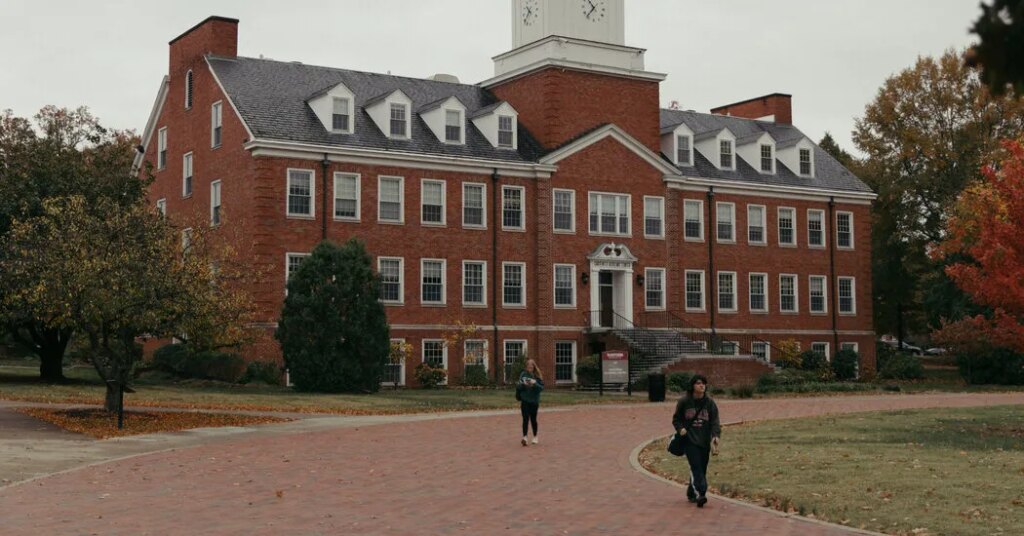
Last March, a handful of students at Transylvania University created a petition, attempting to slow the advance of artificial intelligence on their campus. It asked the administration to cancel chatbot licenses with A.I. giants and instead invest the money in “human-centered education.”
About a third of the college’s students signed on.
Transylvania, in Lexington, Ky., is tiny, with under 1,000 students. But across the country and the globe, there has been a swell of campus resistance to A.I., including a growing group of conscientious objectors who refuse to use A.I. at all.
Polls show the vast majority of American students use chatbots for school work. College leaders have generally embraced A.I., saying it is key to preparing students for the work force.
But as A.I. use grows, more students and faculty are sounding alarms and trying to slow it down.
Much of the opposition comes from the political left, and focuses on how A.I. could harm the environment, diminish the power of workers or be used in warfare. Some of the loudest voices in opposition are studying the arts, where human creativity is paramount, or the law, as tech companies face lawsuits over potential copyright and privacy violations.
But there are also deep concerns that A.I. degrades the experience of college itself, by removing the productive struggle of learning.
Resistors from California to Sydney to Paris are increasingly publishing manifestoes that lay out demands: that colleges not partner with A.I. companies; that professors not be required to use generative A.I. in lessons or grading; and that students be allowed to refuse to complete assignments that require the use of chatbots, without any impact on their grades.
At the University of Kentucky, a research employee who described himself as a humanist successfully applied for a religious exemption from using A.I.
Alice Beatty, 22, helped lead the Transylvania petition drive as a senior last spring. The student newspaper had called attention to the $120,000 the university paid to purchase licenses to ChatGPT and Gemini, chatbots from OpenAI and Google. And Ms. Beatty had participated in a discussion group formed by several A.I.-skeptical professors.
She noted that even before Transylvania provided free access to chatbots, A.I. had been everywhere on campus. Students used it to summarize readings, break down physics problems and compose discussion-board posts and papers that they were supposed to be writing the old-fashioned way, on their own.
Yet when Ms. Beatty and some classmates stood near the dining hall to collect signatures on the petition, almost everyone they spoke to signed.
“I use A.I.,” she recalled some peers telling her, “and I am ashamed I use it.”
A spokeswoman for Transylvania University declined an interview request but said that professors were free to either embrace A.I., limit its use or ban it entirely in their classes.
For students, ethical and practical questions about A.I. will be part of the world they enter after graduating, she said by email.
Vague and confusing college A.I. policies have helped create the conscientious objector movement, said Hollis Robbins, an English professor at the University of Utah who writes often about A.I. and education. She suggested that colleges stop grading take-home assignments that are easy to cheat on with A.I., and shut down online courses that have become rife with academic misconduct in the A.I. era.
If institutions took those steps, she argued, students might be more curious and hopeful about the technology.
“There is silence about these major tech issues,” she said. “Students just seeing grown-ups being inconsistent and letting them down.”
Georgetown University began offering students and faculty free access to Gemini in March. At the time, like many institutions, Georgetown generally allowed each professor to set their own A.I. rules.
Yet in focus groups on A.I. conducted by the university, students asked for clearer guidance. They were worried about cognitive offloading, cheating and A.I. providing false information. Forty percent of the student sentiment was cautious or negative toward A.I., according to the university, compared with 25 percent that was positive or hopeful.
Georgetown’s student newspaper published an editorial criticizing the Gemini license, arguing that it tacitly pushed students toward technology that is often used to plagiarize and avoid academic effort.
This fall, the university is changing its approach. Under a new president, Eduardo M. Peñalver, it announced it would form a faculty committee to come up with clearer principles on A.I. use. For Georgetown, a Jesuit institution, Pope Leo XIV’s recent encyclical on the risks of A.I. will be an important influence.
Dr. Peñalver said in an interview that Georgetown would seek to make course expectations around A.I. more transparent and provide more tech-free spaces on campus. Oral presentations, discussion groups and in-person tests would become more important, he said, to protect “from the intrusion of this technology.”
Still, the university will continue to expand free access to A.I. tools, which he said had the potential to do good.
“We’re not interested in pushing people to use A.I. in ways that don’t align with their values,” Dr. Peñalver said. “But I certainly encourage people to learn about it.”
“Even if you’re opposed to this technology,” he added, “that awareness and understanding is important to the success of your project.”
Many conscientious objectors, though, say they try to avoid generative A.I. as much as possible, blocking it from their devices and not experimenting with it in their own work.
Emily Tucker, executive director of the Center on Privacy and Technology at Georgetown Law School, has been a leader in organizing resistance to A.I. use on campus. She has also signed an open letter with 1,300 other educators “who refuse the call for generative A.I. adoption in schools and colleges, and reject the narrative of its inevitability.”
Law students have told her they feared that if they didn’t use A.I. to speed their output, they would be outpaced in class and at work by those who did. But Professor Tucker said that using A.I. degrades a student’s ability to read and analyze dense legal texts, and risks incorrect citations of case law.
“It’s not useful,” said Professor Tucker, who said she rarely uses A.I. herself, though she acknowledged it might help in some tasks, like seeking specific information within a large set of documents.
At Cornell, Shimon Edelman, a psychology professor who holds a Ph.D. in computer science, has also signed the anti-A.I. letter. He lets students decide whether or not to use A.I., though he warns them it could degrade deeper learning.
He said he had been dismayed to see the Cornell administration greet A.I. warmly, as an “essential tool,” instead of warning more forcefully against its risks. In October, Cornell announced free access to chatbots, A.I. coding tools and agentic A.I.
“It’s unthinkable,” Professor Edelman said of using A.I. in his own research, even when he faced having to read 800 documents for a recent book project.
Emmali Simmelink, a senior studying classics and religion at Whitman College in Washington State, said students on her campus sometimes plug classroom discussion prompts directly into ChatGPT.
“If you can’t generate a coherent thought without ChatGPT, I genuinely lose a lot of respect for you,” she said. She added, laughing, “I am really insufferable about this.”
She said she brings up concerns about the environmental impact of A.I. as soon as she hears somebody say, “I asked ChatGPT.”
The topic can be divisive socially, so much so, several students said, that friend groups often develop a shared view of A.I.
Preston Hicks, 26, is studying history and education at Rider University in New Jersey — a second degree, after he worked previously as a software developer. He said many of his friends are artists who instinctually oppose A.I., a view he often shares.
But he can also imagine using A.I. in his future career as a teacher, to handle paperwork and other logistical tasks.
“I am more nuanced,” he said. “If I see a good use, I will use it.”
The post The Anti-A.I. Campus Movement Is Growing appeared first on New York Times.