After the devastating glacier collapse that killed more than 1,500, Nepal arrived at the U.N. climate talks in Turkey looking for help.
What it found was a system that many say is ill-equipped to help vulnerable countries recover from climate disasters.
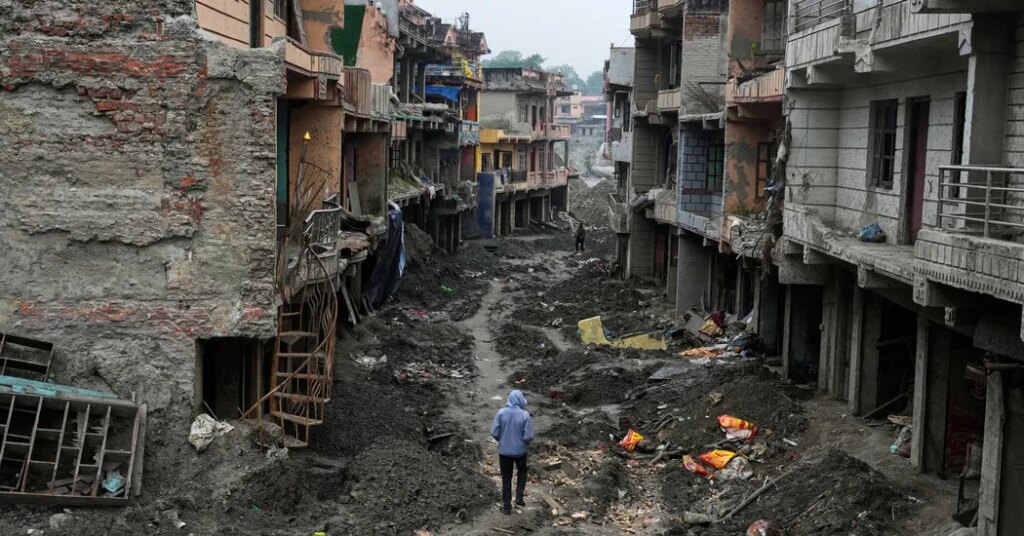
The catastrophe in August occurred after a wall of rock and ice crumbled, setting off a flood that wiped away towns and left thousands missing. Nepal says it will cost roughly $5 billion to rebuild.
But so far, Nepal has received pledges for less than 10 percent of that amount, with much of it in the form of loans.
The devastation in Nepal has become a crucial test case for whether the global community can deliver quick financial relief when disasters strike. Many at the talks, including Nepal and small island nations whose low-lying countries face repeated typhoons and storm damage, said getting help to rebuild could take months or even years, a delay they can’t afford.
“Our melting mountains cannot wait for our negotiations to catch up with their changing reality,” Shisir Khanal, the Nepali foreign minister, told leaders at the climate summit, known as COP31.
This week, an effort by Nepal and Bhutan to make glacial ice melt and other issues facing mountain communities a formal part of the climate negotiations stalled. At the same time, a fund created to help vulnerable countries cope with the economic consequences of climate disasters has promised Nepal just $21.6 million, a tiny fraction of its need.
“We are suffering from a disaster which we did not cause,” said Pramesh Pokharel, a Nepali activist who works with small-scale farmers. “Most greenhouse gas emissions are caused by the global north, rich people and multinational corporations.”
Developed nations and rich companies should foot the bill for Nepal’s recovery, Mr. Pokharel said.
“It’s about who bears the cost of the loss and damages, and who should pay,” he said. “We are demanding that those who are polluting, they must pay the cost of the devastation we are facing.”
In the months since the disaster, Nepal has received patchwork pledges from around the globe. The World Bank said it would make $170 million in emergency financing available.
The United States initially offered $500,000 in aid, then expanded that sum to $36 million after Jensen Huang, the former chief executive of Nvidia, pledged $10 million.
A handful of countries, including Australia and Japan, pledged a combined $40 million. The United Nations helped raise an additional $50 million.
The four entities that have historically provided Nepal with the most support are India, China, the World Bank and the Asian Development Bank.
All those pledges still fall short. Assessments conducted in the days after the catastrophe concluded that damages totaled about $1.8 billion. Rebuilding the devastated areas with improved infrastructure, the government concluded, would cost roughly $5 billion, equivalent to about 10 percent of Nepal’s gross domestic product.
After the Aug. 26 glacier collapse, the Loss and Damage Fund, which was created in 2024 under the U.N. climate treaty framework to help nations recover from climate-fueled disasters, held a special meeting to allow Nepal to submit a fast-track proposal for aid, which led to the $21.6 million commitment.
“When Nepal happened, there was a lot of pressure from all of us,” said Ibrahima Cheikh Diong, executive director of the Loss and Damage Fund. “This is why the fund was set up. Even though we’re not sitting on billions of dollars, our board couldn’t afford to just do nothing.”
Nepal’s finance minister, Swarnim Waglé, said his country’s need remained enormous.
“When the need is $5 billion, $20 million is nothing,” Mr. Waglé said. “However, this is acknowledging that very poor countries, the low-income countries in the fragile Himalayas, are bearing the brunt of the Western industrialization.”
This week the Nepali prime minister, Balendra Shah, is in India seeking a $2 billion package of credits, loans and grants. Nepal was also looking to China to help it rebuild its physical infrastructure destroyed by the flood, which included the main trading corridor between the two countries, Mr. Waglé said. And it was seeking below-market-rate loans as well as grants from the World Bank and the Asian Development Bank, he said.
“I request the U.S. to step up,” Mr. Waglé said. “We’re in this together and cooperation demands that we have to help countries in need.”
Nepal has called the glacier collapse a climate disaster. World Weather Attribution, a scientific group, said that the conditions that led to the collapse had been made more likely because of human-caused climate change.
“The permafrost thawing and the glaciers melting, that’s a direct cause of global warming,” Mr. Waglé said. “Because of global warming, ice is retreating, glaciers are melting, and this rock got exposed to the elements, and that accentuated the vulnerability.”
The disaster in Nepal has forced leaders from other developing nations to find new ways of seeking assistance. This week President Keiko Fujimori of Peru appealed directly to President Xi Jinping of China for aid to help cope with the effects of El Niño. She walked away with a pledge of $22.5 million.
Pacific island nations have started a type of endowment fund to help disaster-proof their countries and “cut out the red tape,” President Surangel Whipps Jr. of Palau said.
The fund, known as the Pacific Resilience Facility, aims to raise $1.5 billion, a reference to the 1.5 degree target in the 2015 Paris climate agreement that experts now say will not be met.
The post Nepal Came to Climate Talks in Dire Need. It’s a Test for the World. appeared first on New York Times.