Ralph Lauren is going through a renaissance.
But when Patrice Louvet took over as chief executive in 2017, the company was at a low point. His predecessor, the first chief of the firm not named Ralph Lauren, stepped down after a little more than a year amid creative clashes with the eponymous founder.
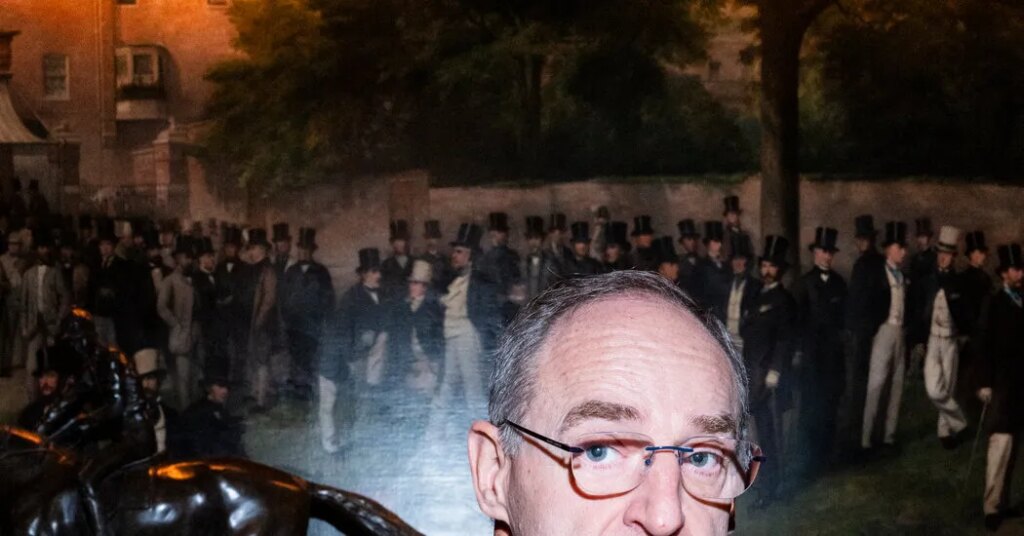
Mr. Louvet, 62, was an unexpected choice. Born in France, he served in the French Navy and spent nearly 30 years at Procter & Gamble, known for selling razors and shampoo, not polo shirts and knit sweaters.
Under his leadership, the brand started relying less on heavy discounting and pulled out of lower-tier stores. Its preppy look is once again popular with young people. Reservations are essential at its packed restaurants, and at the coffee shops, the lines are long. The company’s share price has risen more than 400 percent since Mr. Louvet took the top job.
Last fiscal year, Ralph Lauren brought in $8.1 billion in revenue, a 14 percent increase. It recently raised its forecast for sales and profit margins for the current year, ahead of the holiday shopping season.
Like other retailers, Ralph Lauren must try to remain relevant as trends shift rapidly and politics increasingly intrudes on culture. The company has many stakeholders, but the Lauren family controls more than 80 percent of the vote among shareholders.
Mr. Louvet has picked up many lessons from Mr. Lauren, 87, who is chief creative officer and executive chairman, that have helped guide him on where to take the brand next.
“In this industry, if all you do is magic, then you can build a nice little business, but it’s not going to go very far,” Mr. Louvet said. “If all you do is logic, you can’t be successful in this industry.” Success, he says, is striking a balance between the two.
This interview has been edited and condensed.
People want to know the relationship that you have with Ralph Lauren, the man. How do you work together?
One of the key reasons I left Procter & Gamble is the opportunity to work with Ralph. There are very few visionary philanthropists, entrepreneurs, innovators like him.
We took a lot of time to understand each other as humans, not as businesspeople, before we both signed in May 2017.
We never documented what our respective roles were.
All the McKinsey people right now are lifting their heads and saying, “What?”
Yeah, exactly. No job description. Instinctively, intuitively, we got clear on our respective lanes.
Ralph is very focused on the creative vision of the company. I focus on just running the company and delivering for the near term and the long term.
How has the relationship changed?
The nature of the relationship with Ralph hasn’t changed dramatically. If anything, we’ve become really close friends. We have lunch together every week when we’re not traveling. We might spend two, three hours together and not a minute on business.
The trust has been built over time. There’s been very few situations where we weren’t aligned from the get-go on specific decisions, which is pretty unique 10 years in.
Ralph talks about magic and gut instinct, and you come from an operational background focused on logic and spreadsheets. What’s an example of when you two differed on a business decision?
We did a beautiful fashion show and the theme was “Ralph’s Club.” Janelle Monáe was there, she sang and she got on the tables. It was spectacular. Black tie. After that, Ralph said: “Let’s open a club. I love that spirit, that atmosphere. Magic.”
But the financials made no sense. Ralph, as he often is, was very passionate about it. We ultimately decided this is when the logic needs to override the magic.
The American flag has always played a role in the Ralph Lauren brand. How do you protect what feels essential about the brand while also not having it be politicized?
This company has been around for 60 years. We focus on values that ultimately are universal values, not political values: optimism, authenticity, quality, entrepreneurship, family. The brand is resonating so well in Sydney, in Shanghai, in Chicago, because these values resonate with everyone around the world.
Our business internationally is actually even stronger than it is in the U.S. China is up 35 percent. We’ve been growing north of 20 percent for several years, at a time where the geopolitical situation is tense between those two markets. This is true across every market.
Is it possible to bring clothing production to the United States?
We are keen to bring production to the U.S. We manufacture all our Olympic gear here, as we get ready for the L.A. 2028 Olympics, which will be a big moment for our company. We manufacture a number of our luxury products here. There’s a manufacturing site in Queens.
Our products are pretty sophisticated. I don’t think we want to necessarily drive massive T-shirt manufacturing in the U.S. But certainly the intent is there, the interest is there.
Trend-wise, Ralph is back. But what happens if the fashion cycle changes?
Ralph has many wonderful quotes, including this one: “I don’t want to be too hot and I don’t want to be too cold.” We’re not looking to chase trends.
The majority of our business — more than 70 percent — is our core products that are available year in, year out. We might evolve the color, we might evolve the sizing. It might be a bit oversized or it might be slim fit. But that tweed jacket, that white polo shirt, that rugby shirt, that cable knit sweater, those are staples that stay all year and across time.
One of the pivots we made when we started this journey 10 years ago is to be much more consumer centric. The younger generation was on TikTok. We couldn’t spell TikTok. They were shopping on e-commerce platforms. We weren’t there. They were gaming. We weren’t there.
And we said, “If we want to talk to that young generation and bring them in, let’s understand where they want to engage with brands, where they want to shop, and let’s make sure we’re there in a way that’s consistent with our brand image.”
Many young people are finding the brand through the secondary market. Some brands see the secondhand clothing market as diluting a brand. But your company recently hosted PoloFest, an event selling vintage Ralph clothes, in Tokyo.
Ralph has always been about timelessness. The vision is for products to be handed down, for the father to hand it to his son, for grandmother to hand to the granddaughter.
A lot of people discover our brand, particularly the younger generation now, through secondary markets, which is pretty neat. They become part of that ecosystem, and then ultimately come to our store at full price. You will see a lot of vintage in our stores.
Tell me about your upbringing. You were born in France.
I was born in a little town called Saint-Cloud, just outside Paris. My father was an engineer and worked for a French chemical company. My mother was a homemaker and she did philanthropic activities. I’m the eldest of four.
What was a formative time in your childhood?
When I was 9, my father was sent to New Jersey. I was not particularly excited to leave my friends, my school, my activities, my environment. I was thrown into American public school, not speaking any English. The first few months were rough.
My father had studied at M.I.T., so he knew a little bit of the U.S., but my three siblings, my mom and I were all discovering the U.S. at the same time. I think there’s strength in everyone going through the same experience.
You spent nearly 30 years at P&G. I read that an employee once told you that you were not the right leader. How did that affect you?
It was a massive gut punch. I was in charge of hair care and health care in Japan and Korea, my first general manager role. I am sent there with a very clear mission: to turn the business around. I came in all guns blazing with a sense of urgency.
I learned you must clarify the direction and the vision. It was clear in my head, but I had not really democratized it. Define it overtly and then make sure you’re engaging everyone around it. Don’t move before you’ve done that.
It’s time for the lightning round. What do you wear to feel most confident?
What you’re seeing today. A blue pinstriped suit. Ralph Lauren watch — also available in women’s.
What’s one fashion trend you cannot stand?
White socks and slides.
What are you personally trying to learn right now?
Artificial intelligence, particularly agents.
What’s the last question you asked A.I.?
I asked it last night, what were the drivers to the stock price decline after earnings.
How do you sign off to your emails?
Onwards and upwards, together.
What’s one place that you think people should still be wearing ties but aren’t?
We should be wearing ties everywhere.
Tell me about an object in your office and the significance of it.
Someone from my team gave me a little Yoda. This is an industry where there’s a lot of emotion. There’s a good amount of intensity. Yoda is a good reminder to just breathe and don’t overreact.
The post Behind the All-American Ralph Lauren Brand Is a French C.E.O. appeared first on New York Times.