In March 2000, the nation’s leading measles experts gathered at a Hyatt hotel in Atlanta, just a few miles away from the Centers for Disease Control and Prevention, to make a historic decision.
After two days of poring over data, they came to a unanimous verdict: Measles, which had infected nearly every American child by age 15 just a few decades earlier, had been eliminated in the United States.
Attendees saw it as a public health milestone, one that the chair of the meeting credited to “millions of parents and children, hundreds of thousands of health workers, and thousands of policymakers and legislators.”
“I walked away with the feeling that this was very monumental,” said Dr. Jonathan Temte, one of the physicians at the meeting. He kept a white binder from the meeting, filled with measles data, as a memento.
More than 20 years later, measles experts gathered once again this week. The group is widely expected to announce that the United States, which has logged more than 5,200 cases this year, has lost its measles elimination status, a designation given to countries that have not had continuous spread of measles for more than a year.
The loss will not only be a stunning step back for the health of American children, but it will also be a crushing blow to the public health experts who spent decades working to rid the United States of measles.
“Realizing you’ve got to dust off the old playbook and start all over again, it’s a little depressing,” said Dr. James Conway, a pediatric infectious disease doctor at the University of Wisconsin School of Medicine and Public Health who helped care for measles patients in the 1980s and, recently, during the latest resurgence.
The Long Shot
When Dr. Walter Orenstein first set his sights on eliminating measles in the United States in the late 1970s, his peers called the idea a “long shot,” even “foolhardy.” A few of the researchers he recruited to work on measles elimination at the C.D.C. privately doubted whether they could pull it off.
But Dr. Orenstein, who had recently seen firsthand how vaccines and dogged public health work wiped out smallpox in India, pressed on.
“I saw what a vaccine could do,” he said.
It was an optimistic time in public health. A flurry of vaccine discoveries had provided a path to stop diseases like polio that had plagued children for centuries. Scientists had developed a highly effective vaccine for measles, too.
But this virus was a different beast. There is no known disease more contagious than measles. It can linger for hours in the air and people can spread it days before realizing they are sick.
“The measles virus is relentless,” said Dr. Daniel Salas, who helps lead immunization efforts at the Pan American Health Organization, the organization responsible for reviewing the country’s elimination status. “It doesn’t forgive any kind of window of opportunity.”
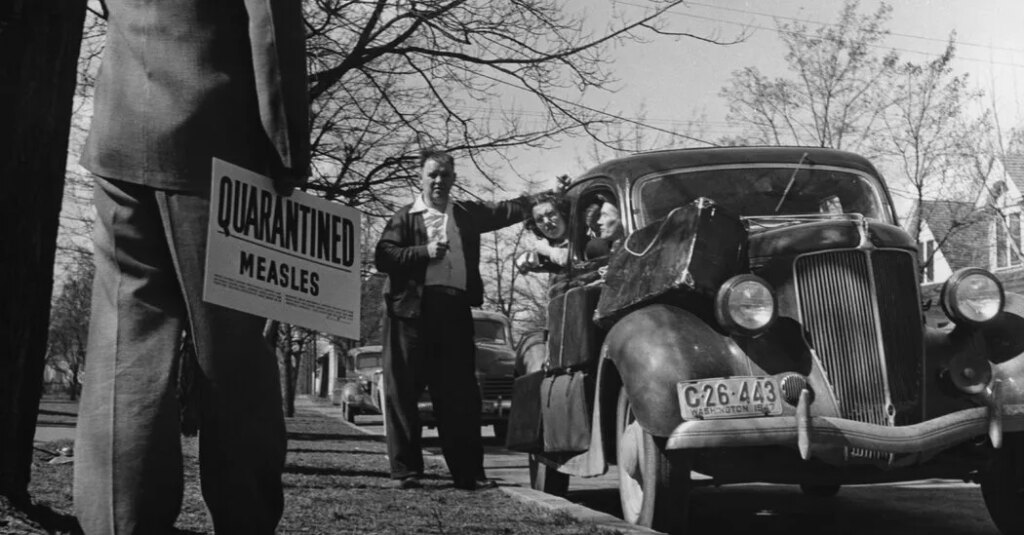
At the time, the virus infected tens of thousands of people and killed dozens every year. The outbreaks were not only dangerous but disruptive, as schools scrambled to hold vaccination campaigns after surges in cases.
If the United States wanted to stamp out measles, a vast majority of American children would need immunity. That goal was ambitious: In 1974, less than two-thirds of young children had received the shot.
After a series of outbreaks in 1977 sickened more than 57,000 children, Dr. Orenstein and his colleagues at the C.D.C. mounted an aggressive public health push, with the goal of ridding the United States of measles by 1982. The agency worked with President Jimmy Carter’s administration on a plan to immunize 20 million American children by giving states the resources for mass vaccination campaigns. The federal health secretary at the time also wrote a letter to all of the state governors, urging them to consider stricter school vaccination requirements.
Vaccinations began to rise and measles cases began to drop. But as the virus fell out of the news, Dr. Orenstein realized a problem: “When measles went down, resources went down.”
President Ronald Reagan’s administration slashed funding for the work to eliminate measles — redirecting that money toward new health priorities — and the 1982 deadline came and went.
In 1989, yet another huge measles wave hit, this one so large that federal officials ran out of money to provide emergency vaccinations. The virus, as it always had, found the gap in nation’s immunity: poor children whose families could not afford vaccines.
The high-profile outbreak, which ultimately infected more than 50,000 Americans, generated so much outrage that Dr. Orenstein and his team saw a window to make their final push. In 1993, C.D.C. officials — again — announced that they intended to eliminate measles.
They moved swiftly to close the final gaps. That year, President Bill Clinton’s administration created the Vaccines for Children program, which let the C.D.C. purchase vaccines directly from manufacturers and ship them to providers, guaranteeing free shots for poor children. Federal health officials also began recommending that children receive two doses of the measles vaccine instead of one, to increase immunity overall and catch the small percentage of children who did not respond to the first dose.
Their efforts proved successful. In 1999, a New York Times article declared that they seemed to have “wiped out measles as an indigenous disease in the United States.”
It was cause for celebration, but there was very little, if any, after the vote at the 2000 meeting in Atlanta. Dr. Samuel Katz, who helped develop the measles vaccine and led the meeting, cautioned that the accomplishment was an “inherently unstable situation.”
The virus was still spreading rampantly across the globe, including in countries bordering the United States, which meant that the nation’s immunity would constantly be tested by imported cases.
In 2016, it seemed as if measles was finally under control when the Pan American Health Organization announced that the virus had been eliminated in all of North and South America, the first region in the world to do so.
“I remember having this kind of revelation, like, wow, this is possible,” Dr. Conway said, “like, this is something we can do as a society.”
Some experts began talking about what was achievable if they could keep the momentum going. Could they wipe out measles globally? How long would it be until children no longer needed the measles vaccine?
Dr. Katz, the meeting’s chair, told his mentees that he hoped to live to see the moment when there were zero cases worldwide.
In the years since the 2000 meeting, one of those mentees, Dr. Yvonne Maldonado, has kept close tabs on measles outbreaks, especially as vaccination rates have ticked down in recent years.
Dr. Maldonado, a pediatric infectious disease physician at Stanford Medicine, watched as the outbreaks appeared to grow larger each year. But she has still been stunned by the size of the latest resurgence and how intensely some members of the public seem to revile the public health systems that helped rein in the virus in the first place.
Of Dr. Katz, who died in 2022, she said, “I’m glad he’s not around to see this.”
The post What It Took for America to Wipe Out Measles appeared first on New York Times.