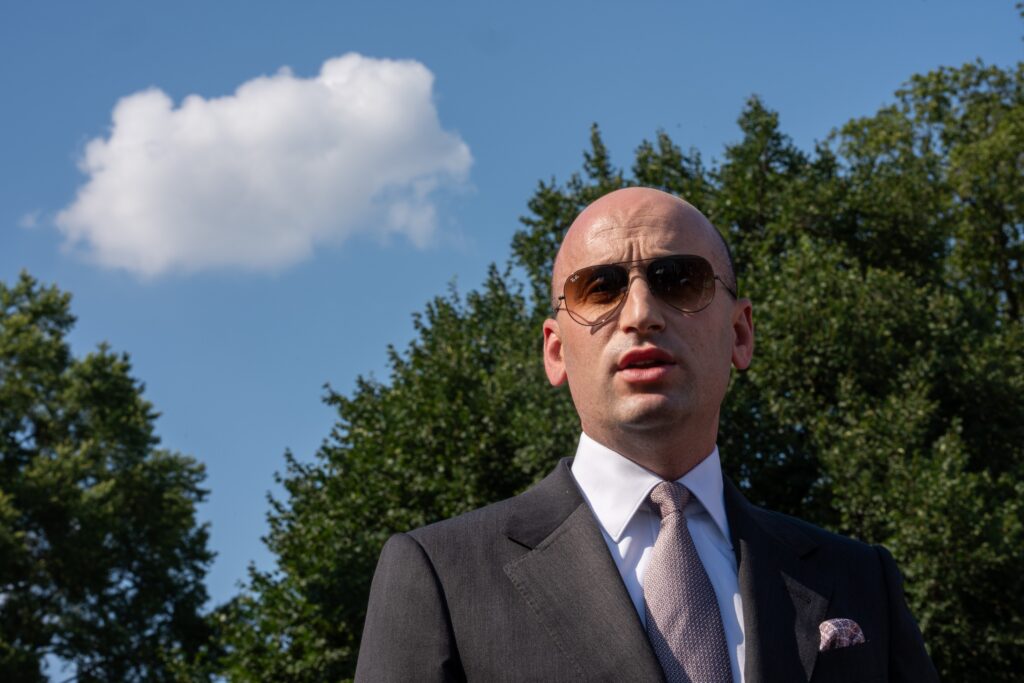
Like so many of the men and women who populate President Donald Trump’s political ecosystem, Stephen Miller, the new White House chief of staff, has crafted an image that is both gentleman policy wonk and urgent Cassandra, warning of barbarians at the borders. He trades in stereotypes and clichés, looking backward in order to define himself in the present day.
Miller is now the most powerful aide to the world’s most powerful man. He portrays himself as a combatant in a business suit, a clear-eyed patriot in a nation overrun by cowardly globalists. Miller has embraced fashion as an expression of order, power and importance. He dresses like the so-called Establishment, situating himself and his point of view in the mainstream. He makes use of fashion’s cultural clout, of its shorthand form of communication. He uses it to proclaim himself reasonable. Even as his words make both his loyalties and his disposition clear.
“If it wasn’t for President Trump, the United States of America would not exist right now. This man saved America,” Miller said to a glowing commander in chief and an appreciative audience at Mar-a-Lago the day he was promoted last week, seemingly ignoring the avalanche of voters who had rebuked this administration. “I swear to you and I pledge to you, Mr. President, my absolute loyalty, my unwavering commitment and my total devotion to your success, and the success of this country.”
The two men stood side by side in front of a giant swan fountain that looked like it was striving unsuccessfully to be Botticelli-esque. The president wore one of his voluminous suits and below-the-belt red ties. Miller was in a trim gray suit — and he was smiling. He had come for his victory lap, and he was quite put together: tailored, pressed, modern enough in fit without flash, and just shy of upstaging his principal.
Miller is not usually caught on camera looking pleased about anything — except, perhaps, when he is in the company of his wife, Katie. Before Miller stepped into his new role Monday morning, he was best known to casual Washington observers as the president’s lead anti-immigration champion, whose state of outrage often approaches hissing. The policy known as the “Muslim ban” in Trump’s first term and the expansive deportation quotas in his second are examples of Miller’s handiwork.
In conversations it doesn’t seem to matter whether Miller is discussing immigration policy with someone sympathetic to his worldview or appalled by it. He is reliably animated, adamant and argumentative as he insists that certain immigrants — namely brown-skinned, non-English-speaking — do not belong in this country because all they’re going to do is make it as awful as the terrible places from which they’ve fled.
“If Somalians cannot make Somalia successful, why would we think that the track record would be any different in the United States? Go third-world country by third-world country,” he insisted during a Fox News interview last year. “If these societies all over the world continue to fail, you have to ask yourself: If you bring those societies into our country and then give them unlimited, free welfare, what do we think is going to happen? You’re going to replicate the conditions that they left.”
Miller, at 41, has managed to foment a great deal of anger and cruelty. On the surface, he is an inexplicable candidate for such dirty work. He grew up in the progressive city of Santa Monica, California. He hails from a Jewish family of immigrants who generations ago benefitted from chain migration. Professionally, his trajectory has seemed to be nothing but upward. Personally, he and his wife have four sweet-faced children. But Miller seems to have thrown off any expectations of reciprocal tolerance.
“The refugee program is not intended as a solution for global poverty. And historically it’s been used that way,” Miller told a group of reporters outside the White House. “The U.S. refugee program in America has been a catastrophic failure.” Except, it seems to Miller, when those refugees are White and of mostly European extraction. He said all this calmly, with a slight smile, dressed in the soothing manner of a statesman: a dove-gray suit, pristine white shirt, a burgundy-dotted tie and matching pocket square.
In words, deeds and style gestures, Miller is a man of contradictions. He can sound like a 1950s Archie Bunker dressed up in modernity. A firebrand wrapped in worsted wool. His clothes are not provocative, nor are they distracting — in ways that are good or bad. They are a costume of concealment.
Miller is not some stodgy guy in a bow tie, nor is he a disheveled attention hound. His ties are narrow. He likes a pocket square, and he often can’t resist one that matches his tie. Men’s tailoring is in the details, and Miller is attuned to the little things. His suits are two-button — a style more flexible and breezier than a three-button configuration. He doesn’t lean toward the high armholes and pronounced structure of Savile Row and the conservative formality of British tailoring. Nor are his suits fitted to the can-you-even-breathe millimeter in the manner of those fashionable Tom Ford tuxedos worn by Hollywood’s leading men on the red carpet. He favors a notch lapel over peak. And while Miller avoids a break in his trousers, they are not hemmed to Thom Browne’s ankle-baring proportions.
Miller has chosen a standard configuration that by default makes his style contemporary. It offers a soothing, thoughtful counterpoint to the jarring public mien, enraged words and fabrications of the man who wears them.
Trump “saved our military from collapse. He saved our economy from destruction. He saved our border from annihilation. And he saved our country from threats at home and abroad which would have been the end of the American Dream forever,” Miller said during his remarks at Mar-a-Lago. “He saved the Republican Party from the ash heap of history and has made it stronger, more popular and more resilient than ever before.” Miller said all of this in the aftermath of the midterm elections, in which Republicans lost their majority in both the House and the Senate, and more than a few states made history by electing Democrats to offices they’d been shut out of for generations. He looked like an unassuming insurance salesman while doing so.
Miller may not have respect for the creators of fashion or those who inspire it with their do-it-yourself imaginative spirit — many of whom are immigrants or Black or Brown strivers. But he understands that the right cut of a jacket and length in a pair of trousers can give the impression that a person is relevant rather than old-fashioned. Astute style choices can cloak an outlier in relatability and commonality. We have been conditioned to believe that unemotional men wear suits. Dressed in a suit, even the most horrifying ghouls manage to slide into polite society — at least for a while. In the 21st century, dangerous men do not come wearing white hoods, saggy jeans or balaclavas. They arrive in khakis and polo shirts, overpriced cashmere hoodies and business suits.
“America’s doors are closed, fully, to asylum seekers. We’ve set up agreements where if you want asylum, then we will find a country elsewhere in the world to take you,” Miller said this summer. “It’s a very simple, a very elegant, very complete solution.”
When the public-facing Miller is not chopping the air with his fingers and ratcheting up the volume on his messages about immigrants and American might and force, when he stands silent, he has a habit of folding his arms tightly across his chest and tilting his head downward. In this stance, one in which he is so often photographed, we see a face drained of affect. His eyes go flat. His mouth tightens into a narrow slash. Perhaps this is a defensive mask, or one of exhaustion. Perhaps he is thinking sad thoughts that he would prefer to keep private. A series of protest posters plastered around the nation’s capital accuses him of having a resting fascist face. “Fascism ain’t pretty,” reads the script underneath a close-up of an impenetrable Miller.
Fashion is Miller’s camouflage. It’s a distraction. It’s his social grace note. The viciousness his many critics declaim is couched within the familiar. It’s just business — nothing personal, nothing to see here. Just another menacing plan, laid out by a policy wonk in a nothing-special suit.
The post Stephen Miller dresses like a reasonable man. But listen to what he says. appeared first on Washington Post.