Not long ago, Americans were living through a historic era of airline safety. Over nearly a 16-year period, starting Feb. 12, 2009, after a commuter jet crashed on an icy night near Buffalo, the major U.S. airlines handled a total of some 10 billion passenger journeys. And of those 10 billion souls, not a single one was lost to a crash. This achievement — the longest disaster-free period ever for U.S. air travel — was on par with the government-led effort to create a polio vaccine in the 1950s or the Apollo project that put the first human beings on the moon. It came to an end on Jan. 29, 2025, when an Army helicopter and an American Eagle commuter jet collided over the Potomac River.
The Potomac crash happened during airline rush hour at Washington’s Ronald Reagan National Airport. The two-person cockpit crew on the jet was following controllers’ instructions for a change in its assigned landing runway. The three people in the Army helicopter had allowed it to drift higher than its assigned altitude and did not see the inbound jet until an instant before they flew straight into it. The two aircraft plunged into the icy river; all 67 people aboard both were killed.
When safety measures fail and a plane goes down, or even when there’s a frightening close call, the National Transportation Safety Board leads the effort to find out how the “accident chain” was started, and why no existing safety measures stopped it. Its investigators interview everyone with any connection to the flight, from mechanics to gate agents. They recover the black box, with precise flight data from the aircraft, and listen to the cockpit conversations. They prepare flight-simulator recreations of what pilots would have seen out their windows and on their instrument panels. They take their time, often a year or more, in trying to provide the best-available answer to the central question: Why did people die?
Air travel has become so safe in large part because of a profound commitment from the people in charge to learn from tragedies — what aviation experts call “lessons written in blood.” In 1956, the Eisenhower administration responded to an airline collision over the Grand Canyon by beginning the decades-long process that would eventually make U.S. airline travel one of the safest forms of transportation the world has ever known. In 2009, the Obama administration responded to the Buffalo crash by overseeing a new set of reforms. With the Potomac crash of 2025, another reckoning was at hand. It would be up to the Trump administration to learn from this lesson written in blood.
But the Trump administration has displayed an extraordinary unwillingness to learn new lessons, and in some cases it seems to be unlearning the old ones. In a news conference following the crash, President Trump complained that the N.T.S.B. method was too slow, and he said he already had a good idea why people had died: D.E.I. hiring practices during the Obama and Biden administrations.
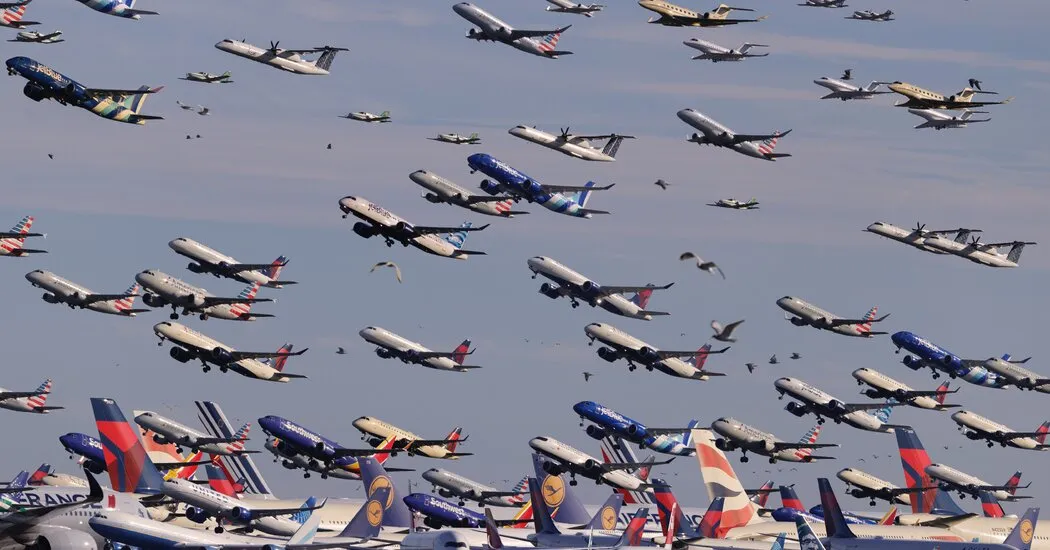
When the N.T.S.B. did release its findings a year later, it found that the culprit was not D.E.I. The immediate problem was the traffic jam of aircraft in the narrow air corridor between National Airport and restricted airspace over the White House and the Capitol, as helicopters and airplanes vied for operating space. But there was a broader context: The whole system was changing and growing in ways that were raising new alarms. Air traffic control facilities were chronically understaffed, and decades of deregulation and falling fares had resulted in overcrowding. Aircraft at the most in-demand hubs were taking off and landing back to back, often using authorized shortcuts to speed up traffic flow. Some of those shortcuts have led to disaster, and after the Potomac crash, the N.T.S.B. recommended 33 separate equipment and procedure changes that the F.A.A. should undertake to make future such accidents far less likely.
But more than a year and a half after the Potomac crash, the F.A.A. has not implemented one-third of these recommendations, a response the N.T.S.B. categorizes as “unacceptable.” (The F.A.A. told me that it is still evaluating how to address the other recommendations.)
When I asked Jennifer Homendy, the chair of the N.T.S.B., about the current state of the recommendations, she was blunt. “Recommendations alone don’t save lives,” she said. “Action does. And the sooner those changes are made, the safer our skies will be.”
Over the past 22 months, the rate of airplane accidents and close calls has suggested a system under enormous strain. Here is an incomplete list of the incidents we’ve seen in the months since the Jan. 29, 2025, Potomac crash:
March 5, 2025: Debris from a failed SpaceX rocket launch affects civilian airliners. Nov. 24, 2025, Louisville, Ky.: An engine rips away from a UPS cargo jet on takeoff, killing all three members of the flight crew and 12 people on the ground. Dec. 12, 2025: A JetBlue flight diverts to avoid a military tanker that had turned off its transponder as part of an operation in the Caribbean, the first of several such episodes. Feb. 27, 2026, San Antonio: A police helicopter crosses the path of a plane cleared for landing. March 2, 2026, Burbank, Calif.: A TV news helicopter wanders into the path of another landing plane. March 22, 2026, New York: An Air Canada jet strikes a fire truck that was cleared to cross its path at LaGuardia Airport, killing the two Air Canada pilots. May 17, 2026, Idaho: Two Navy EA-18G Growler electronic-warfare planes collide during the “Gunfighter Skies” air show. July 15, 2026, Pensacola, Fla.: A Navy Blue Angels demo flight comes dangerously close to civilian spectators. Aug. 4, 2026, Washington: Marine One takes off toward the path of a departing regional jet. Sept. 6, 2026, Miami International Airport: A cargo jet subcontracting to Amazon overshoots a runway on landing and kills five airport employees in an airport van.
This is an extraordinary series of lapses, by any measure. Many of these could have been mass-casualty events, and three did involve fatalities. The Marine One incident was alarming for a different reason. The two aircraft didn’t come close enough to put them in real danger, but the helicopter was carrying President Trump — and, as the N.T.S.B. later found, its crew had taken off from the White House Ellipse before National Airport’s control tower received its required three-minute departure call. (The White House, the Department of Transportation and the Pentagon declined to provide specific answers to questions I sent them.)
All of this appears to be at odds with the cardinal principles that have made modern U.S. aviation so safe.
Everyone involved in aviation has heard of the “Swiss cheese” model of safety, popularized in the 1990s by the British psychologist James Reason. The concept is simple: Each layer of protection might have a few weak points or flaws — the holes in one slice of cheese. But if you keep stacking the slices up, their holes will almost never align and permit an accident. It is this idea — of multiple, redundant what-if protections — that made 10 billion passenger journeys safe over 16 years. Among aviation professionals, the “Swiss cheese” label is now seen as somewhat quaint. (The starchy new term is “safety management systems.”) But as a metaphor, Swiss cheese is hard to beat. As the layers add up, so do the margins for safety. But if you start peeling layers away, new sources of risk are exposed.
In aviation, where safety largely comes down to simply paying attention, this raises the essential question: How alarmed should we be?
When I brought that question to Homendy, the N.T.S.B. chair, she emphasized that the U.S. air travel system remains astoundingly safe. Most anything else you do in your day is statistically more hazardous than getting on an airline flight. And then she stressed, for now. “We are seeing the vulnerabilities in real time,” Homendy told me. “We have a duty to act before another tragedy occurs.”
A Lesson in Blood
The modern history of aviation safety begins on a clear California summer morning in 1956, at Los Angeles International Airport, or LAX — then, as now, the busiest airport on the West Coast. At the time, air travel was still a rarefied experience. Barely one in five Americans had ever been aboard an airplane, compared with around 90 percent today. And those who did fly largely did so on propeller-driven craft. The dawn of the commercial jet age, via the Boeing 707, was two years away.
Airline travel in those days was slow and expensive but super luxurious. Passengers dressed up for flights as if going to church or a fancy restaurant. In-flight meals were served on white tablecloths and typically prepared on board. But at the same time, air travel was seen as so risky that many airports had life insurance vending machines near the departure gates, with policies that would pay off if the plane happened to go down. Between 1950 and 1956, there were multiple fatal airline crashes each year in the United States. When I took a transcontinental jet flight from LAX eastward for college in the 1960s, the departure-gate machine still offered coverage, worth $5,000 for each quarter you put through the slot, up to $75,000. I saw several people feed in their coins and then step onto the plane. My father, a frugal man, said affectionately that it would be a waste of money — even if it “paid off.”
I found no records of whether any of the passengers departing LAX on June 30, 1956, held insurance. But the story of what happened over the rest of the day has been carefully recorded, as one of the most important lessons written in blood.
At just after 9 a.m. Pacific Time that morning, controllers cleared Trans World Airlines Flight 2 for its eastbound departure, toward Kansas City, Mo. This plane was a Lockheed Super Constellation, with a total of 70 crew and passengers on board. Constellations served as troop transports during World War II, and they remain a favorite among aviation buffs because of the model’s distinctive, dolphin-shaped fuselage and its high triple tail. Dwight Eisenhower chose a Constellation as the original Air Force One.
Three minutes after the TWA flight took off, the LAX controllers cleared United Airlines Flight 718 to depart for Chicago. That plane was a four-engine Douglas DC-7 — a bigger and more powerful descendant of the DC-3 famous from old war movies. It carried a total of 58 passengers and crew. Its forward speed was slightly faster than the Constellation’s, but three minutes was a more-than-comfortable spacing for departures. As a routine precaution, the controllers also separated the two planes en route by 2,000 feet of altitude. The TWA flight was instructed to cruise at 19,000 feet, and the United flight — behind it but faster and overtaking — at 21,000 feet.
As often happens on summer days, the two planes began to encounter thunderstorm clouds as they went east across the Mojave Desert into Arizona. Though modern jet airliners can often fly above or around threatening weather, at an altitude of 30,000 feet or more, the piston-driven engines of that era could not lift planes nearly that high. At their cruising altitudes, below 25,000 feet, the flights were more likely than today’s jets to have to go through the weather. This was uncomfortable for passengers and potentially unsafe.
As the TWA plane neared a thickening field of cumulus-cloud buildup in Arizona, its crew requested permission to climb to 21,000 feet. They wanted to get above a cloud layer and presumably gain a clearer view of storms to avoid. The controller initially denied the request, knowing that the United plane was in the general vicinity and at the same altitude. In those days, radar did not cover remote areas like this. Neither the air traffic controllers monitoring the planes’ paths nor the crew members in either plane had a real-time radar image of where each airplane was relative to the other.
Having been denied its initial climb request, the TWA crew asked permission to climb above a cloud layer — to go “on top” — and then assume responsibility for their own route under visual flight rules, or V.F.R. The controller approved the request and reminded the TWA crew that they must maintain visual separation — that is, see and avoid anything else in their path.
This kind of “V.F.R. on top” is no longer permitted for airliners at cruise altitudes, largely because of what happened next. As the two planes neared the Grand Canyon, the TWA plane ascended into the 21,000-foot flight corridor the United plane already occupied. Again, in those days no radar or electronics alerted anyone to the planes’ disastrously converging paths. Cockpit ergonomics worsened the problem. Aircraft of that era had smallish porthole-like cockpit windows and a limited view of where they were heading. The United crew had no glimpse of the TWA plane climbing up in front of it. Until it was too late.
At roughly three miles above the ground, the United plane ran into the Constellation that had suddenly appeared before it. The powerful propellers on the DC-7 cut through the Constellation’s distinctive triple tail. Neither plane could stay in the air. Both plummeted toward the floor of the Grand Canyon. Later investigation indicated that some people aboard might have survived the initial collision and could have been alive through the moments of descent. They must have known they were falling toward their certain deaths. None of the 128 passengers or crew members survived.
It is every flier’s worst nightmare. And for aviation it was a turning point.
‘A Watershed Moment’
Here’s what changed after that Grand Canyon crash: everything.
Of course it wasn’t the end of dangerous flight, and it wasn’t the last airliner collision of the 20th century. Four years later, another TWA Constellation collided with a United DC-8 in heavy fog and bad weather over Staten Island, killing all 128 people on the two planes plus six people on the ground in Park Slope, Brooklyn.
But changes were happening. In the 1950s, the F.A.A. was established, under the Republican administration of Dwight Eisenhower and with the support of the Democratic Congress led by Sam Rayburn in the House and Lyndon Johnson in the Senate. There was virtually no partisan dispute. Nationwide radar coverage, to provide the situational awareness these two airplanes’ crews lacked, was mandated soon afterward. Rules for separating aircraft were strengthened. For instance, these days any aircraft flying above 18,000 feet — which means, essentially, any airliner or private jet you see in the sky — must fly on instrument flight rules, following flight-path and altitude instructions given by controllers. The F.A.A. required black boxes so that doomed aircraft could, in effect, share the lessons of what went wrong. In 1967, Congress created the National Transportation Safety Board to reduce the chance that any such lesson might go unlearned.
As the years went by, aircraft were equipped with ground proximity warning systems, to alert their crews if they were flying too low. Airlines trained their pilots in crew resource management, to avoid confusion or miscommunication among pilots. NASA introduced its Aviation Safety Reporting System, or A.S.R.S., which is an anonymized, no-punishment system in which pilots, controllers or aviation officials could alert authorities to risks they had observed. In the 1980s, jet engines became safer and more reliable; weather forecasting became more detailed and accurate; airliners were equipped with TCAS collision-avoidance systems, which could automatically direct one plane away from another if their paths were about to intersect.
By the 1990s, many of these systems had become more precise. Better weather forecasting helped pilots avoid icing or turbulence when aloft and wind shear when close to the ground. Computerized routing helped prevent flight-path conflicts before TCAS had to kick in. There were more realistic flight simulators and more extensive “human factors” training.
In the Grand Canyon, there is now a small plaque noting the national significance of the crash site, which “represents a watershed moment in the modernization of America’s airways.” But the real memorial is the lives saved in the following decades. Step by step, investigation by investigation, reform by reform, the system kept reducing its accident rate and fatalities.
Then came the crash that signified the next major turning point and offered the next set of costly — and therefore exceedingly valuable — lessons.
‘I’d Have Freaked Out’
Around 9:20 p.m. on Feb. 12, 2009, a twin-engine turboprop flying as Colgan Airlines Flight 3407, a regional feeder for Continental, took off from Newark airport in New Jersey, headed toward Buffalo. It was a frigid winter night, and the takeoff was two hours late because of weather-related delays across the Northeast. The flight was scheduled to take about an hour.
The captain for Colgan 3407, in the left seat of the cockpit, was a male pilot in his late 40s with a troubling flying record. As a young aviator he had failed three of the check rides that are part of the standard progression toward an airline job. In my experience, most applicants pass these check rides the first time. That is because their instructors know that their own reputations will suffer if their students are not fully prepared before taking these examinations.
On repeated attempts, this pilot eventually passed. Under regulations for regional airlines at the time, he was not required to report his results when applying for a job at Colgan. But even after he began his Colgan career, he was required to repeat routine proficiency checks at least three times, because of shortcomings in basic airmanship.
By the time of that fateful takeoff toward Buffalo, the captain had more than 3,000 hours of total flight time, but just over 100 in this model of airplane. Airplanes differ in their responses to varying flight conditions, especially in their handling in unusual flight circumstances or during emergencies.
Alongside him in the cockpit, in the right seat as first officer, was a female pilot in her mid-20s, barely half the captain’s age. Her salary was just under $16,000, equivalent to about $25,000 today. Although her working base was Newark, she still lived with her parents in Seattle, and she would frequently take “deadhead” overnight flights on Colgan or partner airlines to get from her home, on the West Coast, to her work site, in the East. Records show that on the morning of the crash, other pilots observed both the captain and the first officer dozing in a crew room.
The plane took off late but uneventfully. En route toward Buffalo, it leveled off at its assigned cruising altitude of 16,000 feet. In bad weather, these midteens altitudes are a danger zone that larger planes can avoid by flying thousands of feet above them.
Once at cruising altitude, the plane encountered light icing on its exterior and activated systems to offset it. The real problems began, as they often do with icing, as the plane slowed on descent for landing. Ice on an airplane’s exterior can be lethal because it changes the aerodynamics that allow the plane to stay in the sky. An aluminum wing, meticulously tested in wind tunnels to provide maximum lift, turns into a useless slab of metal when covered with a jagged layer of ice. A fuselage coated in ice can create more drag than the aircraft’s engines can overcome. An iced-up tail assembly can keep pilots from controlling the plane’s pitch up or down. Every quarter-inch of an ice layer brings an aircraft that much closer to becoming a frigid brick pulled helplessly toward the ground.
Cockpit recordings later showed that the two pilots were chatting casually about workaday issues — pay, schedules, fatigue, family life, often with the older captain going on at length in what we would now call mansplaining — even as controllers in Buffalo were clearing them below 10,000 feet and lining them up for approach and landing. The black box recorded one especially notable response from the first officer. “I’ve never seen icing conditions,” she said, before either of the pilots knew how serious the plane’s problems were about to become. As things got worse, she told the captain that if she had ever been in these conditions, “I’d have freaked out. I’d have, like, seen this much ice and thought, Oh, my gosh, we were going to crash.”
As she and the captain chatted, their airplane was turning into that frigid brick. By the time the captain recognized the problem, the plane might already have become unflyable. But he reacted in a way that guaranteed a disastrous outcome.
When an aircraft is moving too slowly through the air to produce lift, it can enter an aerodynamic stall and begin to fall rather than glide. The instinctive human reaction at that point is to pull back on the controls, to bring the plane’s nose up and into the sky. Lesson No. 1 in flight training is about overriding that instinct, and instead conditioning yourself to push the controls forward, toward the onrushing ground. Only by forcing the nose down does a pilot have a chance of regaining enough speed to allow the plane to fly. Aerodynamic stalling is like a bicycle that is going too slowly uphill and tips over. Breaking a stall is like pointing the bike downhill to keep it upright.
As the icing got worse and the plane went farther down, the captain pulled back all the harder on the controls, unintentionally dooming those aboard. “Oh, shit,” were his words on the cockpit recorder just before impact. The two pilots died, along with the 47 other passengers and crew aboard the aircraft. The accident also killed one person in his home on the ground, just five miles short of the runway in Buffalo.
The Colgan crash took place three weeks into President Barack Obama’s first term, and like the Grand Canyon crash, it triggered a wave of reforms, requirements and safety regulations. The N.T.S.B. found that the immediate cause of the crash was the captain’s improper reaction to “stick shaker” warnings — a vibrating alert from the flight controls — as the plane entered icing conditions. The report also noted the flight crew’s chatty obliviousness to “sterile cockpit” guidelines, which instruct crews to speak only about flight issues during the first 10,000 feet of climb after takeoff and the last 10,000 feet of descent until landing.
Nearly all of the N.T.S.B.’s recommendations that followed were about the management of regional airlines, versus the tougher standards then applied for major national carriers. Legislators and the F.A.A. put many of these recommendations into action. Mandatory rest periods and off-duty hours were applied to regional crews. More training was required for icing conditions and other perilous circumstances. New pilots applying for a regional carrier were required to have much greater flight experience — 1,500 flight hours, versus 250 before. A centralized pilot database meant that an aviator who had failed standards at one airline couldn’t just quietly find another. Overall, the standards gap between major and minor carriers was reduced.
Some of these changes were controversial. For instance, the 1,500-hour requirement for new pilots made it much slower and more expensive for young people to enter the industry. (How would they accrue those 1,500 hours? For a few young pilots, in the military. For many, study at an aviation-intensive university like Embry-Riddle or the University of North Dakota, followed by a few years as a flight instructor, a crop duster, a charter pilot or some other way of being paid to build flight time.) But the effect is undeniable. Since those changes, no regional carrier in the United States had a single flight fatality — until last year, when the American Eagle plane was hit by that Army helicopter over the Potomac.
The response to the Colgan crash was the beginning of that astounding 5,830-day span between Feb. 12, 2009, three weeks into Obama’s first term, and Jan. 29, 2025, at the start of Trump’s second term.
Lessons Unlearned
Trump began tearing down the aviation safety net within hours of taking office, as part of the deregulatory blitz that had been foretold by Project 2025, the Heritage Foundation’s detailed blueprint for dismantling the federal bureaucracy. Among the flurry of proclamations and executive orders that came forth from the White House that day was a short Department of Homeland Security memo, signed by the acting secretary, informing the members of its many advisory committees that they had all been terminated, in alignment with the department’s “commitment to eliminating the misuse of resources.” Among those targets was an obscure-sounding group called the Aviation Security Advisory Committee.
ASAC was started back in 1989, in response to the terrorist bombing of Pan Am Flight 103 over Lockerbie, Scotland. Originally this group was meant mainly to coordinate antiterrorism efforts. It was in the spirit of other cross-disciplinary groups set up after the Grand Canyon crash and other tragedies, all with the goal that critical safety information would be shared rather than remain siloed. Its advisory role had expanded over time, to cover not just onboard bombs but all aspects of flight security, from insider threats to baggage screening. After the firings, Kara Weipz, the president of Victims of Pan Am Flight 103, raised an immediate alarm. “Today’s action by the Trump administration will undermine aviation security in the United States and across the globe,” she said.
During his first term, a four-year period that was part of American aviation’s accident-free age, Trump and his team largely left expert bodies like this in place. But advisory committees were precisely the sort of bureaucracy he seemed determined to trim in his second term. Seven months after Trump’s D.H.S. shut down ASAC, his Department of Transportation similarly dismantled more than two dozen federal advisory committees, citing concerns that they had “been overrun with individuals whose sole focus is their radical D.E.I. and climate agenda.” Among them was the Research, Engineering and Development Advisory Committee, or REDAC, which works essentially as a review panel for major research and development projects.
ASAC and REDAC are prime examples of the kinds of advisory groups that contribute to the Swiss cheese model that has made American air travel safe. These groups handle questions about every element of the aviation system, and they do so at a time when more and harder questions are coming up every day. “We’ll look back on choices like these as the first step in some future accident chain,” says Bruce J. Holmes, a lifelong aviator who served on REDAC and who, over more than 30 years at NASA, pioneered multiple technologies to make flying safer. The effect of the closures and suspensions, he told me, was “as disturbing as anything I have seen in my decades of work in and with the government.”
Instead, the Trump administration turned to its own experts. Soon after the Potomac crash, Sean Duffy, as the newly confirmed secretary of transportation, who oversees the F.A.A., announced “big news” on X: “Talked to the DOGE team. They are going to plug in to help upgrade our aviation system.” Elon Musk, then in the early days of leading the so-called Department of Government Efficiency, quickly responded with a promise to “make rapid safety upgrades to the air traffic control system.”
What the changes would be was unclear, but during this chain-saw era, Musk repeatedly derided Verizon, which had been awarded a 15-year, $2.4 billion contract to modernize air traffic control communications. The Washington Post reported that the F.A.A. was close to canceling the Verizon project and awarding the work to Starlink, Musk’s satellite internet service operated by SpaceX, after Musk approved shipping some 4,000 Starlink terminals to the F.A.A. At least three terminals were put into trial use, but SpaceX later said there was “no effort or intent for Starlink to ‘take over’ any existing contract.” Around the same time, Musk installed several SpaceX engineers at the F.A.A. as “special government employees” who were given government waivers to work on projects that might financially benefit Musk’s businesses, raising concerns about a potential conflict of interest. (SpaceX did not respond to a request for comment.)
As the SpaceX engineers were moving into F.A.A. headquarters, the agency fired some 400 probationary employees who had not yet won civil-service protection. Duffy posted on X that “zero air traffic controllers and critical safety personnel were let go,” but the Professional Aviation Safety Specialists union said that 132 of its members were among those who were fired. Senator Maria Cantwell, Democrat of Washington and the ranking member of the committee that oversees the F.A.A., said the agency was “already short 800 technicians, and these firings inject unnecessary risk into the airspace.”
All of this was happening as SpaceX itself elevated the risk of commercial aviation. In January and again in March, SpaceX rockets exploded minutes after launch, spewing debris over huge swaths of the Caribbean. Several flights had to be diverted, and some declared fuel emergencies because of changes in course. More than a year later, just before SpaceX went public, the F.A.A. changed its rules to allow more commercial flights to pass through areas where they faced an elevated risk of a catastrophic failure caused by debris from a failed space launch.
Even after Musk fell out with Trump and DOGE ceased operations, the move-fast-and-break-things attitude that he helped bring to Washington seems to be holding sway.
In September, Duffy and Bryan Bedford, the head of the F.A.A., announced that a new A.I.-powered air traffic modernization system, called SMART, would go into trial use in the Washington area. (The acronym stands for Strategic Management of Airspace, Routes and Trajectories.) The reaction from some airline executives was positive, but many air traffic controllers and airline dispatchers, who were unsure how their routes and landing slots would be affected, were less enthusiastic. Legislators from the Washington area asked why their busy airspace would serve as a testing ground; nearly two dozen Democrats in Congress requested that the Government Accountability Office begin an inquiry into the program. The $875 million contract had gone to a technology start-up backed by Andreessen Horowitz, the venture capital firm co-founded by Marc Andreessen, a major donor to Trump’s 2024 presidential campaign.
Maybe this system will be great. But “maybe” has never been part of the Swiss cheese model. Nothing good in aviation happens in a rush. Yet the Trump administration has also tried a quick-fix approach to one of the most persistent problems facing the aviation system in the United States: the shortage of air traffic controllers.
The problem traces to 1981, when President Ronald Reagan fired more than 11,000 striking union controllers and barred them from being rehired. Since then, Republican and Democratic administrations have struggled off and on to recruit and train enough controllers to meet F.A.A. staffing targets. The agency has filled the gap by sometimes requiring 10-hour days and six-day weeks or, as during the Potomac crash, by having one controller do the work of two.
The arguments over why this gap persists would fill an article 10 times as long as this one. The point of general agreement is that the job is hard, that it requires a special sort of temperament and outlook and that it takes a long time to train people for its demands.
In April, Duffy announced a new recruiting program drawing on a previously overlooked applicant pool: video game enthusiasts. In Duffy’s view, the gaming environment would prepare people well for the job. “If you think just what these gamers are doing on screens, and they’re talking and there’s a lot of things going on — they’re used to that,” he said at the time. “And that’s actually what you’re doing in a tower.”
Could it work? Maybe. An F.A.A. recruiting video claims: “It’s not a game. It’s a career.” It will take years to know how well the skills and temperament of a gamer predict the icy calm under stress of the best controllers. “At this point, what do we have to lose by expanding the pool?” one veteran controller said to me. But, he added, the learning curve would still be steep. “This is real life and death. It actually is different from getting shot on a screen.”
In August, Duffy announced on X that with this program, the Department of Transportation had “supercharged” the hiring process “to get the BEST & BRIGHTEST in faster” and reached the staffing target in record time. “The results are HISTORIC,” he wrote. Duffy said the department had added 2,000 candidates to the training pipeline. But he failed to mention that in May, a month after introducing the new program, the F.A.A. cut its staffing targets by 2,000 controllers. They claimed that new and improved systems, including A.I. systems, would bridge the gap.
Earlier this year, the Florida Legislature set in motion another disconcerting change: the renaming of Palm Beach International Airport to President Donald J. Trump International Airport. Such a name change is not in itself a big deal for aviation safety. But in June, the F.A.A. sent out a notice formally ordering the airport’s three-letter international identifier to be changed as well. Before, the Palm Beach airport was PBI. Henceforth, it would be DJT.
This doesn’t happen. The main airport in Beijing is still PEK, after Peking. The one in Ho Chi Minh City is still SGN — yes, for Saigon. Congress changed Washington National Airport to Ronald Reagan Washington National Airport, but it is still DCA on all the charts, and Bill and Hillary Clinton National Airport in Little Rock, Ark., remains LIT. The main exception worldwide is New York’s Idlewild airport, changed from IDL to JFK within weeks of President John F. Kennedy’s assassination in 1963.
These identifiers are so sticky because changing them means updating systems and records around the world, which F.A.A. policy says should not be done “without strong and documented justification.” There is an especially destabilizing period as aviation players make their various systems compliant, such that the airport essentially has two competing identities. One Florida pilot sued seeking an injunction against the change. “In aviation,” he argued, “even minor inconsistencies in airport identification can create safety risks during routing, sequencing and emergency operations.”
More holes exposed, another layer of safety gone.
‘Chaos and Confusion’
A strikingly high proportion of the accidents and near-misses under the second Trump administration have involved military aircraft. The Black Hawk crew over the Potomac that flew through civilian traffic without monitoring its traffic-avoidance systems. The Marine One crew that took off in the same area 18 months later, without clearance from the civilian tower. The unannounced military aircraft operations in the Caribbean, with location beacons turned off, forcing a JetBlue plane to take evasive action to avoid a collision. Even in wartime operations, military aircraft are supposed to coordinate with civilian air traffic controllers, but in these instances they failed to do so.
One of the strangest episodes took place early this year in Texas. Around 9 p.m. local time on Feb. 10, the civilian control tower at the El Paso airport received notice that, effective at 11:30 p.m., its airspace would be totally closed for 10 days. No FedEx or UPS planes. No medevac missions. No flight-school training. No commercial flights in or out — and this for a city of nearly 700,000 people some 270 miles from the next-closest U.S. airport, in Albuquerque. A Southwest Airlines plane taking off just before the closure that evening would be the last air contact between El Paso and the outer world until further notice.
Air traffic control recordings from that evening show the El Paso controller and that last Southwest flight crew asking each other variants of “What the heck?” Overnight, F.A.A. officials in Washington learned what was really going on. Without notifying anyone in the F.A.A., officials from Customs and Border Protection had fired a laser-powered anti-drone weapon system, on loan from the Pentagon, in the area around El Paso. The F.A.A. noticed the laser activity, which can temporarily blind pilots and permanently damage their vision, and out of an abundance of caution, it shut down the airspace.
By the next morning, the shutdown was lifted. “This unnecessary decision has caused chaos and confusion in the El Paso community,” the city’s mayor, Renard Johnson, said at a news conference the next morning. “I want to be very, very clear that this should’ve never happened. You cannot restrict air space over a major city without coordinating with the city, the airport, the hospitals, the community leadership.”
For days after, Trump administration officials stuck to the false story that they had “acted swiftly to address a cartel drone incursion” from Mexico, as Duffy put it in an X post. But it ultimately emerged that the laser system had been deployed by C.B.P. to shoot down a party balloon it had mistaken for a cartel drone.
Another example came this summer in Florida. A pilot for the Blue Angels, the Navy’s elite aerobatics team, miscalculated a turn during a demo flight and came dangerously close to plunging into a crowd of civilians on the beach in Pensacola. The next day, Capt. Adam Bryan, the commander of the team, said this had indeed been a dangerous and regrettable flight error, whose lessons he hoped would be instructive. He was acting like a military professional and an aviator. Defense Secretary Pete Hegseth, posting on X, took a different approach, joking that “the flyovers will continue until morale improves.”
And one other military-adjacent example: As part of Trump’s “Freedom 250” celebration on the Fourth of July, the Pentagon and NASA arranged a nine-hour flyover of the National Mall in Washington that would involve more than 100 aircraft. Among them were four vintage F-5 Tiger jets, three of which were owned by Jared Isaacman, an experienced pilot who had become Trump’s head of NASA. Isaacman wanted to include the planes in the flyover and pilot one of them himself. The F.A.A. flatly refused the request, saying that the planes were not equipped or certified for flight over heavily populated areas. Isaacman found a way to do what he wanted: He got NASA to classify the planes as operating under “public use,” which put them outside F.A.A. jurisdiction. According to numerous news reports, several senior Trump officials had hoped to ride along in the planes. Todd Blanche, then acting attorney general, was the one who ended up in the taxpayer-funded flyover.
In the same spirit of spectacle, two days before Halloween the White House posted a video of Trump waving as the Qatari-donated 747 that has been serving as Air Force One flew at very low altitude over the White House. The airspace over the White House is the most tightly restricted in the country. The Washington Post reported the plane’s altitude during the flyover at between 400 and 1,000 feet, closer to the ground than any commercial flight would ever be allowed to fly over a city, unless it was taking off or landing. The White House post called it “an epic Air Force One flyover at the White House for the trick-or-treaters!”
‘Significant Potential for Collision’
What does all of this add up to? By every statistical measure, U.S. air travel remains phenomenally safe. More Americans died in traffic accidents in the 24 hours after the Potomac crash than were killed in aircraft that night. But the foundations of that phenomenal safety record may be cracking, and the dangerous consequences are showing up.
We have been so safe, for so long, because of profound commitment from people at every level. Most of them are invisible to passengers. We see the flight crew and the cabin attendants, and we may watch the ground crew through the windows with their lighted batons. But there are 10 times as many people we never see, who are at least as responsible for the safe arrival of each flight. These include the airlines’ dispatchers, who act as a kind of duplicate pilot on the ground and who are constantly assessing flight paths to maximize speed and minimize weather disruption. There are the weather specialists and the maintenance crews, who know that each bolt and gasket might be the subject of an N.T.S.B. report. The check-pilots and simulator trainers. Medical staff. It amounts to a team of hundreds working on each flight.
Nearly all of these people have internalized the idea that life-or-death outcomes could depend on them. That was something that impressed me about aviation culture when I was learning to fly in the 1990s. The teenage “hangar rats,” driving refueling trucks at small airports while earning money for flight school: What if they threw the wrong lever and pumped Jet A fuel into a plane that flew on 100LL? The pilots might not know until they tried to take off and had their engines fail at a fatal 1,000 feet above the ground. The flight instructor clearing a trainee pilot for “first solo” — and knowing that if things went wrong, the instructor would be part of the accident chain. The flight attendant who got tired of nagging huffy passengers to be sure their laptops were stowed for landing and then saw one become a deadly projectile after wind shear put the plane into a sudden low-altitude dip. The right-seat first officer who suspected that his left-seat captain was having a mental or medical crisis but hesitated to take command. They’re all thinking: How would this look in the N.T.S.B. report?
I’ve spoken to many such people about air safety since Trump began his second term, and they are concerned, some very concerned, about the trends. “Everything is fraying around the edges, and nobody knows which thread will cause the whole thing to fall apart,” says Michael C. Planey, an aviation and transportation consultant in the Washington area.
When Homendy, the N.T.S.B. chair, testified to Congress about the Potomac crash, she said she had noticed something different about the aviation culture of facing hard truths. “Throughout our investigation, we found numerous people were afraid to talk to us,” she said. “I can’t tell you the number of people who were just scared to speak up because they were worried about retaliation.”
Instead, they are all anxiously watching the runways, which is the most dangerous place for an airplane to be. The risk of hitting another plane in this narrow space is much greater than a collision in the sky. That is why the most significant measure of aviation safety may be the “runway incursion” or close-call rate. And the most serious of these events are classified as Category A (“collision was narrowly avoided”) and Category B (“significant potential for collision”).
In early 2023, as air travel rebounded after the pandemic, the United States had a string of five frightening runway incursions. By the end of the year, there was an alarming total of six Category A and 16 Category B episodes. The F.A.A., the N.T.S.B. and the airlines had formal “safety summits” and searched for lessons not yet written in blood.
In 2024, thanks to this heightened awareness and tightened procedures, the rate of close calls went down. By the end of 2024, the F.A.A. reported a major decrease in serious incursions: two in Category A, and five in Category B, for a total of seven. People in the system worked together, and they learned from their mistakes.
The following year, as Trump, Duffy and Hegseth took command and were further enabled by Musk’s DOGE, the serious-incident rate shot up again. By the end of last year, the F.A.A. reported four Category A incidents and 10 in Category B. The total of 14 was twice as high as in 2024.
And so far in 2026? Through October, the United States is on roughly the same path as last year, with six incidents in Category A and three in Category B.
This is what happens as safety layers are peeled away. Someday our luck will run out.
Aviation is full of maxims. One of the best known among pilots is attributed to the British World War I aviator A.G. Lamplugh: “Aviation in itself is not inherently dangerous. But to an even greater degree than the sea, it is terribly unforgiving of any carelessness, incapacity or neglect.”
How alarmed should we be? Enough to insist that today’s leaders recognize the miracle of air safety in all its robustness and all its fragility. “This is why we do investigations,” Homendy told me this fall. “So we can tell people ahead of time: This is where we’re headed. This is where the risks are.”
James Fallows is the author of 12 books, including three about aviation. His book “Our Towns,” written with his wife, Deborah Fallows, was the subject of an HBO documentary. He writes the “Breaking the News” newsletter on Substack.
The post Is Air Travel Getting Less Safe? appeared first on New York Times.