Welcome to The Midterms, Actually, where every week I write about two things: one big idea or trend I see and one thing I’m hearing from a voice on the ground. We’ll be taking a break for the rest of this year, but will be back to cover the key issues and people leading up to the 2028 election in the new year. Stay tuned!
One big idea
This Tuesday, just a week after voters delivered Democrats resounding midterm victories across the country behind a message of accountability and anti-corruption, Washington’s aversion to listening to voters reared its ugly head.
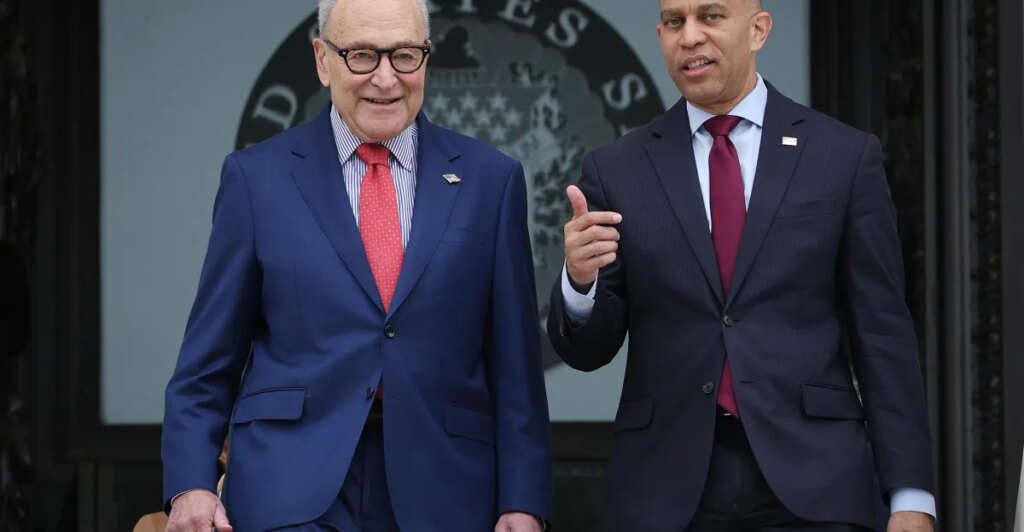
Eleven House Democrats missed a vote on impeaching Defense Secretary Pete Hegseth, dooming the effort to fail and inflaming the calls for congressional Democrats to embrace new leaders, beyond Hakeem Jeffries in the House and Chuck Schumer in the Senate.
But the missed vote, which was condemned by progressives and moderates alike, also highlights a divide in the party beyond the traditional ideological camps. While “moderate” and “progressive” Democrats fight over which candidates performed better in last week’s midterms, and project those fights onto the congressional leadership debate, I’d say the bigger gap is between an anti-establishment electorate and a Washington blob stuck in the old ways of doing business.
Just think of what unified winning Democrats across the board on Election Day — candidates from James Talarico in Texas to Annie Andrews in South Carolina, from Abdul El-Sayed in Michigan to Scott Colom, who leads a still-uncalled race in Mississippi — they didn’t just run against their Republican opponents, they ran against the status quo of both parties, and a political establishment that’s become too captured by outside interests and too self-satisfied with its approach to affect tangible change. The message wasn’t just that the economy is rigged against you, it was that the political system has also been rigged, captured by monied interests and a self-interested political class.
I’ve been a broken record on this point, but this is why I find it more helpful to see this election through the lens of top versus bottom, not right versus left. That is not just a framework that can help you see how Democrats succeeded electorally, but also explains how you get candidates like Colom in Mississippi or Sen. Elissa Slotkin of Michigan now calling for a change in leadership.
Slotkin made the case for a bolder version of Democratic “moderates” on our podcast in October. “I don’t think the divide is moderate versus progressive, particularly in the era of Trump,” she told me. “I think it is fight versus flight.”
Then, at a press conference with Bernie Sanders on Tuesday, she called for a “new generation of leadership.” She wants a leader who will govern for the whole caucus — blue, purple, and red states — and has asked for a full plan on the new majority’s priorities. Until then: “I’m a no until and unless I see that from anyone,” the Associated Press reported.
And here’s what said on this point back in March: “Leader Schumer, Leader Hakeem Jeffries, they’re both from the same borough,” Colom told Semafor, arguing the party needs leadership that understands rural America. Since the election, he has stayed noncommittal on Schumer, calling instead for more geographic diversity among party leaders, per the AP.
The charge for Democrats going forward wasn’t only about issues like anti-war, AI regulation, and lowering the cost of living, it was also to more robustly use the levers of power to frontally oppose this administration. One of Schumer’s biggest points of tension with Democrats was his refusal to shut down the government early in Trump’s term to challenge DOGE, and, later on, his failure to keep moderates united behind a shutdown that appeared to be putting real pressure on the administration to change its policies. That isn’t about right or left — that’s a call for more creativity on how politics are done.
I’m skeptical of the efforts to find a Jeffries or Schumer replacement in the short term. Washington works on access and relationships, first and foremost, and the uncomfortable reality is that, by the very nature of so many fresh faces, the anti-establishment wing of Democrats is at a deficit of options.
However, I’m fairly sure that even in the event of a Schumer- and Jeffries-led caucus, the pressure on congressional Democrats to meet the moment of voter anger won’t disappear. Because the Election Day win wasn’t just about the Democratic left, or its moderates, or arguments about electability — it was about change, and a voter-led outcry that is driven by backlash to this administration, but not solely defined by it.
It reminds me of what David Axelrod said on our show after the election. He reminded people that Democrats’ most successful electoral period — the Obama era — was built off an anti-establishment message, one that rejected the timidity, partisanship, and small-minded infighting between special interests that voters had come to loathe:
Barack Obama…was really fundamentally an anti-establishment candidacy. He was challenging the politics of both parties and the incumbent politics of Washington. … And I think that is the mood of the American people right now.
And here’s what he said about Jeffries/Schumer:
I’m not sure that they will take this advice, but I would be humble if I were them, because this victory was delivered by the American people. This victory wasn’t engineered in Washington. … They’re not sending people there to affirm status quo politics for Washington. They’re sending people there to change it.
Exactly.
What I’m hearing
Democrats won big around the country last week, but perhaps no state was more important — symbolically, politically, and substantively— than Texas. We asked the Texas Tribune’s Gabby Birenbaum to help walk us through just how an iconic red state swept Democrats into office up and down the ticket.
Texas has delivered Democratic wins for both Senate and governor. What are you hearing from people this morning, and was there a conversation or moment in your reporting that helped you understand how this happened?
I think there was very much an awareness that Talarico was in the driver’s seat for Senate, with cautious optimism from Democrats and concern from Republicans. But the idea of a statewide sweep was on the absolute far edge of people’s models, if on their radar at all. I think one of the biggest things I’ve been returning to today is what I heard from lifelong, more Bush/Cornyn-aligned Republicans on the trail this year. They couldn’t get there on Paxton. But more than that, a lot of them wanted to teach their party a lesson — that they should stop bullying them and then taking their votes for granted.
“People will be watching closely to see if their lives improve in the ways Democrats have promised.”
Talarico made his Christian faith central to his campaign, and there’s already talk of a resurgent religious left. How did that message land with the voters you spoke with? Did you see it reach people who wouldn’t ordinarily consider voting for a Democrat?
I think it worked in two ways. It gave a permission structure to nondenominational, more mainline Christians, especially soft Republicans and independents, to support him. And interestingly, Catholic Latino voters raised Talarico’s faith to me frequently. They said they appreciated that he was open about his faith.
Gina Hinojosa also defeated Greg Abbott. In your reporting, what connected these two victories? Were voters responding to the Democrats’ messages, turning against Republican leadership, or some combination—and which issues kept coming up?
I think asking for a fourth term is always difficult — especially so when people are frustrated about the economy. At the statewide level, one Republican described it to me as there being a Republican liability for every voter. Suburban moms were mad about Texas’s embrace of school vouchers. Seniors, veterans, and young people were mad about the THC ban. Rural voters were angry about data centers and the costs they felt in their communities of growth. And I think Hinojosa gave a lot of independents and soft Rs permission to vote for her by focusing on a populist, economic vision, jettisoning anything that could fall under culture wars.
The headline this morning is that Texas “turned blue.” From what you’re seeing locally, what does that description capture, and what does it miss? What are voters expecting these wins to change in their lives?
It undeniably did turn blue — it wasn’t one just one race, it was uniform. But I think what’s worth noting is that there are scores of Republicans and independents who decided, for the first time, to give Democrats a chance at the statewide level, for governor, or attorney general or even agriculture commissioner. People will be watching closely to see if their lives improve in the ways Democrats have promised — lower costs, better schools, rooting out corruption.
The post What the Democratic leadership fight is really about appeared first on Vox.