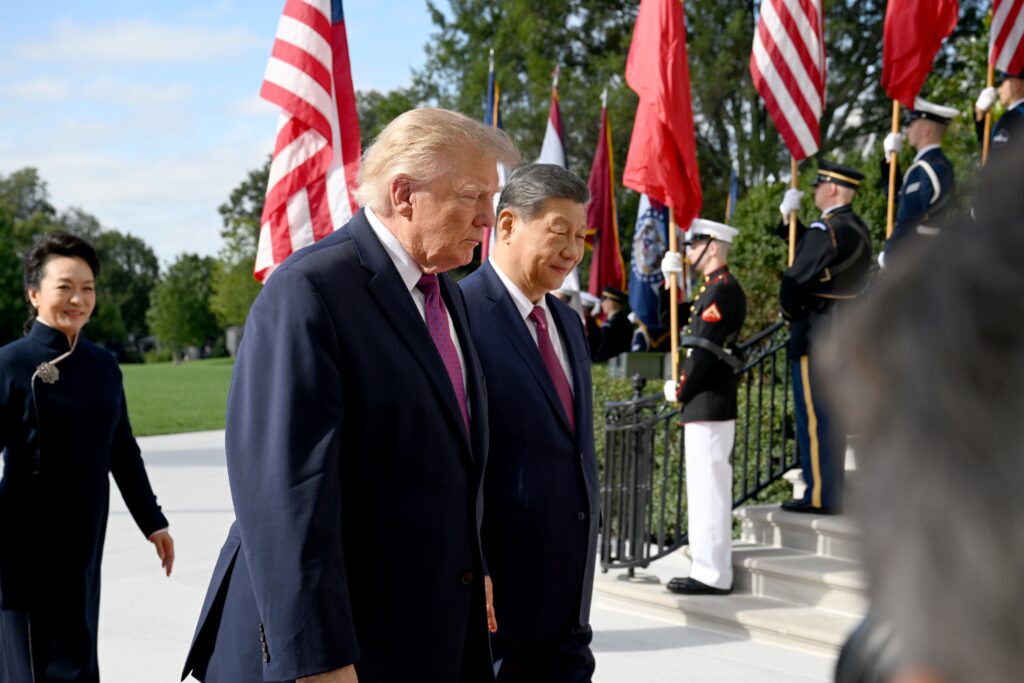
Just a week before President Donald Trump is expected to meet Chinese leader Xi Jinping in Shenzhen, a burgeoning espionage scandal is exposing a contradiction at the center of his approach to America’s chief military and economic rival.
Throughout his second term, Trump has repeatedly warned that the United States cannot afford to fall behind China in the race for artificial intelligence, invoking the threat from Beijing to justify opposition to regulation of the rapidly advancing technology. Yet he has approved the sale of advanced technology to China that hawks in his administration argued could help Beijing close the technological gap with the United States.
And when allegations emerged that Chinese intelligence had successfully targeted Jensen Huang, one of the most influential executives in the technology industry and a man with close ties to the president, Trump appears to have taken little action.
In May, when Trump went to China, Secretary of State and national security adviser Marco Rubio warned him that the U.S. had obtained intelligence that showed Huang was having an affair with a woman believed to be a Chinese spy, according to a person familiar with Rubio’s briefing, who was not authorized to speak about it publicly. That timeline contradicts Trump, who on Monday denied to reporters that he had been aware of the situation at the time of the trip.
Rubio delivered the message aboard Air Force One, shortly before a stop in Anchorage, where Huang boarded the plane as a last-minute addition to the trip. The briefing was first reported by the New York Times.
The briefing was at least the second time Trump had been warned about the case, the Times reported. Rather than distancing himself from Huang, Trump brought him on the trip, continued their regular phone conversations and frequently appeared with him at public events.
Trump resisted being pinned down Monday when reporters asked him when he first was told that Huang was having an affair with a woman whom U.S. intelligence had evidence was a Chinese spy.
“Certainly, it didn’t make much of an impact on me,” Trump said.
Trump also said he does not plan to raise the matter with Xi during their summit next week and left open the possibility that Huang could accompany him on the trip.
Trump’s muted response underscores the competing priorities that have defined his China policy, as his warnings about Beijing’s technological ambitions collide with his close relationships with American tech executives and his desire to preserve a fragile diplomatic thaw with Xi.
Few executives have wielded more influence over Trump’s China policy than Huang, who has lobbied with considerable success to preserve Nvidia’s ability to sell some of its computer chips to the lucrative Chinese market. Huang has become a frequent presence in the president’s orbit, even as his efforts have repeatedly put him at odds with China hawks within the administration.
When Trump hosted a state dinner for Xi during his September visit to the U.S., Huang and his wife sat at the head table with Xi, Trump and a handful of other executives.
“For other presidents, [the scandal] might have led to some kind of strong reaction, but I think Trump’s attitude for this kind of stuff is that they do it to us, we do it to them. What’s unusual?” said Victor Shih, a professor of Chinese politics at the University of California at San Diego. “I don’t think Trump would like to disrupt what he sees as achievements in the past two summits between the two leaders.”
Huang’s close relationship with Trump was part of what made him such a valuable target for China, said Craig Singleton, senior fellow at the nonpartisan Foundation for Defense of Democracies.
“That access ran both ways,” Singleton said. “A trusted relationship with Huang could have helped Beijing influence U.S. decision-making on chip controls by shaping the arguments he brought to the president and could have informed Beijing about Washington’s plans and intentions.”
Democrats criticized Trump for not taking action when he was informed that Huang was the target of a spy.
“What a dereliction of duty. He’s supposed to protect America, not China, not his friends,” Senate Minority Leader Chuck Schumer (D-New York) said Tuesday on the Senate floor. “Trump has been busy trying to defend Jensen Huang when he ought to be defending our national security. It’s that simple, it’s obvious.”
Top Democrats, who will have a majority in both the Senate and House in the new Congress, have called for tighter export controls on U.S. chips. They redoubled those calls in response to the revelations about Huang.
The export of semiconductors to China is a “matter of immense national security importance,” said Rep. Jim Himes of Connecticut, the ranking Democrat on the House Intelligence Committee.
“We are aggressively pursuing more information to understand what happened and whether the decision-making process to export chips was improperly influenced or compromised,” Himes said.
The allegations could also provide further ammunition to the administration’s China hawks, who have disagreed with Trump’s decisions to allow Nvidia to ship some of its less advanced chips, H200s, to China.
Nvidia and Trump’s former AI and crypto czar, David Sacks, have argued that it is beneficial for the Chinese AI industry to be dependent on a U.S. company for chips.
“Whatever the investigation ultimately finds, his credibility in Washington now faces serious questions,” Singleton said. “Even if his policy positions were entirely his own, the suspicion of Chinese intelligence influence could make those arguments much harder to sell.”
If so, the alleged Chinese espionage operation may have backfired “spectacularly,” Singleton said.
So far, however, Trump has backed Huang and signaled that he will not allow the episode to derail the summit in China and Xi’s planned visit next month to the Group of 20 meeting of the leaders of the world’s largest economic powers, which will be held at the Trump National Doral Golf Club.
China has dismissed the allegations as “groundless” and an attempt to smear Beijing. Chinese state media have suggested that the leaks about the allegations may have been deliberately timed to undermine a fragile thaw in U.S.-China relations.
“Given the hard-won easing of tensions between China and the U.S. … is someone behind the scenes pushing an agenda and stirring up confrontation?” the Communist Party-backed Global Times asked Monday, drawing parallels with the 2023 Chinese surveillance balloon incident, which prompted then-Secretary of State Antony Blinken to postpone a planned visit to Beijing.
The muted responses from Beijing and the White House suggest the scandal is unlikely to substantially disrupt the summit, analysts said.
“Either Trump doesn’t necessarily care about this very much or still trusts Huang to a degree,” said Sam Bresnick, a research fellow at Georgetown University’s Center for Security and Emerging Technology.
Cate Cadell, John Hudson and Joshua Yang contributed to this report.
The post Spy scandal highlights contradictions at heart of Trump’s China policy appeared first on Washington Post.