President Donald Trump is poised to begin building a 250-foot-tall arch — the moment a federal court lifts an order pausing its construction.
Trump continues to want the arch, potentially emblazoned with his slogan, “Golden Age of America,” built outside the gates of Arlington National Cemetery, administration officials say. To do so, however, he’ll have to navigate new roadblocks: an incoming Congress that has vowed to oppose his projects, federal judges wary of how Trump outraced the courts to build his White House ballroom and growing resistance from Washington’s residents and leaders.
“The people of D.C. do not support this 250-foot arch,” Mayor-elect Janeese Lewis George said in a statement to The Washington Post, adding that the arch could harm local traffic, emergency evacuation routes and the “sacred” military cemetery itself.
George’s statement sharply contrasts with Mayor Muriel E. Bowser’s silence on the topic for most of the last year.
Trump is set to visit the cemetery on Wednesday to mark Veterans Day. His motorcade’s likely route will take him around Memorial Circle, the traffic roundabout tucked inside Washington’s boundaries where the president hopes to build his arch.
Since he was first pitched on the idea last year, the president has prioritized the arch more than most of his other construction plans, placing it alongside the ballroom in his pantheon of legacy projects. Administration officials say he’s drawn to the arch by its size, dramatic sweep and comparison to the Arc de Triomphe, the 164-foot-tall Parisian monument that the president has long admired and hopes to surpass.
Administration officials sometimes refer to the project not as the “Triumphal Arch,” but by a different name: the Trump arch.
“It’ll be one of the great things we’ve ever done,” the president said in remarks last week.
The fight over the arch has stretched for more than a year, with administration officials and their opponents strategizing over how to turn the president’s vision into reality — or to stop construction before it can start.
Mark Paoletta, a White House lawyer, immersed himself in decades of history about local construction projects to craft the administration’s legal theories, publicly defended Trump’s new arch and helped shepherd it through a federal review, officials told The Post, speaking on the condition of anonymity to discuss internal deliberations.
Local leaders and advocacy groups have countered with lawsuits claiming the new arch will degrade the experience of visiting Arlington National Cemetery, cause other harms and violate multiple federal laws. Nine members of the Kennedy family filed their own suit on Tuesday, citing a Post analysis that the towering arch will cast shadows on John F. Kennedy’s grave site and other graves in Arlington National Cemetery.
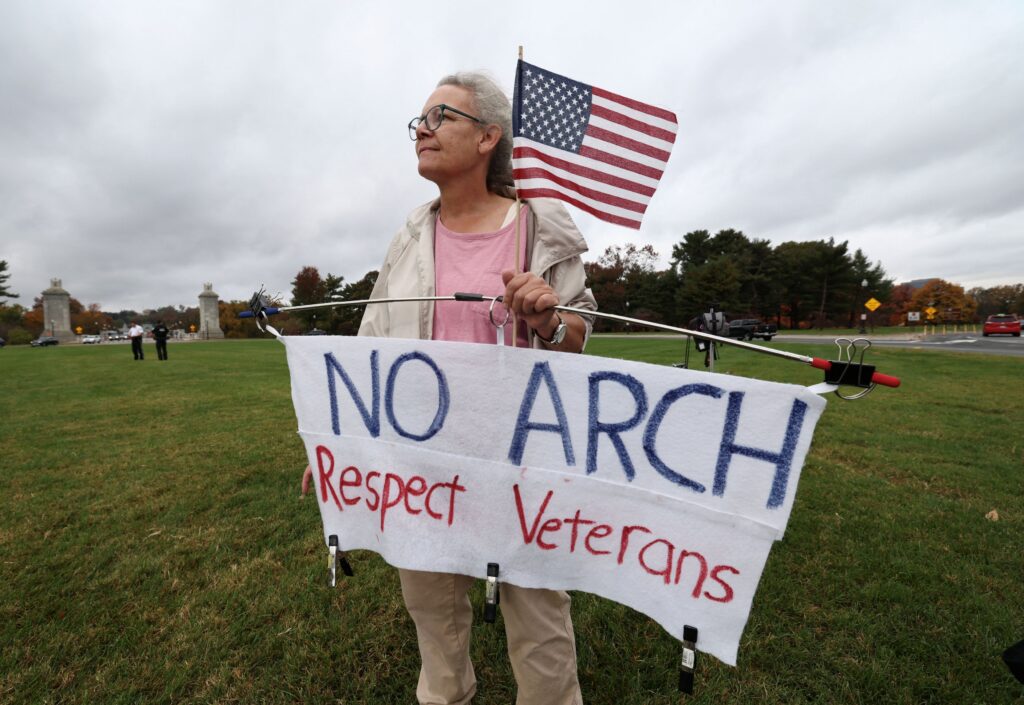
Dozens of retired Washingtonians have also held regular protests at the circle, trained to nonviolently resist construction crews and organized other activities intended to deter the project.
“We’re working nonstop to prevent Trump from moving forward,” said Joanne Vine, a retired D.C. resident who helped organize a local group dubbed the “anti-archers.”
Both sides have also appealed to military veterans, some of whom have said they believe the new structure will honor their service, and others who say it will disgrace the cemetery. Local and national leaders of the Vietnam Veterans of America have broken over the issue.
And both sides achieved momentary victories on Thursday.
A federal commission, led by Paoletta and packed with Trump political appointees, approved the arch following eight-plus hours of public comment, teeing up construction nearly 400 days after the president first hinted publicly about the project. Administration officials said a contractor was prepared to start work immediately.
Minutes later, U.S. District Judge Tanya S. Chutkan ordered a halt to any arch-related work, siding with a lawsuit filed several days earlier by the D.C. government and the commonwealth of Virginia.
“The District and Virginia face tangible economic harms from the construction of the Arch,” Chutkan wrote in her opinion, issuing a pause while she weighed the litigation. Her final ruling could come later this month.
A White House spokesman dismissed the ruling from Chutkan, an Obama appointee, as the work of an “activist district court” and predicted the project, “a tribute to 250 years of American greatness,” would proceed.
“We are confident we will be fully vindicated as this litigation proceeds and look forward to seeing the completion of this magnificent Arch,” spokesman Davis Ingle said in a statement.
The case over Trump’s arch could follow a similar path to his ballroom — all the way to the Supreme Court. In August, five conservative justices allowed work on the ballroom to go forward, concluding that a historic preservationist likely could not prove that she was harmed by its construction, even while declining to rule on the project’s legality. Chief Justice John G. Roberts Jr. and the court’s three liberal justices dissented and said that the ballroom was likely illegal because it had not been authorized by Congress.
Because the justices and lower-court judges allowed construction to go forward while litigation continues, Trump’s ballroom has steadily risen on the White House grounds. The president last week celebrated the installation of its “final beam,” and much of the project is expected to be completed before a final ruling on its legality.
Several federal judges, including Chutkan, have taken note of Trump’s ballroom push and have warned administration officials not to try to end run the courts on other projects. Chutkan also told Trump officials last month that she was skeptical of their recent invocations that the arch is needed for national security, echoing an argument that helped expedite Trump’s ballroom project.
U.S. District Judge Ana Reyes, who has been hearing challenges to Trump’s proposal to take over East Potomac Park for a championship-level golf course, has accused the administration of misleading her after officials cut down hundreds of trees at the course but testified that it was not connected to Trump’s plans to remake it.
“There is no universe in which all of this coincidentally happened all at the same time,” Reyes said during a hearing last month. She has since named a special master to investigate whether administration lawyers committed ethical violations.
Trump and his allies have said that his arch is legally justified and a necessary addition to a partially manmade island, formerly known as Columbia Island, that sits between the Arlington Memorial Bridge and the military cemetery. Past lawmakers and planners who built the bridge envisioned a structure at the site, but Memorial Circle has instead sat empty.
Paoletta last year wrote a memo that said the U.S. Congress’s decision in 1925 to authorize a pair of 166-foot-tall columns at the site had not expired, that federal commissioners had discretion to make changes to the design, and that it could be the legal groundwork to move forward on Trump’s arch, according to White House officials who spoke on the condition of anonymity to discuss internal conversations. His memo has not previously been reported. The administration subsequently released a plan for a 250-foot arch comprising 166-foot-tall columns topped with an additional 84 feet of pedestal and statuary.
Paoletta and his team also uncovered decades-old correspondence and statements from past leaders who said that work on the site was unfinished, including from Gilmore D. Clarke, a landscape architect who chaired the U.S. Commission of Fine Arts, and Ulysses S. Grant III, a retired major general who helped oversee the construction of the Memorial Bridge.
“The central plaza on Columbia Island has never been undertaken and seems to be absolutely essential to link together the two parts of the project, namely, the main bridge itself and entrance to Arlington Cemetery,” Grant wrote to the head of the National Park Service in 1947.
Under Trump’s watchful eye, the project has sped through required federal reviews this year. The Commission of Fine Arts approved it in May, and the National Capital Planning Commission, advanced it in July. Both commissions, which historically included a mix of bipartisan experts, have been remade by Trump and dominated by his appointees.
Trump in August named Paoletta to lead the planning commission, installing him in a six-year term.
Ahead of the commission’s Nov. 5 vote on the arch, Paoletta publicly championed the project in an article and on social media, swapped out two career civil servants who sat on the commission for Trump political appointees who would speak up to defend the project, and held a private executive meeting of the commission intended to resolve lingering issues and expedite approval, White House officials said.
One of those officials defended the decision to install more Trump appointees on the commission, saying it was part of a broader push for political appointees to take controversial votes and protect career civil servants from criticism.
The administration also has sought to reframe the arch as a way to honor military veterans, with the White House reaching out to some veterans’ groups that subsequently endorsed the project. The administration worked with two GOP lawmakers who are military veterans, Reps. Andrew Clyde (Georgia) and Brian Mast (Florida), to testify at last week’s commission hearing.
“President Trump’s triumphal arch will honor our nation and her noble veterans and demonstrate what our nation cherishes the most,” Paoletta said as he announced his vote Thursday for the project.
The president, who officials say has asked for frequent updates on the project, turned to Paoletta at an event celebrating Columbus Day at the White House last month.
“I see my Italian lawyer over here,” Trump said to Paoletta. “He’s so vicious. How are we doing? We’re going to win the case?”
Like the battle over Trump’s ballroom, his arch has drawn opposition from architects, advocacy organizations and preservationists, who call it inappropriately large, distasteful and illegal because it has not been explicitly authorized by Congress. It has also mobilized opponents, who say they are determined to stop the new project after watching Trump rapidly demolish the White House’s East Wing last year.
Vine, a retired marketing and publishing executive at several D.C.-based organizations who leads the “anti-archers” group, said that volunteers coordinate over Signal, an encrypted messaging applications, with different teams standing by to protest and offer other support. The volunteers include members of local groups known as Kalorama Connects and Third Act.
“If Chutkan hadn’t ruled, we were prepared to go the circle” to non-violently block construction, she said. “About 20 or 30 of us were prepared to be arrested.”
Vine has also worked with fellow arch opponents, including Rep. Jared Huffman (D-California), who is poised to chair the House Natural Resources Committee as Democrats take control of Congress next year. She said she is optimistic that Huffman and his colleagues will impose new barriers on the arch.
“We’re hoping we can just delay this to January 3, when the new Congress is seated and it will be harder and harder for Trump,” she said.
Trump also is set to face more scrutiny from the city’s elected leaders.
Lewis George, the incoming mayor, told The Post in her statement that she would “work with President Trump to improve the lives of DC residents. For example, I won’t stand in the way of fixing outdated infrastructure like water fountains.”
But the arch was a different matter, she added in her statement. “I stand with Attorney General Brian Schwalb,” who filed suit last month to block Trump’s project, she said.
A spokesperson for Bowser, who did not sign on to the suit, referred questions about her stance to Schwalb’s office, which Tuesday night filed new declarations on how the arch would disrupt traffic and emergency plans. City leaders have not sued to stop Trump’s other construction projects.
The Trump administration has not been dissuaded by the shifting political dynamics and new litigation.
A day after Chutkan’s order to block the arch, the White House touted a a new website on social media, triumphalarch.com, established by a group known as the United States Triumphal Arch Foundation.
The website also debuted new renderings of the arch, including the structure emblazoned with large letters — “Golden Age of America” — that would replace a different slogan, “Liberty and Justice for All,” that had been approved by federal commissions. The new slogan is a favorite term of Trump’s.
Randy Evans, who leads the foundation and served as U.S. ambassador to Luxembourg in Trump’s first term, referred questions to the White House, which said that the foundation was an outside group and did not speak for the president.
A Monument to the American Spirit. The Military Triumphal Arch will honor the heroes who gave everything for our nation – a monumental tribute to America’s first 250 years & a symbol of the next 250. A legacy of freedom. A future without limits.
https://t.co/vkquwA5qGp pic.twitter.com/ucUPdw3YLL
— The White House (@WhiteHouse) November 6, 2026
The post Inside the fight to build — or block — Trump’s triumphal arch appeared first on Washington Post.