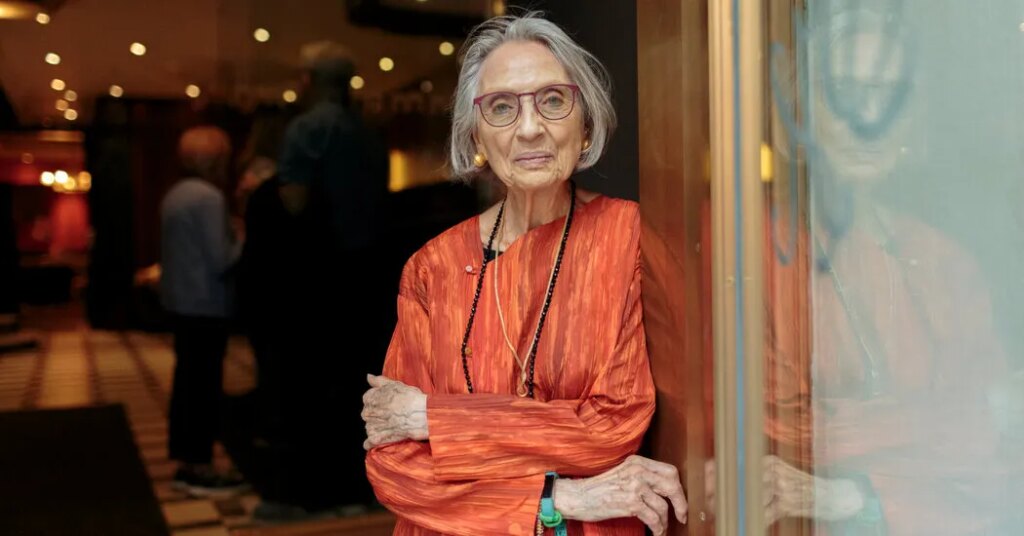
Rita Paul, who scrubbed away the decrepitude of her family’s Greenwich Village flophouse without sacrificing its spirit, ong maintaining the establishment as one of New York City’s few beloved old hotels that was independently run, died on Monday at her home in the Village. She was 99.
The cause was congestive heart failure, Ms. Paul’s daughter, Judy Paul, said.
As a rare intact remnant of Greenwich Village’s bohemian past, Ms. Paul’s hotel was known as the Washington Square Hotel. At its founding, in 1902, it was called the Hotel Earle.
In the following 124 years, the hotel was a gracious accommodation for P.G. Wodehouse and Ernest Hemingway; a fleabag for folk singers like Bob Dylan and Joan Baez and punk rockers like Patti Smith; an inspiration for canonical artworks in music, literature and film; and then an improbable holdout of local history as its peers modernized, sold out or vanished.
The Algonquin Hotel, for example, renovated its storied lobby into sleek unfamiliarity. Much of the Plaza was converted into a condominium. Stanley Bard was ousted from his eccentric management of the Chelsea Hotel. The Carlyle is now one of many Rosewood Hotels & Resorts.
Finally, in 2025, after 52 years of ownership, the Paul family — Rita; her daughter, Judy; and Judy’s husband, Marc Garrett — accepted an offer to sell the Washington Square Hotel.
For $29 million — a $23 million profit after paying off mortgage debt, Judy Paul said — the family sold the hotel and its adjoining restaurant, North Square, to Henry Kallan, who runs the Library Hotel Collection, a boutique hotel chain. He was joined by Sean MacPherson and Ira Drukier, who own several other New York hotels, including the Chelsea Hotel.
The deal stipulated that some of the hotel’s old character will be preserved, above all Rita Paul’s contribution to it, Judy Paul said.
An artist who shied away from Manhattan galleries, wishing for a less cutthroat venue for self-expression, Rita Paul had a sensibility distinctly suited to a restoration of the hotel. By the time she arrived there, the Earle’s refinement had sunk into squalor.
In the era of the hotel’s founding, novels by Henry James and Edith Wharton suggested that the most distinguished residential precinct of New York was Washington Square Park, whose northwest corner the hotel occupies. Early on, it hosted banquets and offered guests reading rooms.
By the 1950s, when the hotel opened a jazz room, The New Yorker’s Goings On About Town section described the setup as a “faintly bleak bar” for hearing “the melodies you thought everyone but you had forgotten.”
In 1961, two young folk revivalists moved in: Ramblin’ Jack Elliott and his protégé, just arrived from Minneapolis, Mr. Dylan. Ms. Baez also had a stint at the Earle with Mr. Dylan, a period she later memorialized in her song “Diamonds and Rust.”
Around that time, Patricia Highsmith, the novelist best known for “The Talented Mr. Ripley,” was using the Earle as a quiet place for trysts. Its seedy charm inspired her short story “Notes From a Respectable Cockroach,” in which an insect whose family has lived on the premises for “at least two or three hundred generations” laments that the crumb quality has “degenerated.”
The Earle’s most famous artistic manifestation was probably in the Coen brothers movie “Barton Fink” (1991), in which a pretentious writer of the 1940s stays at a hotel named the Earle seeking working-class authenticity but finding instead crime and disillusionment.
In the 1970s, the Earle remained a stopover for some young artists — the B-52s lodged there while in town to play at CBGBs — but mostly it was a “dump” for “petty criminals” and “crazies,” Ms. Paul told The New York Times in a 2022 profile.
Its residents, mostly welfare recipients, ranged from a 93-year-old former showgirl and magician’s assistant in a “roach-ridden room,” The Times reported, to a man accused of attempted murder for lighting his sleeping roommate on fire.
The Paul family spent $900,000 in 1973 to buy the Earle — two conjoined nine-story buildings along with a three-story annex that could accommodate 165 rooms. Seven years later, the Pauls moved in themselves. “We had a lot of empty rooms,” Ms. Paul told The Times.
She took on the title of the hotel’s “artistic director” and set about turning it into her own personal gallery.
With the help of an in-house kiln, she reproduced her favorite paintings in the form of glazed, carefully arranged ceramic tiles. Ms. Paul’s take on John Singer Sargent’s “Madame X” was the centerpiece of the lobby. Her copy of “La Belle Rafaëla,” a nude by Tamara de Lempicka, reclined across the bar.
Throughout the rest of the hotel were oil paintings by Ms. Paul of New York City scenes alongside flowers, tile reproductions of work by Gustav Klimt, tile versions of Vogue covers and tile portraits of 1930s and ’40s movie stars like Marlene Dietrich, Joan Crawford and Ann Sheridan.
Ms. Paul turned down potential commissions of her work and focused instead on the hotel. She installed marble floors in the style of some areas of the Louvre, and she found a metal gate at a Parisian antique store.
By family consensus, the Earle shed its name, which had become associated with dilapidation, in 1986. Yet it remained affordable, at least by the standards of downtown Manhattan — a room could cost as little as $200, Ms. Paul’s daughter said in a 2024 interview — and it kept attracting artists.
The singer and guitarist Bo Diddley, a friend of Ms. Paul’s who had a regular room, played in the lobby to celebrate the hotel’s centennial. At a regular jazz brunch around that time, a young waitress asked to sub in as a singer. It was a then-unknown Norah Jones.
Rita Ursel Puchalski was born in Berlin on April 1, 1927. Her father, Jacob, was a successful contractor and real estate investor. The family was Jewish, and after the rise to power of the Nazis in 1933, they moved to Paris. Before long, Jacob reestablished himself in New York.
Rita’s mother, Irma (Stern) Puchalski, stayed behind with her two children in Paris. She had organized the flight from Germany — and in 1940, with a single suitcase, she figured out a way to escape Europe and join Jacob in New York.
There, they shortened their name to Puchall and moved from construction into the hotel business.
Rita studied art at Hunter College and graduated in 1947. She met Daniel Paul through a cousin. They were married from 1949 until his death in 2017. Her daughter Judy is her only immediate survivor.
The new owners of the hotel have committed to keeping Ms. Paul’s tile portraits on the walls, Judy said in an interview. She added that the symbol of the hotel’s independence had always been her mother’s artwork.
“You’ll never be able to duplicate that anywhere,” she said. “This is her aesthetic, her vision.”
The post Rita Paul Has Died. She Nurtured a Fabled Greenwich Village Hotel. appeared first on New York Times.