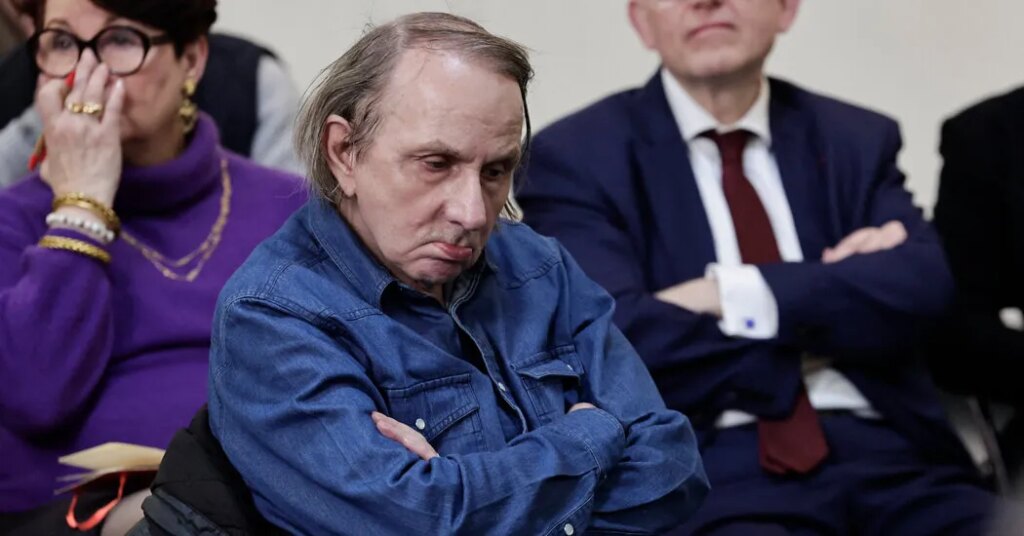
Michel Houellebecq, one of France’s most famous and flamboyantly provocative writers, has been placed under investigation over accusations of inciting violence and racial hatred with comments he made about Muslims in 2022, according to French news media reports.
Although Houellebecq has not been charged, the investigation puts him at considerable legal risk. Being the target of a judge-led probe is a significant step in the French criminal justice system. Any charges would be brought at the end of the investigation, which could take months, if not years.
The investigation which, according to the French newspapers Le Figaro and Le Monde, and Agence France-Presse, was initiated by prosecutors in Nanterre, a Paris suburb, was prompted by remarks that Houellebecq made in an interview with the French magazine Front Populaire. He described Muslims as a threat to France’s security and said they could be subject to the kind of violence that struck Paris in 2015, with the deadly attack by Islamic State terrorists.
“I believe that the wish of the native French population, as they say, is not for Muslims to assimilate, but for them to stop stealing from and assaulting them, in short, for their violence to decrease, for them to respect the law and other people,” Houellebecq (pronounced WELL-beck) told the French philosopher Michel Onfray in the interview. “Or, another good solution, for them to leave,” Houellebecq added.
When Onfray raised the issue of the “great replacement” theory, a racist concept by the writer Renaud Camus that holds that white Christian Europeans are being replaced by people of color, including Muslims, Houellebecq replied, “I was very shocked that it was called a theory. It’s not a theory, it’s a fact.”
The Union of Mosques of France filed a complaint in early 2023 against Houellebecq, Onfray and the magazine’s management.
Houellebecq has since expressed regret for the comments, describing them as “clumsy.” But his lawyers told the French news media they rejected the validity of any legal charges over his statements. They insisted that Houellebecq’s remarks did not constitute incitement to violence or racial hatred.
“A prophet of doom does not wish for misfortune to occur, quite the contrary. His place is not in a courtroom,” the writer’s lawyers, Thibault de Montbrial and Louis Cailliez, said in a statement provided to Agence France-Presse. “Michel Houellebecq can only regret the growing tendency to litigate intellectual debate.”
With his scathing discussions of race, gender and sexuality in books like “Whatever,” “Submission” and “Annihilation,” Houellebecq, 70, has generated sales and outrage in equal measure.
It is not the first time his remarks about Muslims have landed him into trouble. In 2001, Houellebecq was charged with inciting racial hatred over an interview in which he called Islam “the most stupid religion,” although a Paris court acquitted him the following year. The court said that the remark was “‘without a doubt characterized by neither a particularly noble outlook nor by the subtlety of its phrasing,” but that it was not a punishable offense.
After a sustained backlash to his interview in 2022, Houellebecq has kept a lower profile. But his case has re-emerged as issues of racism and Islamophobia have been pushed back to the forefront in France this month, after the deadly shooting of a Black man by a white man in a working-class suburb of Paris.
The suspect in the shooting, identified as Kévin Tessier, 39, told investigators that he had targeted the town, Trappes, because it was a “den of Islamists,” according to prosecutors. Trappes, with its large immigrant population, has long been at the heart of debates over France’s identity.
Residents and officials in Trappes have blamed inflammatory language used by France’s far-right party, the National Rally, for the killing. The party’s candidate for president, Marine Le Pen, currently leads polls in the race to succeed President Emmanuel Macron next spring.
The Union of Mosques of France welcomed the investigation into Houellebecq, saying in a statement, “Given the concerning climate we face, in which certain types of rhetoric serve to prime minds for violence and can provide the ideological breeding ground for terrorist acts — as tragically illustrated by the attack in Trappes — we cannot allow such remarks to go unanswered.”
Ségolène Le Stradic contributed reporting from Paris.
The post Michel Houellebecq, French Writer, Is Investigated Over Anti-Muslim Remarks appeared first on New York Times.