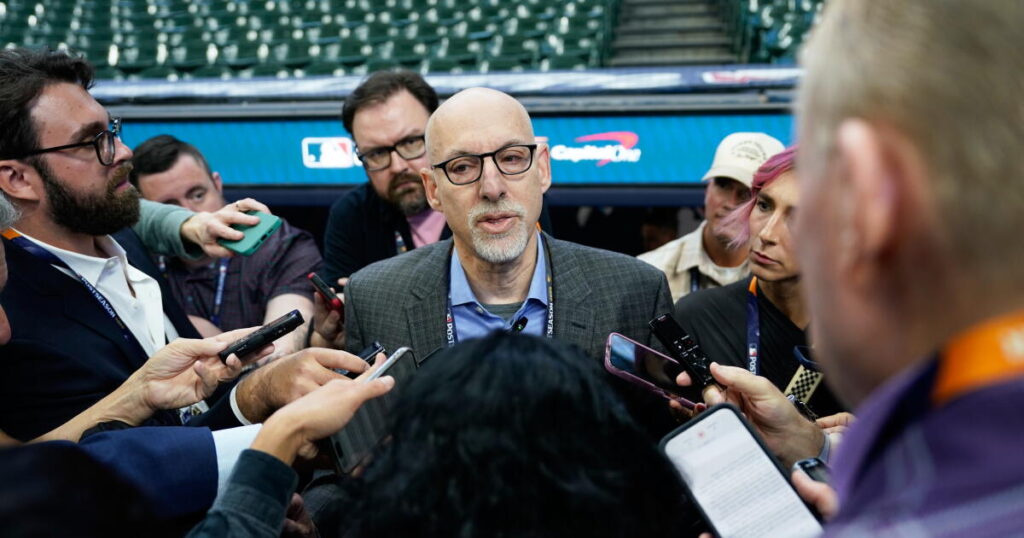
In the hours before Game 1 of the World Series, as the Violent Femmes played “Kiss Off” before their hometown fans in Milwaukee, Bruce Meyer talked about getting blown off by baseball’s owners.
He didn’t put it quite that way. But Meyer, the executive director of the Major League Baseball Players Assn., expressed his frustration that months of collective bargaining over dozens of issues has boiled down to what he sees as one gigantic, inflexible roadblock: “They’ve made clear they’re not willing to talk about anything outside of their cap system.”
The league and its owners are willing to talk about key issues for the union: higher minimum salaries, fewer years to free agency, an end to the qualifying offers that can dampen the market for free agents. But the price would be a salary cap.
The players have made clear they’re not willing to consider the salary cap that owners insist would underpin everything else in what would be a radical new economic system. That could backfire: a wonky provision in labor law could give the owners the option to adopt a salary cap no matter what the players want.
With three weeks left before the current collective bargaining agreement expires — and with the owners planning to lock out players immediately thereafter — player representative and former Philadelphia Phillies catcher Garrett Stubbs called the negotiations “a complete waste of time” and “a charade.” He told the Philadelphia Inquirer the owners continue to present proposals “with the salary cap attached to every single proposal.”
So why wouldn’t the union just walk away from the bargaining table and tell the owners to call when they get serious?
Under labor law, parties in collective bargaining must negotiate in good faith. If the union refuses to discuss a salary cap, the owners could at some point declare an impasse. That would mean the owners would end the lockout by imposing their last offer as a new labor agreement — including a salary cap — and claiming the players would not negotiate in good faith.
That would not be a risk-free strategy. The players could ask the National Labor Relations Board to intervene, arguing they had offered solutions to the owners’ economic concerns — expanded revenue sharing, for instance — that the owners would not consider.
In the 1994-95 strike, the last time the league sought a salary cap, the owners played the impasse card. However, the NLRB found that the owners were the party that had failed to negotiate in good faith. United States District Court Judge Sonia Sotomayor agreed — you know her as a Supreme Court justice now — and ordered the old collective bargaining agreement reinstated.
In this moment, with the NLRB generally considered more business-friendly under President Trump, the union might not find the board as receptive to its positions as it did then.
“I could certainly imagine a scenario where the owners get into his ear how it’s going to destroy baseball and America and everything else, and he puts his thumb on the scale or otherwise reaches out to the decision makers at the NLRB and says, ‘You’re not finding a violation here,’” Jennifer Abruzzo, the NLRB general counsel during the Biden administration, told The Times.
Ivan Smith, a partner in labor and employment law at Seyfarth Shaw and leader of the firm’s sports and entertainment division, said the short-term gain of declaring an impasse might not be worth the potential long-term pain for the owners.
“Ultimately, they want to be able to put enough pressure on the players to get them to give them (the cap) for their business,” Smith said. “But, if you impose, you’re now giving players more tools to fight you. Why go through that?”
One powerful tool, according to Abruzzo and Smith: If the owners go the impasse route — hey, we’re putting in a new labor contract and we’re ending the lockout! — the players could simply respond by going on strike.
The players would have another card to play too, separate from the impasse question. They could vote to decertify their union, which would be something of a chaos option: Hello, owners, who ya gonna negotiate with now?
Under a collective bargaining agreement, the league and the union negotiate various restrictions on negotiation by individual players — draft pick signings, international player signings, minimum salaries, arbitration, free agency, and more.
“If there is no union in place, then they’re not represented by anybody,” Abruzzo said. “So there would be a free-for-all. You would have independent employment agreements with every player.”
On the one hand, that could flood the market with players forced to take whatever salary an owner offered. On the other hand — and this likely would be the objective of decertification — individual players could sue for antitrust violations and the triple damages that can accompany them, pursue a judge’s order to end the lockout, and/or leverage those options toward a new collective bargaining agreement. (And, if the union quickly reassembles, the owners could then argue in court the decertification was a sham.)
Trump is the wild card in all of this. In the 1994-95 strike, President Clinton appointed a federal mediator, although the mediator was unsuccessful in leading the two sides to an agreement.
After Americans largely rebuked his leadership by thumping Republicans in last week’s midterm elections, Trump might well savor an opportunity to get involved and portray himself as the guy who saved baseball.
“He might say, ‘Hey, let me focus on anything else,’” Smith said.
In September, Trump said he would welcome a chance to bring labor peace to baseball.
“If I could help, I’d love to help,” he said.
What do the league and the union have to say about all this? Both sides declined comment for this column.
But baseball runs on deadlines, and the one for missing games next season is about four months away. The options for impasse, decertification and presidential involvement all could require longer than that to resolve.
That means the quickest route to resolution could be Plan A: Actual bargaining, with give and take.
“I’m not prepared to write the process off as ending in a really ugly labor battle,” Manfred said at the World Series. “I believe in the process of collective bargaining. I believe, if people approach the table not with preconceived notions about what has to happen and commit to the process, that we can make an agreement without having a disruption.”
On Kalshi, the “official and exclusive prediction market partner” of the Dodgers, only 39% of bettors say the full 162-game schedule will be played next year.
The post Why the players’ union can’t just walk away if MLB owners insist on a salary cap appeared first on Los Angeles Times.