A divisive election didn’t stop Americans from connecting with one another. This year has been chock-full of unifying works and events spanning music, film, sports and television. Five Post Opinions staff members share which ones meant the most to them.
Bad Bunny at the Super Bowl
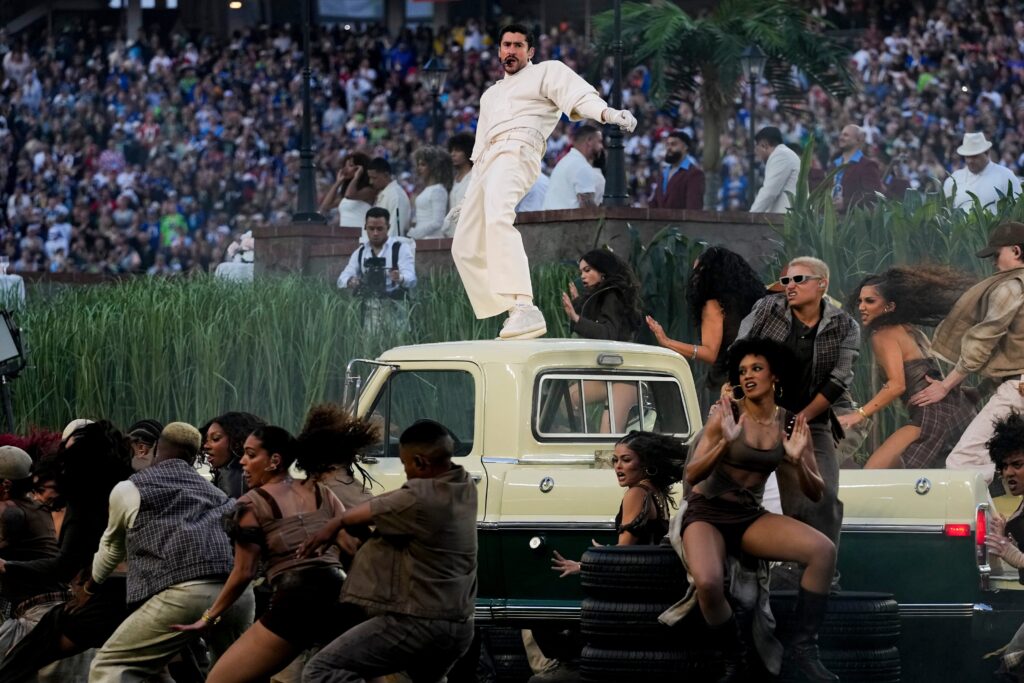
Three cultural achievements mark America’s greatest pop stars: performing at the Super Bowl halftime show, winning album of the year at the Grammys and hosting “Saturday Night Live.” This year, Bad Bunny managed to do the first two in the span of just a week. (He also hosted SNL a few months before.)
It’s fair to assume that the artist’s concert at Levi’s Stadium in California will go down as one of the best Super Bowl performances in history. I had the privilege of watching the event with some Latinos, who welled up as Bad Bunny celebrated not just his Puerto Rican heritage but pan-Hispanic culture on the world’s biggest stage.
They reveled in his effortless fusion of Spanish-language genres — salsa, merengue, reggaeton, Latin trap. They marveled at the small details on the stage — the old men playing dominoes, the child sleeping on two chairs. They cheered as he led a crowd of people marching down the field carrying the flags of the Americas alongside the message: “The only thing more powerful than hate is love.”
Sure, Bad Bunny is not universally adored, especially among right-wing reactionaries who can’t accept that he is a prototypical American success story. Most of the country, however, cherished his “inolvidable” performance.
— Rob Gebelhoff, editorial writer
‘You Can See Everything’
One way to bring people together is to appeal to what makes them different.
There wasn’t just one audience for “You Can See Everything,” Nathan Fielder and Lance Oppenheim’s mind-bending documentary about Theranos co-founder Elizabeth Holmes in the month before she entered federal prison in 2023. My friends could recite their favorite lines from Fielder’s “Nathan for You” on command. My mom was gripped by the Holmes story as it was breaking a decade ago. Me, I’m a sucker for artful color grading — the kind that made Liz’s impossibly big eyes impossibly blue.
Once the movie lured us in, nobody could agree on what was happening in Holmes’s head. Interpretations splintered in a thousand directions. It didn’t help that the directors themselves said they, too, struggled to understand the experience.
I still don’t have a final answer, but in my effort to work it out, I’ve caught up on the news stories, I now own a copy of “Bad Blood,” and I plan to one day watch Fielder’s oeuvre. Over days of discussion, friends persuaded me of some of their readings, and I did my best to convince them of mine.
“You Can See Everything” may be about how you can never get inside another person’s mind. Still, it brought me closer to the people around me.
— Suzanna Murawski, assistant op-ed editor
‘A Knight of the Seven Kingdoms’
The endless entertainment buffet on streaming services lets people watch what they want when they want it, but it’s made the shared cultural moments created by great television — “I Love Lucy,” “M.A.S.H.,” “The Office” and many others — increasingly rare. However, the world of Westeros continues to capture hearts and minds 15 years after the debut of “Game of Thrones.”
The original was a phenomenon, and it possessed the magnetic quality of must-see television. It pulled together people of all cultures, classes and creeds on Sundays for an hour of palace intrigue, over-the-top violence and outrageous spectacle. Its spin-offs have played a similar role, and the latest offering, “A Knight of the Seven Kingdoms,” sucked me and millions of others right back into George R.R. Martin’s world.
Yes, there are ruthless (and extremely blond) Targaryens vying for power. Yes, the show is brutally violent like its predecessors. But it is surprisingly tender. I dare even the most cynical viewer to be unmoved by the relationship between Dunk (Peter Claffey) and Egg (Dexter Sol Ansell). Americans should note the bond that develops between the highborn prince and the lowly hedge knight. If Dunk and Egg can overcome their differences to forge a lasting partnership, what excuse do we have?
— James Desio, researcher
The World Cup
In this extraordinarily divisive year, the beautiful game provided a few weeks of respite.
I won’t pretend the 2026 World Cup — held from June 11 to July 19 across Canada, Mexico and the United States — was free of controversy. President Donald Trump’s push to acquire Greenland rocked the transatlantic alliance as tourists flocked to the U.S. for the matches. His intervention in the decision to delay U.S. striker Folarin Balogun’s one-match ban after a red card reminded Americans of the president’s laissez-faire attitude toward corruption in government.
Yet despite those challenges, the tournament brought the country together. No matter which team you rooted for, at every stage of the tournament, you were celebrating or commiserating with strangers huddled around a television, wearing the same jerseys. There was a sense of camaraderie that football — soccer, if I must — always creates, whether you were jumping up and down or crying into a pint glass.
Although the U.S. team didn’t go all the way, it was unifying for Americans to watch others fall head over heels for our culture. Visitors posted videos of themselves enjoying barbecue and ranch dressing. They celebrated Americans’ warm hospitality and manners. For a few weeks, World Cup tourists reflected the best of the U.S. back to Americans.
Many thanks to those football fans. Goodness knows we needed it.
— Kate Andrews, columnist
‘Shrinking’
“I’m not crying, you’re crying,” I said to myself several times this year while watching Apple TV’s brilliant series “Shrinking,” which debuted its third season in January. I had avoided the show, despite its rave reviews. I struggle with fictionalized portrayals of grief, having lost my father in early adulthood.
But after watching, I was glad I finally gave in to the hype. Most people have either experienced great loss or love someone who has. “Shrinking” shows how to empathize with and respect the grieving processes of others. Its characters wrestle with how (and when) to step up or stand by. These are skills we all need in life to care for each other well.
The show also portrays deep friendships bound not by unconditional love but by something more genuine. The protagonists hold each other accountable when they make mistakes and demonstrate profound capacities for forgiveness.
I felt myself wading through pain with the characters, watching them give in to their struggles and then rise to fight back. They grapple with loss, trauma, illness and awkward hookups. Yes, the show often brought me to tears, but usually between bouts of laughter. In a year that left so many of us disconnected from ourselves and our communities, “Shrinking” can help us remember what really grounds us in this life.
— Chloe Coleman, senior photo assignment editor
The post The cultural moments that brought Americans together this year appeared first on Washington Post.