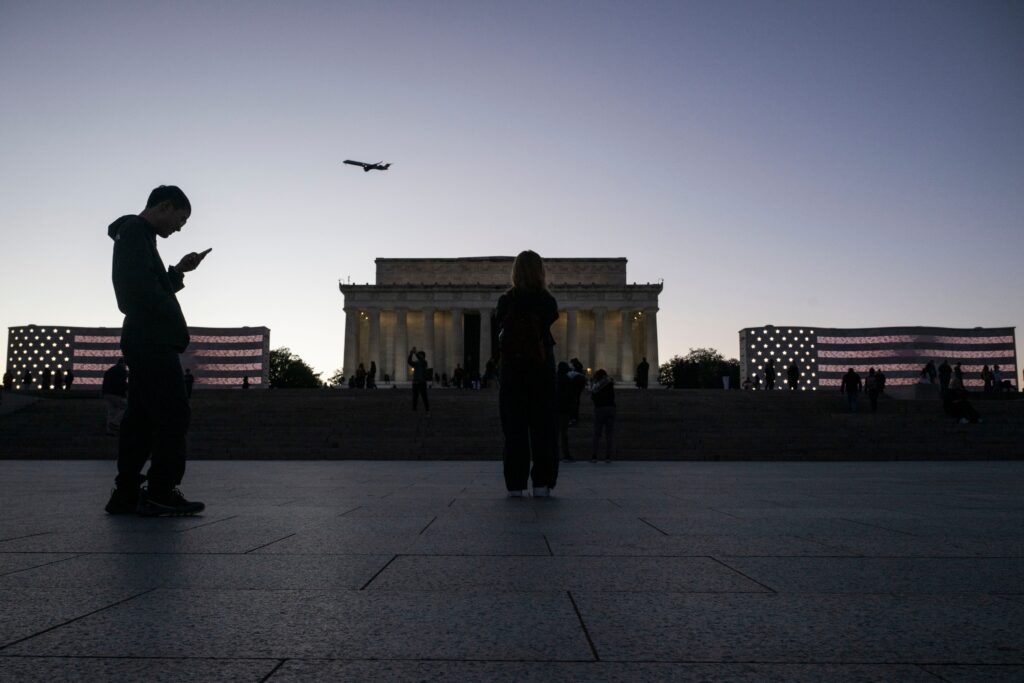
The sylvan landscape around the Lincoln Memorial is a mess, and it will only get worse. On Oct. 24, a new memorial honoring those who served in the first Iraq War, the 1990-91 conflict that forced an invading Iraqi army out of Kuwait, opened just north of the Lincoln Memorial. It sits close to the Vietnam Veterans Memorial along Constitution Avenue and next year there are plans to break ground on new Global War on Terrorism Memorial shoehorned between the two of them. President Donald Trump is also trying to build a giant triumphal arch just across the river, which will loom over the western end of the mall, with yet another monumental addition, a riverside “Garden of American Heroes,” planned for nearby West Potomac Park.
A landscape that was meant to symbolize peace and reconciliation after the Civil War is becoming cluttered mainly with memorials devoted to war and military power. Washingtonians have lost the amenities of peace — parkland and playing fields — and Lincoln is losing his preeminence as the symbolic focus of western end of the city’s monumental core.
The problem is not the remembrance and honor due to those who served but, as oversight groups have been warning for decades, the concentration of too many war memorials in one place. When the mall was designed early in the last century, the monument to Ulysses S. Grant, the great military leader who defeated the Confederacy, was placed two miles away from the temple to Lincoln, the political architect of reunion. Since then, the nation has added memorials to the Korean War and World War II and, while May Lin’s memorial to the Vietnam War is profoundly anti-war, the reconfigured landscape seems to say: War is not an occasional exception to peace but the perpetual American project.
The Desert Shield and Desert Storm Memorial, with a lead design by OLIN Studio, is compact, efficient, professionally designed and it tells a clear story. Its basic shape, two semi-circular arcs of stone decorated with sculpture and enclosing a plaza and fountain, keeps a low profile, with grass growing on its exterior berms as if it has been hollowed out of the landscape rather imposed upon it. Its only significant flaw is the unnecessary proliferation of ugly lighting poles (I counted more than 10), some of them studded with security cameras.
During the lengthy oversight and design review process since Congress authorized the memorial in 2014 it became clear that supporters of the memorial were adamant that it be located on the long, ceremonial axis popularly known as the national Mall, and that it be close to the Vietnam memorial, with which it shares key design features. There was a historical thesis behind this symbolic connection: That the successful military operation to defend Saudi Arabia from Saddam Hussein (the 1990 Desert Shield) and the war to force him out of Kuwait (1991 Desert Storm) were essential to restoring American faith in its military after the long, cruel, protracted and failed war in Vietnam. That thought is made explicit in a quotation from President George H.W. Bush, who championed the war, inscribed on the memorial wall: “We set out to confront an enemy abroad, and in the process transformed a nation at home.”
This was a strategic repackaging after the fact of a war that had been difficult to sell before it started. In the years after Vietnam, Americans reverted to a reflexive suspicion of war and preference for peace, which made it hard to build support for a giant military operation to liberate one authoritarian regime from the aggression of another. Sovereignty and international law were at stake, but oil was an issue, too, with Saddam Hussein seizing the vast Kuwaiti oil reserves and poised to control those of Saudi Arabia, putting potentially 40 to 45 percent of the world’s supply under his dominion.
The Bush administration built a significant coalition of international partners and pitched the war as the first great moral crusade of the post–Cold War era. Diplomacy and coalition building are honored in the memorial’s circular fountain, a low disk of bronze with the names of dozens of coalition partners engraved on its rim. The liberation of Kuwait is symbolized by a stainless-steel sculpture of an American eagle flying with a raptor, a symbol of the hereditary emirate ruled by the Al-Sabah family.
Throughout the review process, the Commission of Fine Arts, then an apolitical body with architecture and design expertise, tried to steer planners away from the site at 23rd Street NW and Constitution Avenue. The area isn’t just dense with civic structures, but busy with people and traffic, with Constitution Avenue and 23rd Street clogged with cars connecting to Interstate 66 and Memorial Bridge. Congress could have insisted that the new memorial be located in a dignified, symbolically significant spot farther from the Lincoln Memorial, but it didn’t. Supporting new memorials, especially when they are built with private funds like this one, is an easy win for politicians; saying no to them, even when that’s in the interest of a sacred civic landscape, is a good way to get branded as hostile to the interests of veterans.
In the years after World War I, individual military units took the lead in memorializing the fallen. In 1924, on a site just south of what is now the Dwight D. Eisenhower Executive Office Building, the Army’s first division erected a monumental column topped by a sculptural figure of Victory (sculpted by Daniel Chester French, the same artist who designed the seated Lincoln at the Lincoln Memorial). In 1936, a memorial to the army’s second division (a flaming sword of gold just north of the Mall, near the White House), was dedicated.
These memorials to individual military divisions suggested an untenable future for memorialization in Washington, with every single unit from across the armed forces wanting — and arguably deserving — its own memorial. Despite political pressure from veterans, the country pulled back from that and moved toward memorializing more collectively, with national war memorials in Washington, and individual markers in cities, towns and other localities.
Now, it is the proliferation of war that threatens to make memorialization untenable. The design for the Global War on Terrorism Memorial, by Japanese architect Kengo Kuma, is significantly more adventurous and poetic than the Desert Storm memorial, but it too will function as a semi-circular outdoor room. As these forms proliferate around Lincoln, they begin to resemble side chapels of a cathedral. And they may do to the National Mall what the side chapels of the Middle Ages did to the great cathedrals, overburdening one big symbolic idea with a lot of little ones, privatizing and tribalizing a shared landscape into more occasionally used smaller plots of memory.
Meanwhile, the proposed victory arch recasts America’s military power not as defensive but aggressive, like the rebranding of the Department of Defense as the Department of War. When the Global War on Terrorism Memorial is completed, there will be a consistent but disturbing narrative to this landscape: Vietnam, a gash of black granite in the earth, was the dark night of the national soul; war renewed us as a nation when we first defeated Saddam Hussein; and the Global War on Terror, the authorization for which still stands and was used most recently to justify U.S. attacks on Venezuelan boats suspect of carrying drugs, makes war permanent. And who can object to war when Triumph is always in sight?
Inside the Lincoln Memorial, however, the agony of war is everywhere apparent, in the rhetoric of Lincoln’s Gettysburg Address and his Second Inaugural. And it’s painfully obvious in the face of Lincoln himself, a man drawn into war reluctantly. It was not, for him, a crusade but a penance. Now as the grass is paved over to make room for yet more memorials, it encroaches on him from all sides, as if to say, war is forever growing on us.
The post The Mall was meant for peace. It’s getting crowded with war. appeared first on Washington Post.