Democrats’ decisive victories in last week’s midterm elections are the launching pad for the 2028 presidential race, which is wide open on the Democratic side and could be just as open on the Republican side as well.
“There’s no front-runner,” John Anzalone, who served as the chief pollster for President Joe Biden’s winning 2020 campaign, said of Democratic potential contenders. “There are just a lot of really good candidates who have to prove themselves.”
Republicans are less sure about who can break through for their party.
“The voters have spoken with a very clear repudiationof the current direction of the country,” said Republican strategist Mike DuHaime, “so any candidate will have to articulate a change of direction, but also keeping Republicans on the team. That’s no easy trick.”
Here are some early winners and losers among the potential 2028 presidential candidates.
Get The 5-Minute Fix in your inbox
Winners
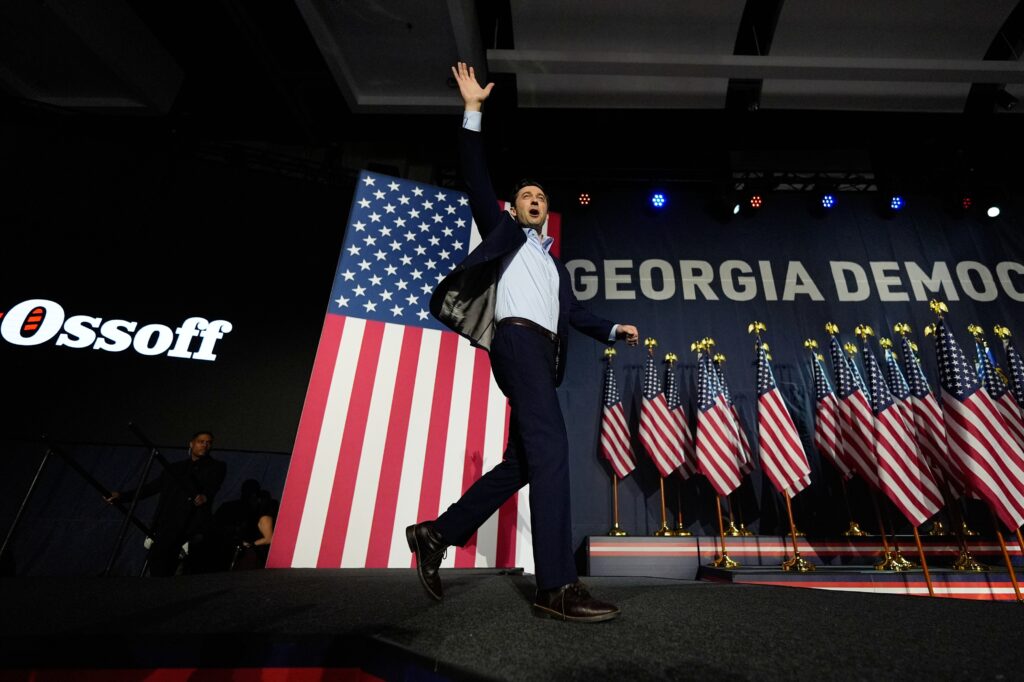
Jon Ossoff: The Democratic senator from Georgia was already a top likely presidential contender before the midterms, for his youth, social media virality and campaign speeches that mercilessly criticize President Donald Trump. After winning reelection in his purple state by 18 points and probably helping to carry a Democrat into Georgia’s governor’s mansion, Ossoff has an even stronger case on which to run — and he wouldn’t have to worry about a Republican governor appointing his replacement. (Same with Democrat Raphael Warnock, Georgia’s other senator, who wasn’t on the ballot this year but has been much more publicly open than Ossoff to a run.)
Ron DeSantis: Florida’s outgoing Republican governor wasn’t on the ballot, but he is the likeliest presidential contender whose state didn’t get wiped out by Democrats. Florida was the only competitive state to keep its governor’s mansion and Senate seat in GOP hands (though Republicans did lose a number of congressional districts that DeSantis and the legislature had gerrymandered). He’s already planning a run.
Alexandria Ocasio-Cortez: The midterms did little to settle the debate among Democrats over whether a liberal approach or moderate approach gets more votes. Ocasio Cortez, a congresswoman from New York, was one of the first members of the Democratic Socialists of America to win federal office. After campaigning for liberal candidates who won in some surprising areas, like Abdul El-Sayed in Michigan’s Senate race or Troy Jackson in Maine’s Senate race, she’s an obvious pick for the broader progressive movement to get behind if she runs for president. But candidates who are actual members of the DSA, like Angie Nixon in Florida’s Senate race, lost. And some other liberal candidates didn’t perform as well as moderate Democrats did.
Democratic governors: There’s a clear avenue for someone outside of Washington to run for president. Democrats had stunning wins in the states and will soon hold a majority of legislatures and a majority of governor’s mansions in the country for the first time since 2010. State leaders will be able to move more quickly than Congress to enact policies. Top of this list is Pennsylvania Gov. Josh Shapiro (D), who easily won reelection and secured a governing majority in the state legislature for the first time in more than 30 years.
Republicans not on your radar: Before the midterms, it was unclear whether a Republican could win by distancing themselves from Trump. Now, they may have to. Republicans who aren’t at the center of the Trump administration may seem like fresh options. Outgoing Georgia Gov. Brian Kemp is considering a run. Former New Jersey governor Chris Christie has said he is, too. “Why not me on a rainy day?” Sen. John Kennedy (R-Louisiana) has said.
Someone neither party has thought of yet: Possibilities include a celebrity, a union or business leader, or an incoming star member of Congress (Barack Obama was a first-term senator when he ran and won). Insiders say to leave room for surprise candidates, especially now that Democrats’ bench is so big.
Losers
JD Vance: The vice president will have to work hard over the next couple of years to put space between himself and the losing policies and politics of the administration he helps lead. That effort started hours after Tuesday’s vote, when Vance publicly distanced himself from the Iran war, blaming it for Republicans’ losses — and risking a Trump endorsement. “Maybe he won’t run,” Trump responded of his vice president.
Marco Rubio: The secretary of state was seen by traditional conservatives as a viable alternative to Vance and MAGA-ism. But Rubio is the nation’s top diplomat at a time when the administration’s foreign policies are seen as toxic.
Ted Cruz: The Texas senator has been framing himself as an alternative to Vance for a while now, and he wasn’t on the ballot in these elections. But Cruz will soon be the only Republican statewide leader in Texas. His opponents could point out that he nearly lost to a Democrat in 2018, which Democrats in the state say set the stage for their once-in-a-generation wins deep in conservative territory.
Amber Phillips writes The 5-Minute Fix newsletter, a quick analysis of the day’s biggest political news. Send her an email here, or ask a question that could be featured in an upcoming newsletter.
The post The 2028 winners and losers from the midterms appeared first on Washington Post.