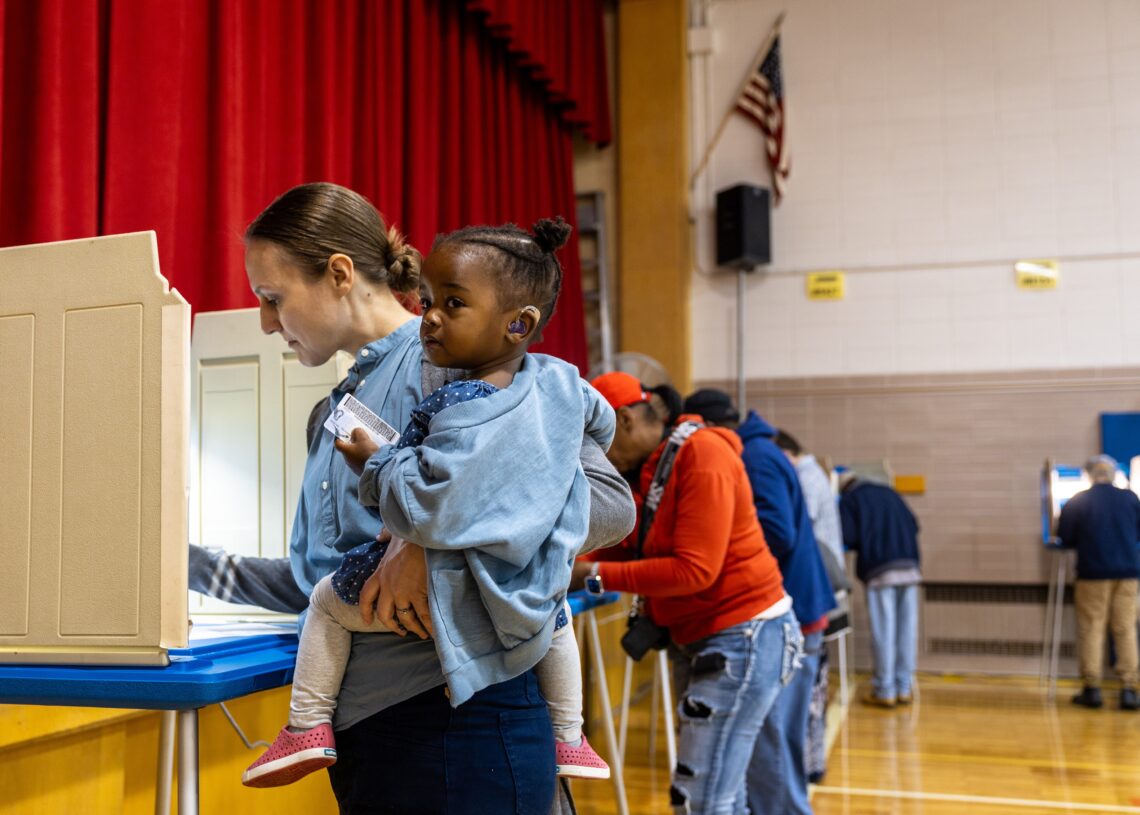
Amid the magnitude of the midterms blue wave, it was easy to miss another big winner: America’s decentralized election system. GOP election deniers lost, but so did Democratic election fearmongers.
Prominent Democrats warned that President Donald Trump could try to cancel, disrupt or otherwise subvert the midterms. “If he can’t win Americans’ support, he’ll try to cancel their vote,” Senate Democratic leader Chuck Schumer (D-New York) wrote for Democracy Docket on Oct. 30.
Some anxiety was understandable. Trump, who tried to overturn his 2020 defeat, spent the past year pushing against the boundaries of presidential authority over voting. But the institutions held.
Courts repeatedly checked Trump, including a Supreme Court with a 6-3 conservative majority. In September, the justices rejected the president’s attempt to use the U.S. Postal Service to impose new restrictions on mail voting.
Days before the election, the Trump Justice Department asked the Supreme Court to force California to segregate about 20,000 ballots associated with people the administration suspected might be noncitizens. Lower courts refused, warning of possible disenfranchisement and disruption. The Supreme Court refused too, without a noted dissent.
In Alaska, the Justice Department took the extraordinary step of asking a federal judge to delay certification of the Senate result if Republican Sen. Dan Sullivan lost by fewer votes than were cast for another candidate with an almost identical name, Dan J. Sullivan Jr., the “Decoy Dan” whom Democrats recruited as a spoiler. Alaska’s GOP-led state government opposed the federal motion, and a federal judge threw it out.
Congress supplied another check. Trump’s Save America Act would have significantly federalized election administration, imposing nationwide registration and identification requirements and compelling states to share their voter rolls with the federal government. It stalled because Republicans lacked 60 votes. Several members of the president’s party wisely resisted pressure to blow up the filibuster to jam it through.
Each party is tempted to assert more federal sway over elections when it controls Washington. Under President Joe Biden, Democrats pushed the For the People Act and Freedom to Vote Act. These would have imposed national rules governing registration, early voting and mail ballots. The Constitution ingeniously gives states primary responsibility for administering elections, gives Congress an override for federal contests and assigns the president no role.
As we argued in March, decentralization protects against political capture. There is a free-market insight here: Systems are more resilient when decision-making is dispersed. States experiment, mistakes remain more contained and citizens have multiple places to challenge inevitable abuses of power.
The public backlash was intense after the Supreme Court sharply weakened Section 2 of the Voting Rights Act this spring in Louisiana v. Callais. That cleared the way for Republican-led states to redraw districts represented by Black Democrats. But Black turnout surged across the South, helping Rep. Shomari Figures (D-Alabama) survive in a new district that Trump would have carried by double digits two years ago. Gerrymandering also backfired on the GOP in Texas, North Carolina and Florida as voters proved harder to engineer than district lines.
Trump deserves acknowledgment, not praise, for accepting the results. It’s something that should be routine but cannot be assumed after Jan. 6, 2021. The implications extend to 2028. Democrats now hold the governorships in all seven states that were presidential battlegrounds in 2024: Arizona, Georgia, Michigan, Nevada, North Carolina, Pennsylvania and Wisconsin. Their state-level gains will matter if election disputes erupt again as they did in 2020.
Trump tested the system, and his opponents sometimes underestimated its fortitude. America’s sprawling, state-run election machinery — supported by an independent judiciary — frustrated both impulses. Voters got the final word, exercising their most precious of personal liberties.
The post Election deniers lost. So did election doomers. appeared first on Washington Post.