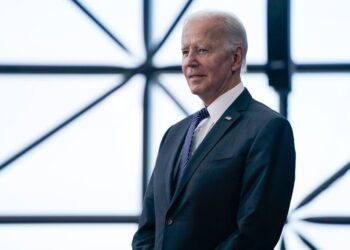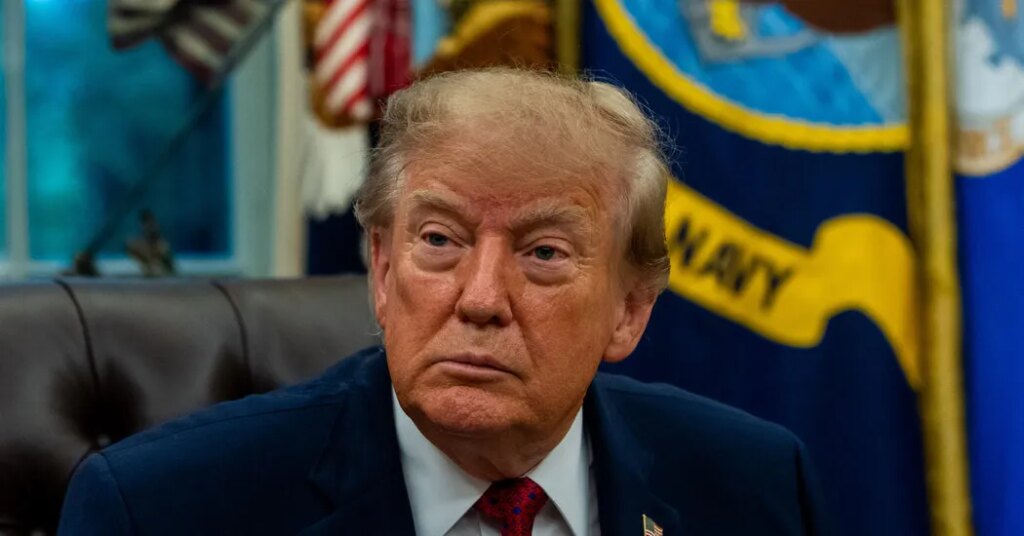
The public split last week between Vice President JD Vance and Defense Secretary Pete Hegseth over whether the conflict with Iran is a worthwhile expenditure of American resources and power is now permeating an urgent question: How does the Trump administration get out?
The debate over the war inside the administration has hardly been a state secret since it started more than eight months ago. Mr. Vance privately expressed skepticism about a full-scale military operation; Mr. Hegseth, fresh from the capture of President Nicolás Maduro in Venezuela, was among the most gung-ho.
On Wednesday, after the Republicans’ broad defeat in the midterm elections, Mr. Vance was unsparing: “The reason we lost is the war.” He added: “If you’d like to argue it was worth it, that losing the Senate for the next 6 years was worth it, then do so.” Mr. Hegseth responded with a defiant, self-promoting video that seemed to be an argument for full speed ahead. With the U.S. military again massing a major force near Iran, Mr. Hegseth argued to “fight, fight, fight.”
Now the president must decide where he will come down as he weighs whether to launch a renewed attack in coming days. Just as Mr. Trump cited a jumble of objectives as the war began — collapsing the Iranian government, dismantling the remnants of its nuclear program, restricting the country’s missile arsenal and ending Iranian help to proxies in the region — he is struggling to articulate how much more the United States should expend in the deeply unpopular conflict.
On Wednesday, the president said it was “largely true” that Republicans lost badly in the midterms because the conflict had driven up gas prices, as Mr. Vance said. But he added that he would make the same decision to go to war again.
“The Iran thing, we had to do,” he said, “and we continue to do it.”
Like Presidents Harry S. Truman and Dwight D. Eisenhower in Korea, Lyndon B. Johnson and Richard M. Nixon in Vietnam, and the four presidents who tried to extract themselves from Iraq and Afghanistan, Mr. Trump is discovering that every escalation plan and every negotiating strategy are rife with trade-offs. Tempting as it may be to declare victory and leave, history will assess whether he stopped the Iranian nuclear program or ended up bolstering Iran’s determination to obtain a weapon, and whether he eviscerated the hard-line leadership or cemented it in place.
The choices are made all the more vexing for Mr. Trump by his new, lame-duck status. The Iranians will be calculating that he has been weakened; before the election, Congress had authorized no supplemental funds for a war the Pentagon conservatively estimates has already cost $47 billion, not counting the hundreds of billions of dollars in higher gas and oil prices. They may be calculating that time is on their side.
“The concern is that Trump will conclude that he is facing his worst nightmare for the next two years: going down in history as a loser,” said William F. Wechsler, the senior director of the Atlantic Council’s Middle East programs and a former top Pentagon counterterrorism policy official. “The only way out of it, he may therefore conclude, is to win the war. That could lead to a decision to restart major combat operations, if not immediately, then in the months to come.”
Mr. Hegseth and Gen. Dan Caine, the chairman of the Joint Chiefs of Staff, have presented the president with a menu of military options that Adm. Brad Cooper, the commander of U.S. Central Command, developed in recent months. It is unclear which way Mr. Trump will go: He has approved resuming a major campaign against Iran several times in recent months, only to pull back from the operations just hours before they were to begin.
On Sunday, Mr. Trump told CNN that it was “highly unlikely” the United States would have to renew strikes if negotiations were successful.
“They’re withering away financially,” he added. “We’ve hit them militarily. We could finish them off.”
At the core of the problem, according to people engaged in the debate, is a fundamental issue: Mr. Trump and his aides still cannot agree on what they are trying to accomplish.
Here are some of the options currently under review.
A Brief, Intense Resumption of War
The most ambitious option that the U.S. and Israeli militaries have developed calls for a short but intensive operation of several days whose targets would probably include Iran’s energy infrastructure, nuclear facilities, and missile and drone arsenals, according to several U.S. officials who spoke on the condition of anonymity to discuss operational matters. But they stress that they have no expectations that a few days of battle will collapse the government; for that, U.S. officials are relying on continued economic pressure.
Any option that involves major combat operations would include strikes from attack planes aboard two aircraft carriers now in the region (a third carrier is expected in about two weeks); fighter jets at land bases in the Middle East, as well as U.S.-based, long-range B-1 and B-2 bombers. In total, scores of fighters, bombers and other support planes would join the fight. More than 50,000 troops in the region, Europe and the United States are assigned to the overall Iran mission, as are more than a dozen warships.
In recent weeks, the U.S. and Israeli militaries have stepped up exercises, flying planes over Iraq to practice strike maneuvers. The Pentagon and State Department have withdrawn personnel from bases and facilities in the region as a precautionary measure. The United States also recently delivered an additional Patriot antimissile battery to Israel, military officials said.
Mr. Trump has often spoken about targeting Pickaxe Mountain, the American name for a deeply buried nuclear site that Iranians call Kooh Kolang. Mr. Trump has said he is considering using a 22,000-pound MOAB bomb, the largest nonnuclear weapon in the American arsenal, against the site.
But weapons specialists say that the MOAB explodes aboveground, producing a wide blast, and would probably not destroy an underground site like Pickaxe, which is composed of granite. And it is far from clear that it is worth the effort: While Iran has reportedly stored many of the advanced centrifuges that could purify uranium, the nuclear material to manufacture a bomb is still untouched, under the rubble of a June 2025 attack.
Pros: A dayslong campaign would inflict more damage on Iran’s already degraded missile and drone arsenal. Perhaps it would result in concessions in limiting the country’s nuclear program and fully reopening the Strait of Hormuz.
Cons: It has not worked before. Iran would strike back at Gulf states, almost certainly driving up energy prices and inflation around the world. It has said that this time it would also target more data centers and underwater internet and communications cables. Defending the Gulf states would add to the strain of the Pentagon’s eroded global supply of missile interceptors.
“The US has the forces to start big, but munitions are likely to keep it short, and at greater risk to US forces than in Feb,” Kelly A. Grieco, a senior fellow at the Stimson Center, a research organization in Washington, wrote in a social media post last week. “And if the US starts another round, it doesn’t get to decide when it ends. Iran gets a vote.”
A Pared-Back Military Strike
A second military option would essentially amount to a shorter, scaled-back version of the first plan. Many energy targets would probably fall off the table, and strikes would most likely focus on military and nuclear sites, officials said. The thinking behind this approach is that Iran would be less likely to retaliate by attacking Gulf energy infrastructure.
This more limited military option would still be a marked expansion in scope and intensity from the small-scale strikes that the United States has conducted in recent weeks against Iran’s Qeshm Island, officials said.
Those strikes and others against missile and drone launchers across the country have been meant to stop Iran from its escalating attacks against commercial ships in the Strait of Hormuz. Some of these smaller strikes, sometimes carried out by long-range American artillery based in Gulf countries, have hit empty cruise missile launchers.
Even if only limited and defensive, these smaller U.S. attacks over the past few weeks marked the first American bombing of targets inside Iran since two days of strikes at the beginning of September.
Pros: Mr. Trump could claim that the United States had inflicted additional damage to Iran’s arsenal, declare victory and begin the exodus from the region. A more limited offensive would also preserve the Pentagon’s stockpile of scarce interceptors.
Cons: Administration officials concede that a limited strike would achieve none of the goals Mr. Trump set out at the beginning of the war, and would still leave Iran with significant leverage over the Strait of Hormuz. Some nuclear and missile sites, as well as drone launchers and ammunition depots, could be destroyed. But Iran has surprised American commanders with its resilience and its ability to dig out and rebuild damaged or destroyed sites and weaponry.
Let Vance Negotiate
Before the midterm elections, Mr. Vance reached out to Gen. Mohsen Rezaei, the secretary of the Supreme National Security Council and the former commander in chief of the Islamic Revolutionary Guard Corps, suggesting that American and Iranian officials meet soon. In his letter, he said he would lead talks for the United States — an unusual role for the vice president, as such negotiations are usually led by a special envoy (in recent times, Steve Witkoff and Jared Kushner) or the secretary of state. Mr. Vance got deeply involved in the negotiations in April through June over a memorandum of understanding with Iran that quickly fell apart.
Initially, the proposal seemed well received, and officials from Qatar, Pakistan, Turkey and Saudi Arabia have all been involved in communicating with the Iranians. But in recent days, some American negotiators have turned more pessimistic, according to people familiar with their thinking, fearing that whatever agreement they reach could be undercut back in Tehran by radical hard-liners.
One of the key sticking points is sequencing: The United States wants Iran’s nuclear material dealt with first, before billions of dollars in frozen Iranian funds held overseas are released, or sanctions reversed. Iran wants to hold on to the nuclear material until the end of the process, essentially as an insurance policy. And there are many other disputes about limits on missile capabilities, future nuclear activity and inspections.
Pros: History shows that a diplomatic solution is the only way to have long-term limits on a nation’s nuclear program. Mr. Trump, many experts believe, would be lucky to get limits akin to those in the 2015 Obama-era deal, in which Iran shipped 97 percent of its uranium stockpile out of the country. That was the deal Mr. Trump terminated in 2018.
Cons: No one knows who is making decisions in Iran, and there is public discussion in the country now about just racing for a bomb.
Muddle Along Until the U.S. Can Leave
In this scenario, the United States would live with the status quo: a naval blockade that prevents Iran from exporting oil, while U.S. escorts and patrols ensure that 11 to 18 million barrels of non-Iranian oil get through each day. This would effectively allow Mr. Trump to avoid making a decision, in the hopes of a longer-term resolution.
He could also seek to negotiate a narrow deal to reopen the Strait of Hormuz, leave sanctions in place and slowly withdraw — letting the Gulf Arabs work out a deal with the Iranians over how the strait is managed. Such a deal would not address the nuclear or missile issues — much less the nature of the Iranian leadership — that triggered Mr. Trump to go to war in February.
Pros: The long game requires patience — not Mr. Trump’s strong suit — but may be the most effective way of eventually cracking the leadership.
Cons: Maintaining the blockade is expensive, and if there is no war but no peace, European and Arab allies are not likely to participate. It could mean more misery for the Iranian people, who are caught between their own government and the United States and Israel. And there would be no timeline to the end game, meaning the conflict could drag on for the remaining years of Mr. Trump’s presidency and into that of his successor.
Jonathan Swan contributed reporting.
The post Here Are the Difficult Options Trump Is Weighing to Resolve the War in Iran appeared first on New York Times.