Turnout in the midterm elections reached its second-highest peak in more than a century — only slightly behind the 2018 midterms, during President Donald Trump’s first term — with the greatest number of voters casting ballots in states where Democrats won unexpected victories.
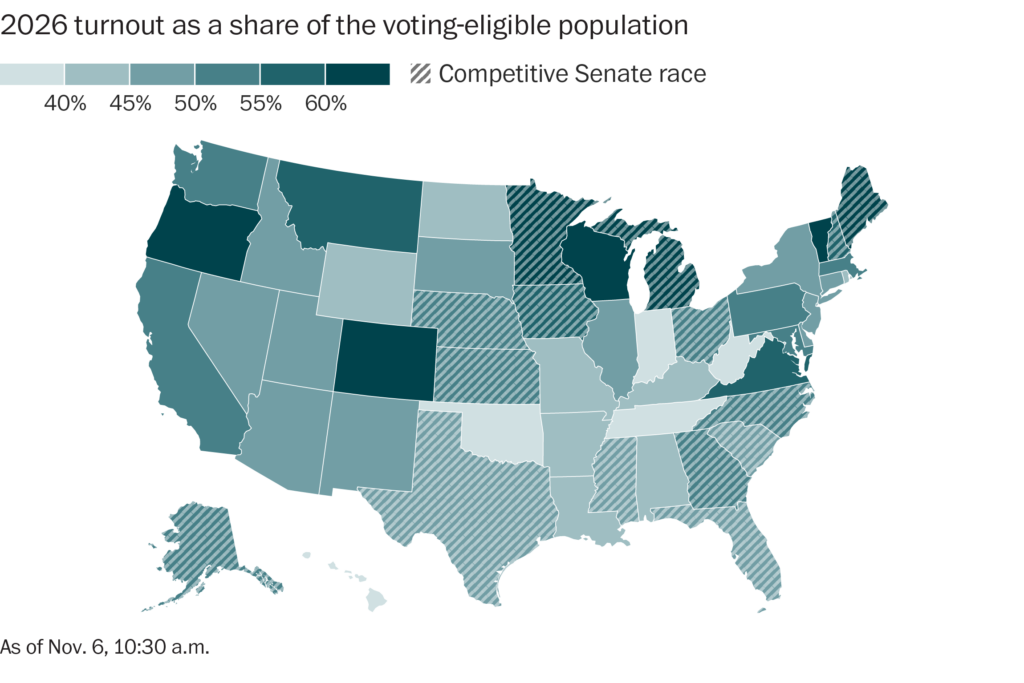
Across the United States, 49 percent of eligible Americans voted, the second-highest turnout since 1914, when neither women nor African Americans could vote in many states, according to preliminary data from the University of Florida Election Lab.
Three states with the highest turnout — Maine (65.7 percent), Minnesota (65.2 percent) and Michigan (63.2 percent) — held competitive Senate races where Democrats prevailed. All three also elected Democratic governors.
National turnout increased by three percentage points compared with 2022’s midterm elections. It was only slightly lower than in 2018, during the first Trump presidency, when 50 percent of eligible voters turned out.
Despite setting high marks for a midterm, turnout was lower than the 2024 presidential election by 15.2 percent. But the gap was smaller in the most competitive races, including in Maine, where Democratic Senate nominee Troy Jackson ousted Sen. Susan Collins (R), and Texas, where state Rep. James Talarico defeated Ken Paxton, the Texas attorney general, in the race for U.S. Senate.
Across all states with competitive Senate races, turnout averaged 52 percent, higher than the national average.
“When it comes to turnout, Trump has had more of an impact than anyone of the last century. He has the ability to mobilize both sides, for and against him,” Tom Bonier, an analyst and former Democratic political strategist, said of the president.
“What was different this time around [compared with 2018] was that he was repellent to Republicans as well, so that many just chose to stay home,” he said.
Turnout is often lower in wave elections because one side stays home.
Daron Shaw, a Republican pollster and politics professor at the University of Texas at Austin, said he expected Republicans would benefit from higher turnout because it would counter Democratic enthusiasm.
“In fact, it was exactly the opposite,” he said.
Lower-propensity voters showed up because they were “upset over the economy, perhaps a little anger over the Iran war and it’s relationship to higher gas prices.”
“Trump is an incredible mobilizer,” Shaw said. “But he also happens to be one of the great counter-mobilizers of all time.”
The post Historic voter turnout powered Democrats’ blue wave appeared first on Washington Post.