Microscopic shards of plastic have been found everywhere scientists have looked, from the depths of the ocean to the clouds above.
Now a UC Riverside environmental scientist with a particular set of outdoor and laboratory skills has found them in remote mountain snows reachable only on skis. In a new paper, she and 13 colleagues report they found plastics at every site sampled. They also describe how storms act like a scrub brush for the sky, and hint that the longer the gap between them, the more plastic the next one brings down.
For Aleksandra Karapetrova, the answers were hiding in plain sight; layered in the snow she already knew how to read. She has been an avid alpine enthusiast for more than a decade: ski mountaineering, alpine climbing and digging snow pits to read the snow and evaluate avalanche risk in the Rockies, Cascades and Sierra.
She also went to graduate school to study toxicology, and while there, began looking into microplastics. She wanted to document how they got into drinking water by way of the snowpack. By doing what she loves most, spending time on her skis in remote mountain country, she saw a way to help her western mountain communities, where water is a constant source of interest, friction and concern.
Roughly 27 million Californians rely on water melted from the Sierra snowpack, and it irrigates roughly 1 million acres of farmland too.
In the spring of 2024, Karapetrova skied dozens of miles into the Sierra’s deepest reaches to take samples of freshly fallen snow — in places where the water crystals are unsullied by roads, people or even ski lifts.
Scientists have known for years that microplastics shed from our clothes and spun off tires make their way into the atmosphere. Airborne, they are picked up by raindrops and snowflakes, or “scavenged,” and sent plummeting back to the ground during storms.
“They’re a part of the water cycle,” Karapetrova said.
But how much plastic comes down during a given storm — the rate of deposition — and how that varies by location and recent weather had not been well understood.
“A lot of studies were only looking at seasonal deposition,” she said. She knew that people like her who study both hydrology and avalanche risk could do better, because they know how to read individual storms in the distinct layers they leave behind in the snowpack. “I was like, let’s connect these two fields and go for this.”
So Karapetrova took to her skis and went looking.
She collected 43 samples from seven sites across the Sierra Nevada . Six of the sites were considered rural, more than two miles from any sizable population center, although three of these were on the western side of the Sierra — and directly downwind from the San Joaquin Valley, which is intensively agricultural and home to 4.3 million people.
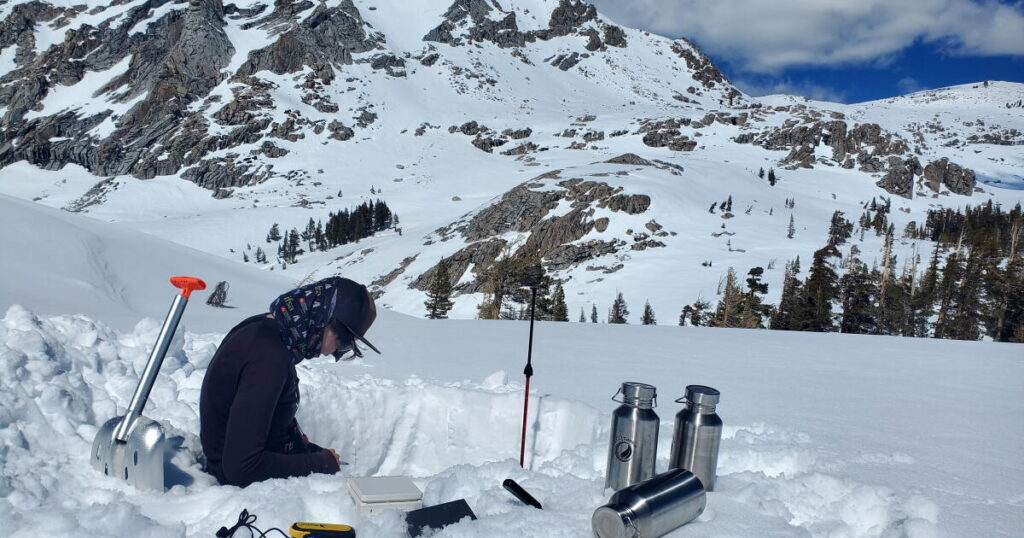
To reach her remote sites, she’d park by the side of a mountain road and ski three to 10 miles in; at least one trip involved an overnight stay. Photos taken by her field partner, Sonya Maple, a co-author on the paper, show Karapetrova knee-deep in fresh snow, ringed by peaks, the only signs of people the two women’s ski tracks and footprints.
For contrast, she also sampled a snow research station on Mammoth Mountain, run by the U.S. Army’s Cold Regions Research and Engineering Laboratory and UC Santa Barbara, near the ski area and the town of Mammoth Lakes. There, she could ride the lift.
Using weather records and the eye she’d developed checking snow layers for avalanche risk, she matched each layer in her snow pit to the storm that laid it down, taking a sample from the beginning of each one.
That’s where she expected most of the plastic to be. Between storms, microplastics hang in the lower atmosphere. When snow begins to fall, the flakes sweep them up and drag them down, which scientists call scavenging.
“The cleansing kind of begins at the first of the storm,” Karapetrova said. As the storm goes on, there’s simply less plastic left in the air to catch.
That meant the longer the dry spell before a storm, the more plastic it carried. The layer that fell after 28 days without snow held about 69 particles per liter of meltwater. The layer that fell after just four dry days held about 11.
Storms did most of the work. At the Mammoth site, Karapetrova also set out a collector to catch plastic settling out of the air on dry days from April to July. Snowfall brought down about 7.5 times as much plastic per day on average as dry weather. However, the authors note the dry samples were collected later in the season with a different method, so the comparison is rough.
Not surprisingly, the researchers found most microplastics came down near people. Storms deposited 267 to 3,190 particles per square meter per day at the remote sites, and on average three times as much, 2,560 to 7,480, at the Mammoth site.
Karapetrova and her colleagues were also very careful not to contaminate their samples with microplastics.
“That was a huge part of this paper,” she said.
“All the equipment we were taking into the back country … we wore wool shirts, cotton shirts, cotton lab coats. All the equipment we used was metal: the bottles, the snow cutters, even the position I was in when I was digging the pit, making sure I was downwind of what I was sampling,” she said.
It was critical for the work but did add another 25-30 pounds of extra weight she and Maples had to lug into the back country.
The team also accounted for background contamination.
Diana Lin, a researcher at the San Francisco Estuary Institute, said the study was impressive, and demonstrates novel and effective methods for detecting microplastics in the snow.
Scott Coffin, a staff toxicologist at the state Office of Environmental Health Hazard Assessment, who was not involved in the research, said as far as he knew the study is the first to link microplastic deposition to individual snowstorms. It shows that storms “wash out” plastic that has built up in the air, he said, and that models can help trace where it came from.
He also complemented the team’s rigor in trying to minimize microplastic contamination.
“Imagine digging snow in a storm without a polyester jacket!” he said in an email.
“The findings are a sober reminder of plastic’s global impacts — reaching otherwise pristine, remote alpine environments — and the importance of research and action to reduce plastic pollution,” he said.
The post A UC Riverside scientist skied deep into the Sierra to track microplastics in snow appeared first on Los Angeles Times.