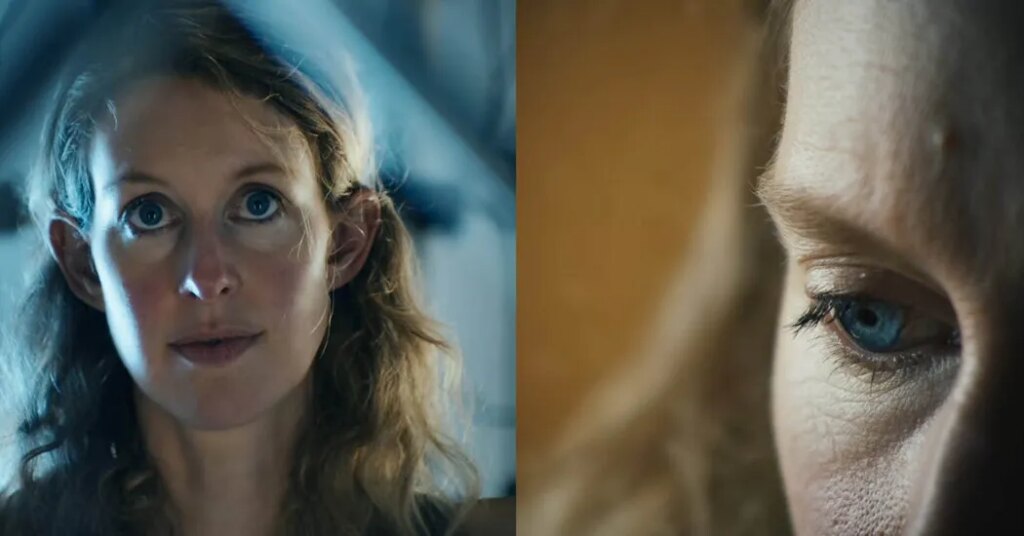
If “You Can See Everything” has done an excellent job of blowing minds, it’s partly because of how it holds — and sometimes assaults — you with its wildly weird faces.
Audiences got their first peek at those faces in a trailer where you hear Elizabeth Holmes, and then see her in close-up. Her cheeks are flushed, her brows raised and she’s smiling, her large eyes wide.
What is she thinking?
There’s a cut to Nathan Fielder, who directed the movie with Lance Oppenheim.
Fielder, his mouth open, stares at her. What is he thinking?
Their faces evoke theatrical masks, but is this a comedy or a tragedy?
Holmes’s and Fielder’s faces, along with that of her partner, Billy Evans, are crucial to how “You Can See Everything” explores the nature of reality, and in doing so makes you question the truth claim of its title — though of course seeing isn’t knowing. Their faces give the movie a stylistic signature as well as humor and even horror.
The documentary isn’t a definitive portrait or journalism, though it is certainly a lot. It is, among other things, about the utopian promise and the grotesqueries of Silicon Valley, one reason it feels so of the moment. The other reason is that its big faces dovetail with the close encounters that smartphones and virtual meetings make part of our everyday lives. Only when these faces are seen in a cinema, they loom.
Art has beckoned us with faces since time immemorial. By the end of the 19th century, the moving faces in moving pictures drew us nearer, helping close the distance between the art and the viewer. With films like “Kiss” (1896), faces became canvases, landscapes, our mirrors.
One revelation of early cinema is its range of faces, like that of Bertha Regustus. In “Laughing Gas” (1907), she plays a woman whose dentist visit sends her into paroxysms of contagious laughter:
The character is stereotypical (a maid), yet Regustus’s role and expressive presence suggests a Hollywood — richer, more diverse — that didn’t happen.
As the star system emerged, faces became instrumental to how films were sold and how the audience’s desires were stoked, their dreams created. Many faces faded; some became totemic. In the 1933 drama “Queen Christina,” the director Rouben Mamoulian shows how Hollywood turned humans into immortals. In the final scene, he opens on Greta Garbo in long shot. …
… then pushes in, finally stopping on her face:
Mamoulian said that when Garbo asked what she should feel here, he told her: “I want your face to be a blank sheet of paper. I want the writing to be done by everyone in the audience.”
It sometimes took marginalized filmmakers — independent, documentary, avant-garde — to reveal something that wasn’t an ideal or an idea, something wholly human, like the characters in John Cassavetes’s “Faces” (1968):
In Fielder and Oppenheim’s previous work, faces underscore reality but also hide it. Fielder often uses his own decidedly unglamorous face to comic effect in his television shows, especially with his deadpan. Like Garbo (really!), he turns it into a blank you fill with meaning.
For his part, Oppenheim has used close-ups to humanize his subjects in “Spermworld” (2024), a documentary about sperm donors and recipients that could have devolved into a freak show.
It’s an approach that recalls Tod Browning’s “Freaks” (1932), in which so-called oddities are more human than their ostensibly normie brethren.
So much in “You Can See Everything” remains unexplained and unresolved, Holmes’s purchase on reality included. It seems instructive that one of its most memorable scenes could be mistaken for a master class on acting. As they do, Fielder and Holmes are talking with an air of tense intimacy. She’s framed in tight close-up and looking up, her face aglow with a golden light. She looks soft, beseeching. She looks beatific.
“It took me a really long time to be OK with letting someone see me cry,” Holmes says.
There’s a cut to Fielder. He nods, and the music intensifies.
The movie cuts back to Holmes. “Um, but,” she says, “I don’t know if I’m strong enough.” The camera holds on Holmes as her eyes begin to water and a perfect tear splashes on her cheek:
Is this the real Holmes? I don’t know, and I doubt anyone does, Holmes included.
It is worth remembering that the first face in the film isn’t hers but Evans’s. He’s talking on the phone and his face fills the screen. So it’s only when there’s a cut to a long shot and he stands that you see Holmes is also in the room, sitting against the back wall with a baby and notably not in close-up. Her hair is disheveled, and her gaze is unfocused. In the foreground are the blurred vertical lines of a crib.
Holmes is already in prison, the filmmakers suggest, which, in the end, may be the only thing you can actually see.
Photos and videos: A24 (“You Can See Everything”); Library of Congress (“Kiss”); Edison Manufacturing Company (“Laughing Gas”); MGM (“Queen Christina” and “Freaks”); Continental Distributing (“Faces”); HBO (“The Rehearsal”); FX (“Spermworld”)
The post What Do You Really See in ‘You Can See Everything’? The Real Faces of Cinema. appeared first on New York Times.