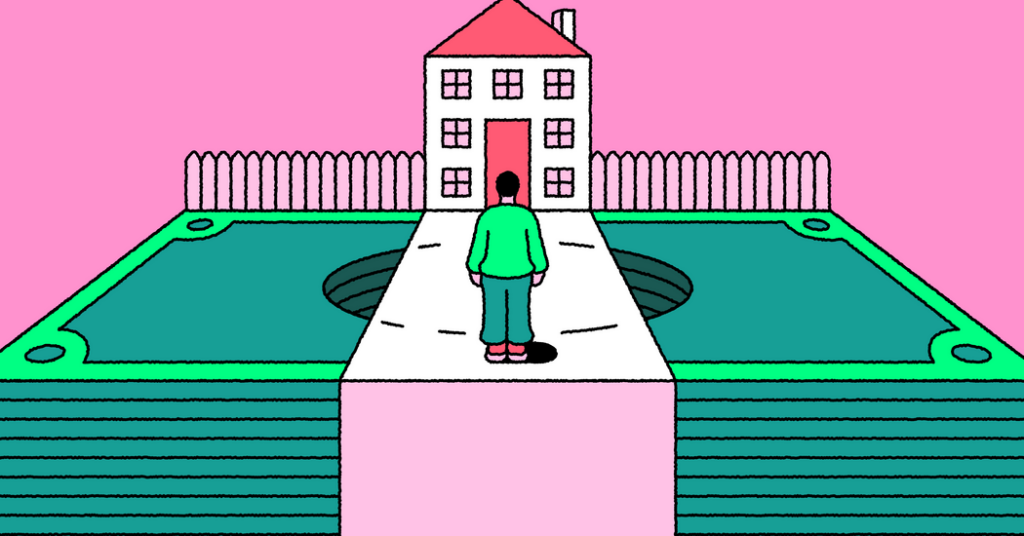
Most homeowners are familiar with home equity loans or lines of credit, which allow them to turn some of their property’s rising value into cash for renovations, to pay off debt or medical bills or to fund a college education.
Now, a crop of financial technology firms is promoting a newer product known as a home equity investment — or, sometimes, a home equity “contract” or “equity sharing” agreement. It’s often described as an alternative, “flexible” way for homeowners to tap their home equity. The product gives homeowners a cash payment in exchange for a share in their property’s future value. The contracts are increasingly packaged as securities and sold to large investors.
The firms say the contracts don’t require homeowners to take on new debt or make monthly payments, and aren’t a form of debt.
“Remember,” says a video on the website of Unison, a home equity agreement provider. “It’s not a loan. It’s cash. Your cash, to use as you wish.”
But some state authorities and consumer advocates say the contracts are, in fact, a type of home loan, with complex, often confusing terms that can put unwitting borrowers at risk of having their equity drained or even losing their homes. The firms, these skeptics say, “mislabel” the transactions as investments or options to evade the consumer protections that accompany traditional home loans.
“Whatever this product is called, it is a loan masquerading as obligation-free cash,” says a brief from the National Consumer Law Center. The center has filed lawsuits challenging the contracts in two states.
The contracts are still a tiny part of the home finance market but have been growing quickly in recent years, in part because of investor interest. The product lets institutional investors benefit from home value increases without the “operational burden” of owning properties directly, according to a report from business consulting firm Oliver Wyman.
The number of investments made by the three largest financial technology firms rose to more than 13,000 in 2024, compared with fewer than 200 in 2018, according to an analysis of company data by the Urban Institute, a think tank.
The investments are increasing as many Americans’ home equity is rising, even as some struggle to afford basic needs. Americans have roughly $35 trillion in home equity — the value of their home after deducting a mortgage or other debt. More people have been tapping that equity by taking out traditional home equity loans or lines of credit to pay off credit card bills or other debt. (Refinancing a mortgage to tap the cash generally doesn’t make sense at current interest rates since many homeowners have loan rates at 4 percent or below and rates are around 7 percent now.)
Here’s what to know about home equity investments.
What are they?
Financial technology companies, including Hometap, Unlock, Unison and Point, give homeowners cash in a lump sum, based on percentage of the home’s current value, in exchange for a share of the home’s value at some point in the future. Homeowners agree to make a lump-sum payment at the end of the contract term — typically, 10 or 30 years — or earlier if the home is sold.
If homeowners can’t pay in full when the contract terminates, they can possibly take out another contract or mortgage to pay it off. If they can’t, they may be forced to sell their home.
Who qualifies for these contracts?
The contracts are based mostly on home equity rather than on credit scores or a homeowner’s income, making them attractive to people with “less than perfect credit” and those without steady income, according to the Coalition for Home Equity Partnership, a group representing financial technology firms. The contracts aren’t reported to credit bureaus and are “particularly useful,” the partnership’s website says, if a homeowner can’t qualify for a home loan.
What can I use the cash for?
The funds can be used for a variety of purposes. About two-thirds of homeowners paid off debt, and just under a quarter used the cash for home improvements, according to an Urban Institute analysis based on data from three large providers.
A 2025 report from the Consumer Financial Protection Bureau said that typical customers were in their 50s when they signed the contract, and that about 90 percent already had mortgages.
How much do the loans cost?
Unlike traditional mortgages, the contracts don’t disclose an interest rate. Rather, homeowners are typically required to pay a percentage of the home’s value, or its increase in value, in a balloon payment at the end of the term. This is risky, consumer lawyers say, because it’s difficult to know what the home’s value will be and, therefore, how large a payment will be due.
In some cases, the terms entitle the provider to a payoff of double the percentage used to calculate the initial payout, said Eric Halperin, a public interest lawyer whose firm has filed a class-action lawsuit against Unlock on behalf of homeowners in Colorado. If a homeowner receives a payout of 10 percent of the home’s value, he said, the provider may be entitled to 20 percent of its value at the end of the term. (Unlock said in an email that it believed the claims in the suit were “without merit” and would defend against them.)
In an example included in a class-action lawsuit filed in August against Unison, Anne Cuvellier, a 68-year-old social worker in East Longmeadow, Mass., and her husband received a $57,137 equity advance on her home in 2017. After the company deducted about $20,000, including fees and the amount of an existing second mortgage, the Cuvelliers netted about $36,329.
In exchange, the couple granted Unison a 70 percent stake in their home, where they had lived since 1990. The suit says Unison estimated that as of September 2025, Ms. Cuvellier — her husband died in 2021 — owed as much as $241,651. That’s four times the original advance. If she reaches the end of the contract’s 30-year term, when she will be nearly 90, she will probably be forced to sell her home because she doesn’t expect to have the money to pay Unison, the complaint says.
In late 2024, Ms. Cuvellier needed cash for maintenance work on her home and was approved for a loan from a credit union. But Unison refused to authorize the loan, the suit said, because it would be secured by her home and “infringe on” Unison’s claim to her equity. Ms. Cuvellier had to take out a personal loan at less favorable terms instead.
Shennan Kavanagh, the director of litigation at the consumer law center, said it was only when homeowners’ terms expired or they needed another loan that they got a payoff quote and realized how much they owed.
“That’s typically when they understand the toxic nature of the product,” she said.
Jesse Silverman, general counsel at Hometap, said the design of home equity investments made them incompatible with many mortgage regulations. However, it is working with the Coalition for Home Equity Partnership to propose customized requirements, such as “situation-based” disclosures that show consumers what their final payments would be, depending on how much their home appreciated over time.
“We support regulation as long as it’s tailored to the structure of our product,” he said.
How do regulators view home equity investments?
States vary in their treatment of the contracts. Some, including Connecticut, Maine, Maryland and Illinois, consider the contracts to be loans. The authorities in some states, including Colorado and Massachusetts, have taken enforcement actions against the contract companies.
At the end of the Biden administration in early 2025, the Consumer Financial Protection Bureau issued a report saying the complex terms and a lack of standard disclosures may prevent consumers from understanding the true costs and risks of the contracts. The bureau filed an amicus brief in a lawsuit against Unlock, arguing that the contracts were residential mortgage loans; the Trump administration withdrew the brief.
Should I consider a home equity agreement to pay my credit card debt?
Helene Raynaud, senior vice president of business development at Money Management International, a nonprofit credit counseling agency, said the contracts might appeal to homeowners who needed cash but were loath to add to their regular expenses. “They cannot absorb another monthly payment,” she said.
She suggested that someone struggling with credit card debt consider working with a nonprofit credit counseling agency to devise a debt management plan. Those plans allow debt repayment over time at a lower interest rate. A list of counseling agencies can be found at the National Foundation for Credit Counseling.
“You don’t need to put a lien on your home to pay off credit card debt,” she said.
The post A Way to Tap Home Equity That Consumer Advocates Call Toxic appeared first on New York Times.