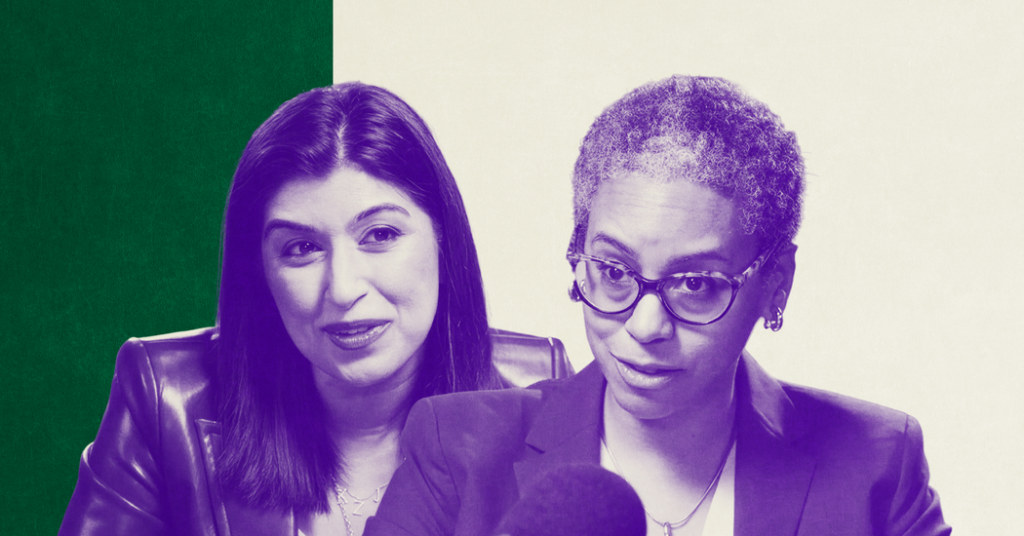
Democrats campaigned on affordability. Now comes the hard part: delivering. In this episode, the economist Natasha Sarin and Elizabeth Wilkins, the president and C.E.O. of the Roosevelt Forward, discuss how Democrats can take on powerful interests and make the economy work for ordinary Americans.
Below is a transcript of an episode of “The Opinions.” We recommend listening to it in its original form for the full effect. You can do so using the player above or on the NYTimes app, Apple, Spotify, Amazon Music, YouTube, iHeartRadio or wherever you get your podcasts.
The transcript has been lightly edited for length and clarity.
Natasha Sarin: I’m Natasha Sarin, and I’m an economist and professor at Yale. I used to work in the Treasury Department with Secretary Janet Yellen, and I’m joined by Elizabeth Wilkins. She is the president and C.E.O. of Roosevelt Forward, a progressive advocacy organization, and my former colleague in Joe Biden’s administration.
We agree on a lot about economic policy and live our lives thinking about it. We also disagree some, so I wanted to invite Elizabeth here for a conversation about the historic midterms we’ve just lived through and what comes next. Welcome, Elizabeth.
Elizabeth Wilkins: Thanks so much for having me.
Sarin: Thanks for being here. I guess where I want to start is, very simply, how are you feeling this morning? We are having this conversation on Wednesday, right after the midterms. How’s it going?
Wilkins: It’s a pretty good feeling. You know, just, on a personal level, I worked on the 2008 Barack Obama campaign for a year and a half, so lots of blood, sweat and tears. And I remember the dream of winning in Texas, of winning in Georgia. And to see, this morning, the country wake up to this idea that there really is people power — and it is all over this country, and it is ready for not only not bad but for something good — is really exciting.
Sarin: I also feel that way. I’m almost nervous to say it, but I feel like this election marks the end of the Trump era in our politics. And if that’s true, it raises really deep and important questions about what comes next. And I think we’re going to spend the next few years grappling with the answer to that question. But the fact that we even get to have that conversation now feels so remarkable, and it feels so decisively remarkable. They’re saying “blue wave.” Forget the blue wave; it’s a blue tsunami that we all got to experience Tuesday night. There are a few moments in your life, when you’re a political junkie like we are, that you get to watch and you’re like, “This actually happened,” and Tuesday night was one of those nights.
Wilkins: Totally. Absolutely. I’m pretty excited.
Sarin: We’re going to seat a new Congress in January. Democrats will have both the House and the Senate. If you were giving Hakeem Jeffries or Chuck Schumer advice at this moment, how should they think about what policy should look like over the course of the next few years?
Wilkins: I think something you just said — which gave me a little bit of anxiety but also excitement — kind of answers the question for me. When you said that this feels like it could be the end of the Trump era, I think that’s only true if we make it so. Like, Tuesday night was one moment. It was an opportunity. But I think we now need to prove to people that life would feel truly different if we had somebody else in charge.
If I were sitting in Congress today or in January, I would be saying, “What are my major tools for showing what would be different?” I have oversight powers, and I have legislative powers, right? And I would say, “How can I use both of those to start that drumbeat?”
So on the oversight side — and I’ve got to say, I think we have to show people not in the abstract but concretely. If I am struggling with costs and, more than that — and you’ve said this really eloquently — I’m not just struggling with costs but I’m struggling with insecurity, with economic precarity, with a feeling of lack of agency and control in my life. How can you use both your oversight and your legislative powers to demonstrate that it could feel different? I’ll just give one example: If I were advising folks on how to use oversight powers, I would say, “Let’s not spend the next two years just investigating the Trump administration.”
Let’s say people are really upset about health care costs and they’re really, really mad at health insurance companies. Let’s bring health insurance C.E.O.s in and ask them about prior authorization. Ask them about self-dealing. Ask them about hospital charges, etc. Ask the pharma C.E.O.s about drug prices. This is the moment for a Democratic majority to show that they are willing to take on powerful interests to lower costs and make life better for people. And you can think about that across a whole bunch of different industries that are directly impacting whether people feel like they can afford their groceries, their health care and their housing and whether people feel like they have control in their lives.
Sarin: Yeah. That resonates very deeply with me — particularly this focus on health care, which is a place where many Americans right now are in the open enrollment period. If they’re among the roughly 160 million Americans who get their health care provided by their employer, they are seeing costs go up this year by 10 percent. Those are the highest increases that we’ve seen at any moment over the course of the last two decades.
And so the explosion of health care costs and the fact that this has become a really significant part of what I think this crisis of economic precarity is really about, right? Because people feel like they are one bad health shock away from potentially being on the brink. And it’s not just that their health care is very expensive. It is also that it is laden with bureaucratic red tape that makes it hard to get services, that makes it hard to get the type of care that we all deserve.
I think there are really deep questions about what one should do about that. I’m very sympathetic to this idea about thinking more about antitrust, thinking more about oversight and accountability of some of these industries. Particularly, there’s really interesting evidence about private equity in health care, where you have seen as a result of private equity ownership of different types of health providers, which has increased by something like 2,000 percent over the course of the last few decades.
You’re seeing, in nursing homes, worse outcomes for patients. So I am super sympathetic with trying to figure out what to do here. And it seems incredibly first order for me. And we’re also confronting the fact that Americans, as a result of the reconciliation bill that President Trump passed last summer, are in a moment when people — millions of people — are uninsured as a result of those types of policy decisions that were made.
With all of those things to be addressed, I guess, again, the question of prioritization comes up, which is: What should we do? And particularly, what do you use the next couple of years to do? Because I don’t think it’s just these messaging bills and all of that. This is agenda setting for what a future Democratic administration could aspire to do and what they are going to focus on.
Wilkins: Absolutely. And I would say prioritization is super important. Health care, as an overall priority, has to be No. 1. And I do think we kind of have to do both things at once. It will not be enough just to restore the cuts. If what we do is we say to Americans, “The best we can do is what was happening to you for the decade before Trump,” we will have lost this moment. Knock on all the wood. I think that we can walk and chew gum at the same time.
Sarin: Which is not to say we shouldn’t undo the cuts, right?
Wilkins: No. Just to be clear, that’s table stakes. We can’t leave people who are in pain — immediately, right now — hanging out to dry. But we also can’t let that be the ceiling on our ambitions. There are two things going on: One is that we have markets that are broken and costs are going up. And then another thing is that people are so angry that they are treated so poorly by the institutions that they need so badly for their health care, right?
And I just think you have to do both of these things at the same time, and the prioritization comes in. Are we going to spend a whole bunch of time trying to do impeachment? Are we going to spend a whole bunch of time trying to do policy that has to do with looking backward, or are we going to spend a good amount of our time on health care, on A.I. companies, on energy prices and energy costs?
And so to me, thinking about a two-track, where you’re on one track saying, “What does it look like to make sure that your insurance company can’t also own the pharmacy benefit manager and also own the provider and also own the pharmacy?” That is one. And then there’s a real debate to be had about what it means for us to do real structural reform in the marketplace. And I think, if we take a lesson from Tuesday night, it is that we have to meet the ambition of the American people with the ambition of our policy proposals.
Sarin: I totally agree with you, and yet I think it is hard. And it’s hard for the following reason: I think that the question about ambition and structural reform is really at the heart of it, and health care is a very good illustration of exactly those types of challenges, because I almost think there are two different types of policy approaches you might be interested in pursuing.
One, my colleague Zach Cooper at Yale, who’s an economist, has started a version of what he’s calling like the 1 Percent Steps for Health Care Reform project. And what that is is gradual incrementalism to bring down health care costs. It turns out that if kids have fall birthdays, they are much more likely to get flu vaccines because they can get them at their annual checkup. And otherwise — as a parent, I totally understand why this would be — it’s just hard to make it to that other appointment. And if you can get kids vaccinated, you can actually save about $500 million in doctors’ visits that you don’t need or E.R. visits you don’t need, as a result of that policy change that’s relatively minor.
And if you add up all of these gradual things, Zach’s point is that there’s actually a lot of money to be had in health care cost savings as a result of those types of approaches.
There’s a different type of approach, which is, I think, a bit your version of meeting the ambition of the moment, which is, what we need is to talk seriously about Medicare for all. We need to talk seriously about the idea that the health system is fundamentally broken and that we have to rip out the guts rather than try to, on the margins, make the system work a little bit better.
As an economist, it won’t surprise you, I tend to be drawn to incremental approaches not because I don’t like the idea of ambitious approaches but because I think that the health system’s really complicated. We talk about it as if it’s one thing. It’s, like, the veterans’ health system and the state health systems and the federal health system and the hospitals, and it’s just, like, there are many different parts, and I feel like there’s actually a lot of low-hanging fruit to be had in doing the parts a lot better than we’re doing them today. But maybe that strikes you as not ambitious enough.
Wilkins: Well, I would actually maybe put it a different way. I’ll tell you a slightly different thing that I worry about, which is — and this is true of health care, and this is true of a lot of other areas in the economy — we do truly need structural reform, but that takes time.
Sarin: Tons of time, yeah.
Wilkins: And have been waiting for a long time, and I don’t think we can say to people, “You can’t make next month’s premium bills? Don’t worry ——”
Sarin: “We’ll wait a decade.”
Wilkins: Yes, exactly. I don’t think of it as incrementalism, but I do think we need a policy strategy that says: What kinds of down payments — that are achievable today and can be felt today — should we focus on in the effort to build up to a bigger structural reform in the future? What I think about is: What are the smaller but impactful things that we can do now that are directionally correct for the kind of structural change that we want to see in the future? I’ll give you an example within the health care context.
When I was at the Federal Trade Commission under Lina Khan, we saw a problem where pharmaceutical companies would file with the F.D.A. — it’s called filing in the Orange Book, these lists of patents for medicine, and it’s sort of like a patent protection scheme, an extra patent protection scheme. And we saw a whole bunch of filings that looked kind of bogus but that were increasing the patent protection life of a bunch of drugs or that were protections for things that shouldn’t have been there in the first place, like devices.
And we started writing letters to companies to say, “You can’t do this, and there’s actually individual liability if you do this. Are you sure you want to stand by this listing?” And not only did we get a bunch of listings delisted, but just through our letters, we got three companies to say, “Do you know what? We were going after insulin devices. We will cap our insulin prices at $35 voluntarily.” That was the kind of intervention that was immediate. People could see their insulin prices going down. It’s not the structural reform that we need, right? But it builds the will to say, “We need to go after drug pricing schemes. We need to go after market structures that aren’t working. We will do something now on the way to doing something big later.”
Sarin: And I think what I’m hearing you say is that it’s a version of — I think you even said it, like, walk and chew gum at the same time — do the short-term stuff but also think longer term about the types of structural changes you really need to make. It is, though, interesting, if you look at these midterm elections, after cost of living issues and affordability, the second big issue that was animating voters was corruption.
We have just lived through this attack on our institutions, this change from being a country that is governed by the rule of law to one that feels like it’s governed by the rule of deals in proximity to this administration. And I just feel like there needs to be something done about that, in part because we know that corruption is a tax on the economy. It lowers growth. It makes it harder for the country to feel and the government to feel like it’s really serving people if it feels like it’s only serving the interests of the few who have kind of stolen it for themselves. Does that fit into this type of agenda setting and prioritization?
Wilkins: I think it totally does. And this is back to maybe your first question, about what should be done in the next two years. I think we have to understand corruption the way people understand it, which is not separate from the affordability agenda. There is a direct tie between the capture of our democratic institutions and whether or not they can respond to the needs that people are expressing. That’s the narrative we have to tell, and we also have to show, not tell, that we are actually willing to do something about it, right? Part of the problem is that people feel as if the system is rigged.
Most people don’t actually differentiate between political leaders and corporate leaders. They sort of think those are all them. They’re all leaders.
Sarin: They’re the elites.
Wilkins: They’re all in it for themselves. Exactly. And they’re not in it for me. So there is a real need to demonstrate that political leaders are actually willing to differentiate themselves and go after the forces that are capturing the government.
Were I in the position of advising what an oversight agenda should look like that has to do with corruption over the next two years, I would have two buckets: One is a whole bunch of corruption-oriented things that tie directly to people’s pocketbook costs and their experience in the economy. For example — just to go back to pharmaceutical companies — a bunch of pharmaceutical companies did some deals, got relief from tariffs from the Trump administration, then they turned around and raised drug prices. That relief didn’t go to people. It went straight to the pockets of the corporations. I would investigate those deals.
And then there’s another bucket, which is that these were the most expensive congressional elections in history — between $11 billion and $12 billion spent around the country. The Times reporting is that the top 20 donors spent $2 billion just by themselves. I think people get that.
Doing oversight that looks at, very specifically, what’s going on with Elon Musk’s corporate contracts with the government or looks very specifically at what’s going on with the quid pro quo with the crypto industry. Those are the folks that are pouring money into our elections and buying policy outcomes for themselves, and I think that the American people will get that, and that’s sort of the drumbeat that we need to show.
Sarin: I think I agree some but also disagree some in both of these buckets, so I kind of want to dial into both of them. One is: I do agree that we need much more antitrust enforcement. We need to look at mergers — very deeply true. And the work that you did at the F.T.C. was an important step in the right direction, but a step, and much more needs to be done.
I find some of the narrative around “The corporations are greedy, and they’re profit maximizing for themselves, and they’ve gotten greedier, and that’s why prices are high.” I don’t find it exceptionally compelling as an economic argument, in that corporations are profit maximizers. That, in some sense, is what they are doing, and if they’re corporations that are organized in the regular corporate structure, it’s actually what they have to do, which is operate in the interests of their shareholders.
Whether or not certain rules exist or shouldn’t exist with respect to how the government treats different types of industries and different corporations is a really important first-order question for us to grapple with. But it is less obvious to me that some of the narrative, from a lot of people that I respect as policy thinkers, that has had versions of “Greedflation is why prices are rising” is really a compelling explanation for what has happened in the economy over the course of the last many years.
I’m kind of curious to get your reactions to that and also curious to get your reactions on this question about money and politics. Because I can tell a different story about what we saw Tuesday night, which is that Elon Musk literally moved to Texas and spent half a billion dollars on these elections, and the result of it is that Texas is sending James Talarico to the Senate and has elected a Democratic governor.
And not to say money in politics is good or “Yay, we should cheer the hundreds of billions of dollars that are being spent by the very elite,” but I feel like I need a bit more of a nuanced view about what money in politics is really doing. Because in some sense, I’m thrilled about the strength of our institutions and the strength of our democracy, that Tuesday night was kind of a repudiation that you can’t just buy elections.
Spend all this money, have all this access and yet not exactly be able to drive the political outcomes. Not that it’s not a problem, but maybe, what is the problem, precisely? And then what is the set of solutions that are going to effectuate change?
Wilkins: Totally. I will tell a slightly different story about two years ago and Tuesday night around money and politics. Sherrod Brown in Ohio two years ago got wiped off the map by tens of millions of dollars from the cryptocurrency industry, right? It was one of the biggest stories in politics. And what did you see right after that election? You saw the crypto industry pushed legislation passing in Congress. Now, they kind of messed up their politics, and they didn’t end up getting everything they wanted, but right after that election, in particular, and big crypto spending around the country, you saw politicians all of a sudden afraid to go against the crypto industry and willing to work on reforms in the way that they wanted.
I do agree what is incredible about Tuesday night is that the playbook didn’t work for the first time. I don’t actually take that as a sign that our political system and our institutions are strong. What I take that as is that it took, as you said, a tsunami to overcome those forces and we cannot squander this moment. This is the moment to change those dynamics and harden our institutions against those influences in the future.
Sarin: I find that really interesting, and I think there’s a really interesting question about where political power sits. And as a result, the crypto example you gave is actually super helpful to dive into. There’s this great new book by some of my economist friends, Owen Zidar and Eric Zwick, that’s called “The Everywhere Millionaire.”
And one of the theses of the book is that we’re spending too much time in our politics and our policy discourse talking about people like Elon Musk and not enough time talking about where wealth and power feel like they sit in our economy.
And that actually tracks with my experience when I was in Washington, which is that I’ve worked a lot with members of Congress on tax policy, and it always struck me that a lot of political power seemed to sit with two sets of groups. It sat with community bankers, and it sat with car dealers. And why is that? Not because they’re Elon Musk-level donors to our political process but because literally there is one in every district, right? And they are incredibly important. And as a result, they’ve created so many types of preferences within our tax code to essentially favor those types of industries and those types of everywhere millionaires in ways that I feel like are really corrosive to the system.
As I try to think about what you do about that, I feel like I want us to have a broader conversation than “Here are the biggest donors in this midterm cycle or in the ’28 cycle,” because it feels like it’s a broader story about our politics and our policymaking process than you can capture by those individuals, if that makes sense.
Wilkins: Yeah. I mean, look, it’s certainly true that there are certain individuals that are fun to beat up on because they’re really good symbols of a thing that is wrong in our politics. But I agree with you in the sense that this is not an individual problem; it’s a systemic one. In terms of tax policy, you’re totally right: We should tax the wealthy. That is not going to be enough, so we really have to take on not only taxing the wealthy but everybody who’s an everywhere millionaire also needs to be brought much more into the tax base. That, I think, we could violently agree on.
And then I just want to go back to one other thing you said, which was really interesting, which was about concentrated corporate wealth and power more broadly and its economic effects. It is true that we have corporations that are designed and have to profit maximize. And you said something about making sure that we have rules of government that protect our institutions. What I would say is that we should have rules of the economy that make sure we drive innovation and growth toward real problems that real people face rather than toward financial engineering.
Like, we can change the rules of the road for the government, and we can also change the rules of the road for how corporations are organized and how they are incentivized to make their money. That’s through the tax code, what kind of engineering does or doesn’t bring them wealth. That can be through a regulation. But the idea of, within a capitalist system, driving corporate incentives toward innovation, entrepreneurship and growth rather than toward financial engineering, I think is important and ties into this corruption question, because at some point, no matter what rules you have to protect government, if there is enough wealth, it will find a way in.
Sarin: I actually just want to spend a beat on what I think one of these emerging conversations is likely to be in our politics and one of the takeaways from Tuesday night, which is artificial intelligence and what our posture toward it as a government is going to be.
It’s super important at this moment. It’s going to be super important over the course of the next two years. And as you think about agenda setting and forward-looking, one of the things that I personally would love to see from Democrats is an answer. And I feel like this is actually animating real concerns that real people have at this moment. And a lot of what we saw Tuesday night with the data center moratoriums actually reflects that. I wonder if you have a thesis about what — I named a lot of problems for you in this space — one should do.
Wilkins: I’m pretty sure that if I had all the answers, somebody would pay me a lot of money right now. First of all, I think ——
Sarin: There is a lot of money — there is so much A.I. money flowing around from all sides.
Wilkins: That is very true. To plus one to your premise: Tuesday night, data center moratoriums won around the country.
Archival clip: “One count found at least 41 jurisdictions nationwide passed bans or restrictions on data center construction.”
I think this story is wild, but in the last week, you saw the story about how Google is now saying to schools that if they don’t want A.I. in schools, they’re going to shut off their access to Search. The thing about A.I. right now, in this moment, is that it touches so much of what people want, need and believe about their lives.
It is economic precarity. It is the sense that some kind of system is rigged and then this sort of very deep personal sense of “Do I have control and agency over how I choose to raise my child, what they’re exposed to and whether I can raise them with my values?” There is a really wide spectrum of what people are feeling. That’s part of why it’s so hard to think about what the right solutions are, right?
I think we need to do, one, “What’s the list of harms that we are actually worried about?” and then “What solutions are appropriate to those harms?” I think we have a wealth of answers. This is a little bit of a professional hazard for me, but I do really like the New Deal legacy. It’s one of the most creative regulatory moments in our history.
I mean, we did all of these things with, I guess, a few principles in mind, which I think we could return to in thinking about regulating A.I. One is controlling the concentration of power at the top: How much power is too much power in the private markets vis-à-vis our government? The second is: How do we build power and agency for people at the bottom? And then the third is: How do we lay a foundation of security, like Social Security, underneath everybody? And I think that if we can figure out in our regulation of A.I. how to deploy those three values — and say at the end of the day, we want democratic control, we want power and agency for people, and we want economic security — we could think of what this A.I. moment could be in terms of, like, a new New Deal for people.
Sarin: I’ve been saying, I actually think about thinking about A.I. also as a cost of living issue for people.
Wilkins: Totally.
Sarin: Totally. Right? And corruption is a cost of living issue, and health care is a cost of living issue. And child care and elder care and everything else that people are experiencing, ranging from how they’re interacting with the tariffs to how they’re thinking about these questions about gas prices. These are all fundamental cost of living questions, which is why cost of living dominated the midterms, why it is going to dominate the ’28 presidential election.
And I feel like some sort of framework, like I’ve been saying — you said, “new New Deal”; I’ve been saying “a newer deal” — just some sort of framework that allows you to get at the structural change that you need in the economy feels really important. The thing that makes me nervous about the fact that we need that is, if you look at the New Deal era and at Roosevelt, if you spend a lot of time thinking about F.D.R.’s legacy, it wasn’t quick fixes.
And by the way, it wasn’t even that all of the policies we got right at once, right? There was a lot of time to innovate and think about, like, “This structure for Social Security actually isn’t doing what we want it to, so we need to do this.” And you had the capacity to do that in a Congress that was willing to legislate in a way that we just don’t have at this moment. I worry that we govern in these two-year election cycles, and something on the scale of a newer or a new New Deal — it just requires you to be able to do more than that.
Wilkins: Yeah. I worry about the same thing. There’s also just a communications thing. Like, F.D.R. had his fireside chats.
Archival clip of Franklin D. Roosevelt: “Let us unite in banishing fear. We have provided the machinery to restore our financial system; and it is up to you to support and make it work. It is your problem no less than it is mine. Together we cannot fail.”
He didn’t actually get us out of the Depression until we went to war, right? And he got re-elected even in the midst of some serious economic pain. Part of that is because he could narrate to the American people, like, “Here are the forces that I’m up against, the kinds of changes that I want to make. They’re not going to be here overnight, but here’s what I’m doing for you. Here’s how I’m fighting for you. When I have a loss, I’m going to explain it to you.”
We need to be unafraid to have that kind of communication relationship and to say, “I’m not going to win every day, but I’m going to give you small proof points that I’m fighting for you on the way to these bigger structural changes.”
And you’re totally right about Congress. We’ve got to do something about that. Congress needs to step up and do its job again. It is meant to be trying to solve these big problems for folks, and it shouldn’t be the role just of the executive, the way that we are seeing right now, frankly. We do have some real capacity and structure questions about what would make the institution of Congress able to move again the way that the American people want it to.
Sarin: A lot of podcasts sometimes end with book recommendations or ideas or shout-outs, but since we are econ wonks, I wanted to try something slightly different, which is what I’m tentatively calling economics in the wild — an econ story that struck you this week that is not midterm-related, since we got to do a bunch of that already.
I’ll give you mine first. The Dallas Cowboys Cheerleaders — by the way, obsessed, so I will do a shout-out plug. I’m obsessed with the Netflix show “America’s Sweethearts.” But the Dallas Cowboys Cheerleaders are actually mobilizing and unionizing and in an effort to make it such that they’re able to collectively bargain for a bigger share of the pie that the Dallas Cowboys currently have. Their current share of the pie is basically nonexistent, and they’re using this moment to unionize.
That makes them, by the way, only the second professional football cheerleading squad that has unionized. And I speculate that the reason that they’re able to do this at this moment actually has a lot to do with the Netflix show, because in the absence of it, you wouldn’t have been able to have the capacity to do this, because the team would’ve said there are thousands of girls trying out to be cheerleaders. If you have this posture with respect to the type of bargaining capacity you want — there are other people that are going to take these spots.
I think it’s just a very interesting and important case study about worker power. You actually see it play out on the show as well, as you have these young women, who are remarkable athletes, that are advocating for what is really only fair with respect to the type of commitment that they’re making to the organization. And — I don’t know — I think there’s a lot of interesting policy discussions to be had about unionization, but in this case, I have to say I’m really excited for the Dallas Cowboys Cheerleaders.
Wilkins: Oh, I love that one. I have to tell you ——
Sarin: Do you watch the show?
Wilkins: I haven’t watched the show.
Sarin: You’ve got to watch the show.
Wilkins: A, fair, but B, as a native Washingtonian and obligatory Commanders fan, I couldn’t possibly shout out anything having to do with the Cowboys, so I’m glad you brought it up and I didn’t have to, but I am super, super excited about the cheerleaders unionizing.
This isn’t quite this week, but it just feels so in line with the vibes coming out of Tuesday night. The Brewers versus the Dodgers leading up to the World Series was such an American story of the little guy beating the Goliath. But it also is a story about money in sports, right? The Dodgers can have the players that they have is because of the way that the rules are structured in baseball. There isn’t a salary cap. There is flexibility for teams to have more money, spend more money. And it means that it sets the rules for competition in baseball and what you can do.
To me, watching the Brewers win was not just the tried-and-true American David versus Goliath, but it also said something about the choices we make when we structure markets, the kind of competition that we do or don’t want to see. And I think America told us we don’t like that there are Goliaths like that, and maybe we should have different rules so that everybody can compete fairly.
Sarin: I am so proud of two econ wonks who just did sports stories in this wrap-up. Elizabeth, thank you so much for being here. I feel like we have many more such conversations to have in the next couple of years and beyond, so thank you.
Thoughts? Email us at [email protected].
This episode of “The Opinions” was produced by Emily Holzknecht. It was edited by Kaari Pitkin. Mixing by Gautam Srikishan. Video editing by Arpita Aneja and Mahdokht Mahmoudabadi with help from Jan Kobal. Cinematography by Kyle I. Kelley and Bets Wilkins. The postproduction manager is Mike Puretz. Original music by Carole Sabouraud and Aman Sahota. Fact-checking by Mary Marge Locker and Kate Sinclair. Audience strategy by Shannon Busta, Kristina Samulewski and Ali Baluch. The director of Opinion Video is Jonah M. Kessel. The director of audio engineering is Isaac Jones. The deputy director of Opinion Shows is Alison Bruzek. The director of Opinion Shows is Annie-Rose Strasser.
The Times is committed to publishing a diversity of letters to the editor. We’d like to hear what you think about this or any of our articles. Here are some tips. And here’s our email: [email protected].
Follow the New York Times Opinion section on Facebook, Instagram, TikTok, Bluesky, WhatsApp and Threads.
The post What Democrats Can Do Now to Lower Costs appeared first on New York Times.