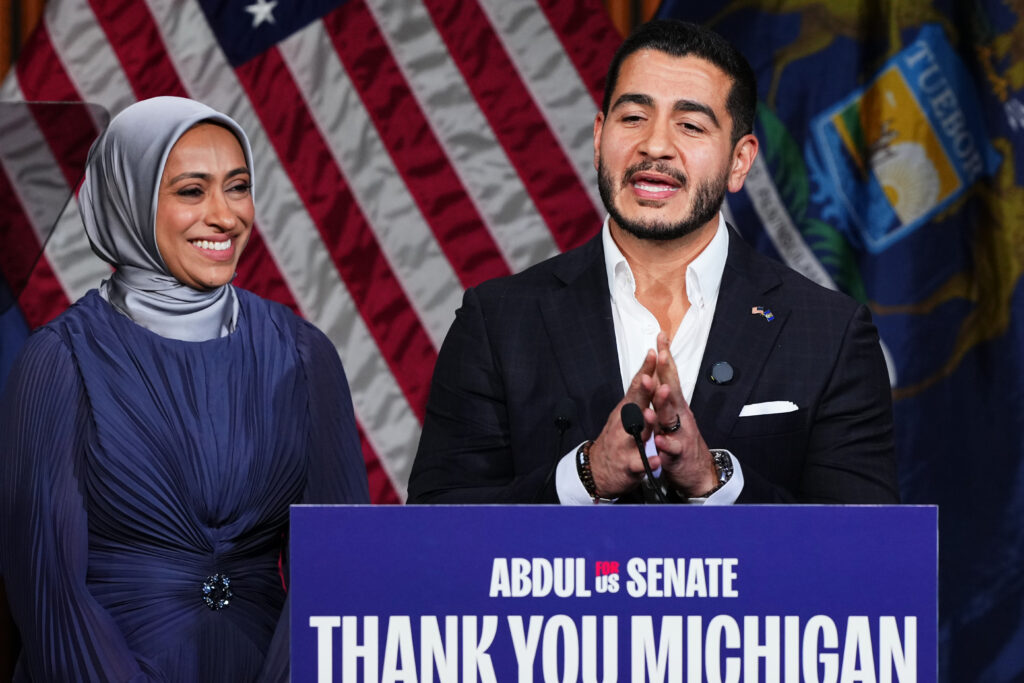
DETROIT — When Abdul El-Sayed, Michigan’s newly elected senator, stepped to the microphone at his victory party, he gave praise to Allah.
He introduced himself with his full Arabic name, Abdulrahman Mohamed El-Sayed, which he had joked on the campaign trail contains “sounds that come out of parts of people’s throats they don’t know they got.”
And as he stepped into the moment America elected its first Muslim senator, El-Sayed laced his speech with nods to his culture as both an embrace of an identity maligned by millions of dollars worth of attack ads and a dunk on the Republican opponents who tried to use it against him.
“You chose hate, and Michigan chose hope,” El-Sayed said to his Republican opponent Mike Rogers, telling him to “enjoy your retirement.”
The Islamophobic rhetoric, deployed not only in ads but spoken on the trail by President Donald Trump, Vice President JD Vance, Sen. Ted Cruz (R-Texas), Health Secretary Robert F. Kennedy Jr. and Rogers, among others, backfired in a state with one of the country’s largest Arab and Muslim populations.
El-Sayed won by a seven percentage point margin, according to unofficial returns.
He said Republicans had nothing to say about how expensive gas or groceries become, and he anticipated they would go for the “red meat” of anti-Muslim attacks.
“Here’s the problem with the red meat: It becomes an addiction,” he said during an appearance Thursday on “The View.” “Once you go there and you put that out there, then you’re forced to defend it. So what do they do? They double down. They triple down again.”
In the end, it did not work with voters angry about the cost of living and the war in Iran.
El-Sayed’s vote margin was 10 percentage points better among voters in low-income counties than Vice President Kamala Harris in the 2024 presidential election, and his vote margin improved by 17 points among White voters without a college education — long a key constituency of the Trump coalition — and his margin also improved by 43 points among voters under 25, according to a voter poll by NORC.
In Dearborn, the country’s first majority-Arab city, Trump won by six percentage points in 2024. But the city’s voters both posted record turnout Tuesday and voted for El-Sayed by more than a 65 percentage point margin. More voters cast ballots in the Senate contest than the race for governor.
Cruz predicted “Americans will die” if El-Sayed was elected.
Kennedy falsely asserted that modern Arab Muslims don’t produce science.
Vance called El-Sayed “very, very evil.” And Trump repeatedly called El-Sayed a “violent jihadist.”
Rogers, appearing at campaign events, never corrected his surrogates and repeatedly suggested that El-Sayed had ties to terrorist organizations.
“Mike Rogers ran the most Islamophobic, hateful campaign I’ve ever seen,” Michigan Democratic Party Chair Curtis Hertel said Thursday.
The Rogers campaign did not respond to a request for comment. Alyssa Brouillet, a spokesperson for Rogers, told The Post during the campaign that Rogers condemns all hate including Islamophobia and that the critiques of El-Sayed’s associations and comments were factually accurate.
After the election, Rogers released at statement that did not mention El-Sayed and said, “Michigan — we have a state to save, now more than ever.”
Hertel said Black pastors in Detroit told him the way Republicans talked about El-Sayed reminded them of how Black people had been disparaged for generations.
“Winners should be gracious, but I do find glee in the fact that he lost,” Hertel said of Rogers. “It was a huge mistake for them and backfired.”
Hertel’s GOP counterpart, Michigan Republican Party Chair Jim Runestad, agreed that associating El-Sayed with Muslim stereotypes was the wrong message for a state like Michigan.
Runestad told MS NOW on Wednesday that national Republicans should have more “sensitivity to the local conditions” and that Trump’s branding of El-Sayed as a “jihadist” did not help.
“For me, politics is a game of addition and not subtraction,” Runestad said. “You have to be very careful about a whole community feeling that they are being attacked with your words.”
In the Michigan Senate race, Republican advertisers spent $46 million — more than one-third of their total ad spending — on attacks against El-Sayed that invoked terrorism or 9/11, or referenced Islam or Muslim groups, according to a Washington Post analysis of AdImpact data.
The Senate Leadership Fund, the GOP’s super PAC dedicated to electing Republicans to the Senate, spent the most on these types of attack ads, more than $16 million.
“They’re basically throwing every iteration of anti-Muslim rhetoric that we’ve been hearing for the past 25 years at him,” said Rozina Ali, author of “Seasons of Fury,” a book exploring seven decades of Islamophobia in the United States. “It’s like they’re just trying everything they can, so it’s national security, radicalization, secret missions, secret intentions.”
Two weeks before the election, El-Sayed attempted to rebut the negative stereotypes head on with an ad saying his name means “servant” and that he prays daily.
“Faith is a thing there’s just too little of in Washington,” he said. “I am a man of faith. That’s a good thing.”
Yet multiple voters raised fears about El-Sayed’s religion as an explanation for voting against him.
“I don’t think he’s pro-American,” said Theodora Calvas, holding a pair of American flags and wearing a red, white and blue cowboy hat while she waited for a Republican rally in Macomb County with House Speaker Mike Johnson (R-Louisiana) the weekend before the election. “And I really don’t want, I hate to say, a Muslim influence in our Christian country.”
A supporter interrupted the speakers during the rally, shouting “Islam is evil” and “No sharia,” referring to the Muslim doctrine of sharia law.
El-Sayed responded to the attacks with a mix of humor and hitting back.
He’s told reporters he follows shawarma law, joking “if a shawarma has lettuce in it, it is not a shawarma — it is just a sandwich,” and Shakira law, because “these hips don’t lie.”
But he’s also directly challenged why opponents question if he would have dual loyalty to his country and Muslim doctrine. A clip, in which he compares the insinuations to attacks John F. Kennedy faced when he was running to be the first Catholic president, quickly went viral. And he’s aggressively challenged both Vance and Trump over their remarks.
“Donald Trump created this moment. He created it by being a bully,” El-Sayed said in an interview this week about the tone of politics and the meanness on display in his race.
“We can be governed by bullies or we can be governed by principles,” he said. “I prefer to be governed by principles, but I don’t back down to bullies. I bully bullies. I think that the only way to address a bully is not to appease them or ignore them. You have to beat them, and then we have to get back to a world where we’re governed by principles.”
Shopping for groceries at Westborn Market in Dearborn earlier this week, Noor Khalil, 31, said she thought people who backed Republican nominees in this climate were racist
“It’s the most racist people that think racism is not a problem in our country,” Khalil said.
Nic Antaya, Luke Connors, Harry Walton and Haider Zaidi contributed to this report.
The post How Islamophobia backfired and helped elect the first Muslim senator appeared first on Washington Post.