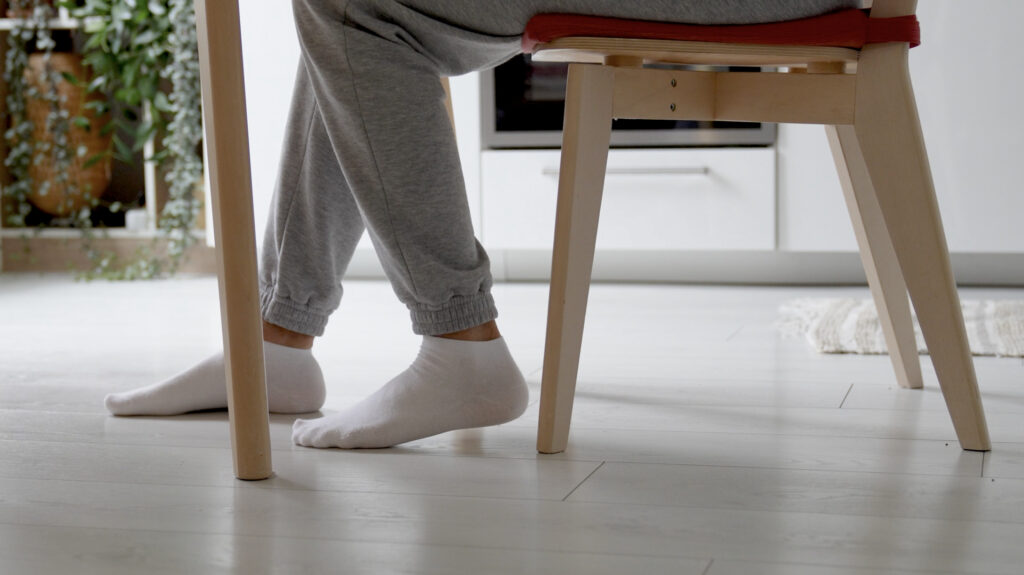
Do you bounce your knee while tackling an arduous task, tap your foot while answering emails or drum your fingers on a notepad during a meeting? These everyday behaviors are often perceived as signs of restlessness. But what if seemingly trivial movements — known as fidgeting — could actually benefit your health?
“When we talk about fidgeting, we’re really describing the nervous system’s tendency to keep the body in motion,” said David Perlmutter, a board-certified neurologist in Clearwater, Florida, and seven-time New York Times best-selling author. Perlmutter said that fidgeting isn’t necessarily a bad habit; it may simply be your brain’s response to sedentary behavior.
“We tend to think movement only ‘counts’ when we’re exercising,” Perlmutter added. But, as it turns out, even small and seemingly inconsequential motions may have positive health effects, including improving your circulation, the way your body processes sugar and your ability to focus on a task.
Here’s a closer look at how fidgeting can help introduce subtle bursts of movement into your day and how those may manifest as micro health benefits.
Fidgeting and blood flow
Normally, muscle contractions in your legs help move blood from the lower body back toward the heart, maintaining healthy blood flow. Sitting relatively motionless for hours can decrease blood flow in the lower body, which can lead to muscle stiffness and mild swelling in the legs and feet.
But even small movements while sitting can help get blood moving again, said Milica McDowell, a physical therapist in Bozeman, Montana, and author of the book “Walk.” While fidgeting isn’t going to provide the same benefits as a 30-minute walk or a strength-training session, it can help keep “oxygenated blood moving throughout your body and reduce pooling of fluids,” McDowell said.
In a small 2016 study, researchers instructed 11 healthy young adults to sit for three hours, keeping one leg still while repeatedly bouncing the other leg for one minute every five minutes. They found that this small movement produced a substantial (though temporary) increase in blood flow through the popliteal artery, which runs behind the knee, in the fidgeting leg. Additionally, the same artery in the sedentary leg was less able to dilate in response to an increase in blood flow, a potential sign of reduced vascular function.
Other research suggests that more deliberate movements, such as seated calf raises, may also help improve circulation. In a 2026 study involving 34 healthy young adults, researchers found that a brief seated routine combining heel raises and leg stretches after an hour of sitting more than doubled blood flow through the popliteal vein, which carries blood from the lower leg toward the heart.
For this reason, McDowell considers seated calf raises one of the “best fidgets.”
Fidgeting and metabolic health
When your muscles contract, they absorb glucose (sugar) from your bloodstream to use for energy, said Gillian Goddard, an endocrinologist, adjunct assistant professor at NYU Grossman School of Medicine and author of “The Hormone Loop.” This supports a healthy insulin response and helps stabilize blood sugar levels.
Even small movements, such as tapping your feet or bouncing your legs, can activate this process, Goddard said.
In one small study, 20 adults with obesity drank a glucose beverage and then spent three hours either sitting still or intermittently fidgeting both legs. When participants fidgeted, researchers found, their glucose and insulin levels rose less in response to the drink than when they remained still, suggesting that even small, repeated muscle contractions may help your body regulate blood sugar after eating.
Fidgeting also contributes to non-exercise activity thermogenesis, or NEAT, the energy you expend through everyday movement outside of exercise. A 2023 scientific review highlighted research showing that people who fidgeted while seated burned roughly 46 percent more energy than when they sat still. While that doesn’t necessarily translate to a substantial number of calories, they can add up over the course of a day or week.
Fidgeting and focus
“The cognitive effect of fidgeting varies significantly from one person to another because of differences in baseline brain chemistry, sensory processing styles and the specific nature of the task being performed,” said Doha Ayish, a board-certified neurologist at Houston Methodist West Hospital.
Fidgeting may help some people stay focused, particularly during tasks that call for sustained attention. This may be especially true for people with ADHD.
In a 2024 study of 70 adults with ADHD, researchers tracked participants’ movements while they completed an attention task. They found that fidgeting more was associated with correctly completing the task. It could be, researchers suggested, that movement may help people with ADHD maintain the arousal and alertness needed to sustain attention.
“The brain functions best within an optimal range of arousal,” Perlmutter explained. “Too little, and we become sleepy, disengaged and easily distracted. Too much, and we may become anxious or overwhelmed,” he explained. “Small, repetitive movements may help some people regulate that level of arousal and remain engaged with what they’re doing.”
How fidgeting compares to larger movements
Ahmet Arac, a board-certified neurologist and assistant professor of neurology at UCLA’s David Geffen School of Medicine, said that while studies show that leg fidgeting can increase blood flow to the moving area and support metabolism, the effects are short-term and modest at best.
And despite its potential benefits, fidgeting alone can’t undo the health consequences of prolonged sitting. “There is no strong evidence that fidgeting is sufficient to overcome the adverse health effects of a sedentary lifestyle, especially when compared to an active lifestyle with regular cardiovascular exercise,” he said.
If most of your days are largely spent with your bottom in a seat, focus on fitting more physical activity into your life whenever you can to combat the sitting: That might mean scheduling movement breaks throughout the day (even a brief walk can help), making time for intentional exercise or simply being more active outside of work hours, such as in the evenings and on the weekends.
And when you really can’t get up for long periods of time, try fidgeting intentionally. McDowell recommends movements that activate your leg muscles, such as seated calf raises, toe tapping, ankle circles or periodically straightening and bending your legs.
It’s not the same as going for a run or lifting weights, “but it’s better than sitting and doing nothing,” Goddard said.
The post 3 ways fidgeting may actually benefit your health appeared first on Washington Post.