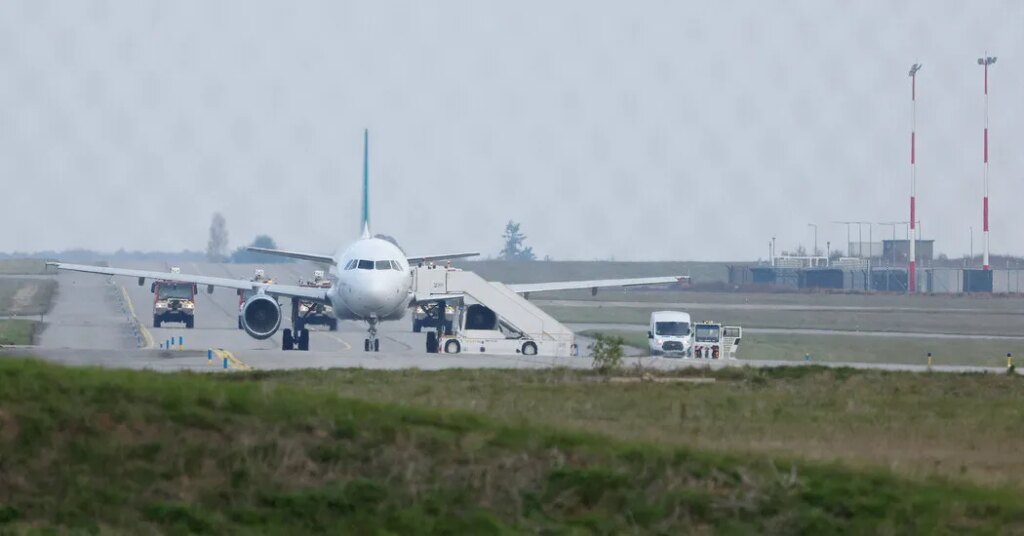
Bomb threats targeted several European airlines on Thursday, disrupting flights in Italy, France and elsewhere after a series of similar threats this week upended travel for some across the region.
All the planes targeted this week have landed safely, and no explosives have been found on any of them, according to officials.
The latest threats resulted in several flights being diverted, and assistance from fighter jets, and they disrupted travel for hundreds of passengers. The source of threats was not immediately clear, nor how they were issued.
Anxiety over airspace security is running high in Europe. A spate of hybrid warfare attacks and intimidation tactics have rattled air travel in recent months as Russia’s war against Ukraine spills over its borders.
Here’s what we know:
What flights were targeted on Thursday?
In Italy, a Finnair plane from Helsinki was escorted to an airport in Rome by military jets after a threat, officials said. French officials said that an Aer Lingus plane flying to Rome from Dublin had been diverted to an air base in France because of a threat. The authorities in the Czech Republic said that four planes heading to Prague had received bomb threats.
Three Ryanair flights headed to Sofia, Bulgaria, from Copenhagen, Madrid and London were also threatened, the Bulgarian transport ministry said in a statement. The flights from Madrid and Copenhagen landed at Sofia Airport; the flight from London was diverted to an airport in Plovdiv, a city in southern Bulgaria.
What are officials saying?
Officials have not given many details about most of the threats. The police in the Czech Republic said Thursday on social media that the threats included a mention of placing of “an improvised explosive device” on board a plane.
A series of similar threats on Tuesday included mentions of explosives on planes, briefly disrupting flights in Poland, Spain, Bulgaria and Italy.
Who do officials believe is responsible?
Neither the identities of those making the threats nor their motives were immediately clear.
Apostolos Tzitzikostas, the European Union’s commissioner for transport, said in a statement on Thursday that it was too early to conclude with certainty whether the reported incidents were linked.
According to analysts, the volume of threats reported over just a few days suggests that at least some are linked. While some could have been made by amateur copycats, the overall number of threats makes it unlikely that they are unconnected, said Paul Mason, an independent aviation security expert.
“This is likely to be a coordinated campaign of bomb hoaxes,” said Rhys Jones, a security analyst at Osprey, an aviation risk consultancy.
When asked whom investigators held responsible for threats made against the aircraft destined for Prague on Thursday, the Czech police declined to offer any information beyond a brief statement shared online.
How can the authorities respond?
Marco Chan, a lecturer in aviation operations at Kingston University in London, said that even if a bomb threat is assessed as a probable hoax, it is difficult for the authorities to determine that for certain without searching the plane.
As a result, he said, the authorities have little choice but to ground the aircraft for emergency inspections if a threat is received midflight.
“If there is a shred of concern as to whether there is a bomb threat, they should always treat it as genuine,” Mr. Chan said. “It’s better safe than sorry.”
Aurelien Breeden contributed reporting from London.
The post What to Know About the Bomb Threats Disrupting Flights in Europe appeared first on New York Times.