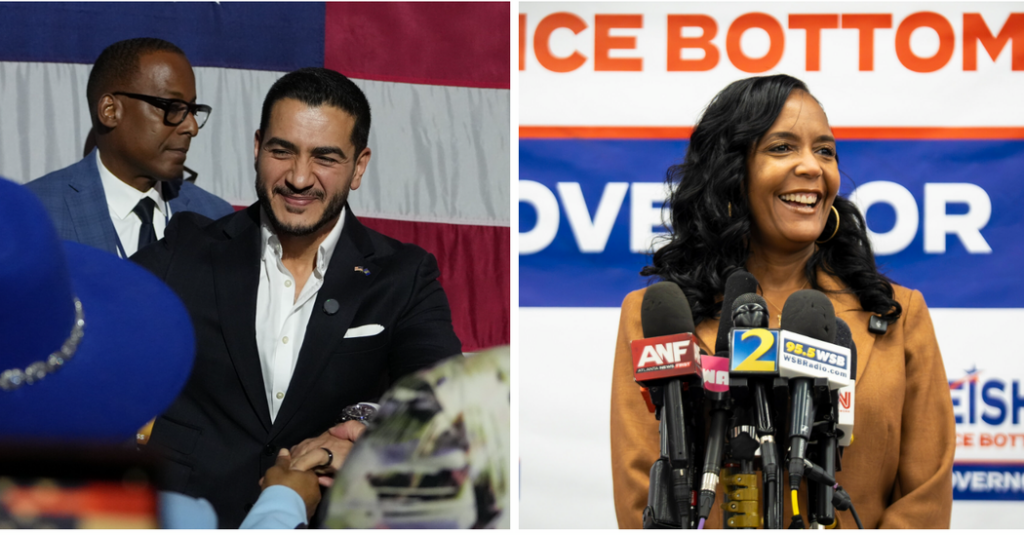
The first Muslim senator. The first Blackwoman to be elected governor of any state. The first openly gay male senator. The first Black governor of Florida. The first elected Hispanic governors in Texas and in California.
The number of “firsts” achieved on Tuesday’s elections was extraordinary. Barriers came crashing down across the country. And yet during the campaigns, the candidates themselves hardly uttered a word about being on the precipice of history. There were no exhortations to vote for a particular person because “representation matters.”
Instead, most of them spoke relentlessly about household finances that had become impossible to manage, an unpopular war and corruption. They did not — and could not — hide their identities. But these facts were not central to their pitches to voters.
This is a major shift in the politics of identity. Ten years ago, when Donald Trump first surged to power, his opponent Hillary Clinton campaigned with slogans like “Stronger together” and “I’m with her.” Diversity itself was a value that Americans were encouraged to embrace as voters.
But in multiple election cycles now, voters have seemed fairly uninterested in symbolism for its own sake. Millions of Black, Hispanic and Asian voters have whipsawed between the two parties in search of leaders — anyone — who will improve their material conditions.
In a time of stagnating wages and wealth, many Americans appear to have concluded that representation was insufficient. They have demanded tangible changes: lower health care bills, higher-paying jobs, the opportunity to purchase a home.
“The language of ‘firsts’ used to be that the symbolism could stand in for what voters wanted,” said Daniel Martinez HoSang, a professor of American studies and political science at Yale University. “The electorate thinks differently now about the symbolism of ‘firsts.’ Not that it’s not important, but candidates recognize that it’s a thin ground to run on.”
Democrats learned this the hard way in 2024. Even with Kamala Harris, a pathbreaking Democrat herself, on the ballot, Mr. Trump won the support of many Black, Hispanic and Asian voters. Republican leaders eagerly hoped that a new multiracial conservative coalition had been born.
Then on Tuesday, voters of every major demographic lurched left. Two years after helping to deliver Mr. Trump back to the White House, Hispanic voters swung toward Democrats more than any other racial or ethnic group this year. Young Hispanic men shifted back almost 50 points toward Democrats. Black Americans’ support for Democrats, after wobbling two years ago, is now back at 2020 levels.
The midterm results confirmed that many voters are not operating out of loyalty to an identity group. They are fed up with the economic and political status quo and will follow leaders who project a similar dissatisfaction.
In this era of politics, each party is constantly re-assembling a winning coalition. Increasingly, voters are showing an independent streak, refusing to vote with any bloc if they don’t see results.
“The candidates and the party really have to deliver for people,” said Professor HoSang of the Democrats who won this week. “There’s a scenario where people feel like there was all this hope mobilized and possibility, and no material change. If that happens, it will deepen the cynicism.”
After the election of Barack Obama in 2008, the ultimate pathbreaking moment in modern American politics, some Americans became disappointed that their material conditions did not improve as much as they had hoped they would. For decades now, under both Democratic and Republican presidents, unemployment among Black Americans remains almost always twice as high as it is for white Americans.
This record, over time, has made it difficult for candidates to appeal to the power of representation alone.
In victory on Tuesday night, the candidates who had achieved “firsts” tended to deal lightly with the history they had just made, while sticking to the main themes of their campaigns.
Nearly 20 minutes into her message of populism, Gina Hinojosa, the new governor-elect of Texas, finally alluded to the extraordinary fact that a state whose population was more than 40 percent Hispanic would now have a Latina as its leader.
“As excited as I am by the history we’ve made tonight, I pray it does not compare to the future we build together,” said Ms. Hinojosa. “The nation will look at Texas and say we won something far more important than an election. They will look at Texas and say that faith in government has been restored.”
But even if Democrats have downplayed identity, their opponents have kept the issue of race front and center.
From day one of Mr. Trump’s return to the White House, his administration attacked diversity initiatives at schools, companies and within the government, accusing them of reverse discrimination.
At the same time, Mr. Trump has continued insulting entire racial and ethnic groups.
In the waning weeks of the midterm cycle, Mr. Trump and others escalated their Islamophobic attacks against Abdul El-Sayed, the Michigan Democrat who will now become the country’s first Muslim senator. Mr. El-Sayed responded with unapologetic pride in his ethnicity and religion.
Near the opening of his victory speech on Tuesday, Mr. El-Sayed pronounced his full name — Abdulrahman Mohamed El-Sayed — with relish. No sanding off his pronunciation for any ears unfamiliar with the sound of his family’s native language. He also called his rival, Vice President JD Vance, “habibi” in jest, using an Arabic term of endearment.
Democrats have long expected they would have an enduring and diverse coalition. Beginning in the 2000s, a popular argument began to circulate that the party would one day enjoy electoral victories simply as a matter of demographic destiny. As the country diversified, the belief went, it would inevitably become more liberal. This has not occurred, as evident in 2024.
Hispanic voters, for instance, are now perpetual swing voters. This group has often been misunderstood as caring mostly about immigration, as if they had all recently arrived in the country. At this point, more than half of Hispanic adults were born in the United States, often to parents who were also born here.
But in a way, the long-awaited demographic turnover finally arrived in American politics this week. The slate of winners broke so many barriers in part because the country itself has become far more diverse. Since opening up to immigrants from around the world in the second half of the 20th century, the country is now generations deep into a whole new demographic reality.
Baby Boomers, who have long dominated the country’s political scene, are about 70 percent white. Millennials are around half. Gen-Z is more ethnically and racially diverse than any generation in American history. People like Mr. El-Sayed (42 years old), Sen. Jon Ossoff in Georgia (39) and James Talarico in Texas (37) have simply grown up in a different country.
The story this week, then, is not only about racial or gender demographics. It’s about the arrival of a new generation. For these Americans, diversity is not a campaign slogan. It’s a simple fact of life.
The post They Made History as ‘Firsts.’ That’s Not What They Ran On. appeared first on New York Times.