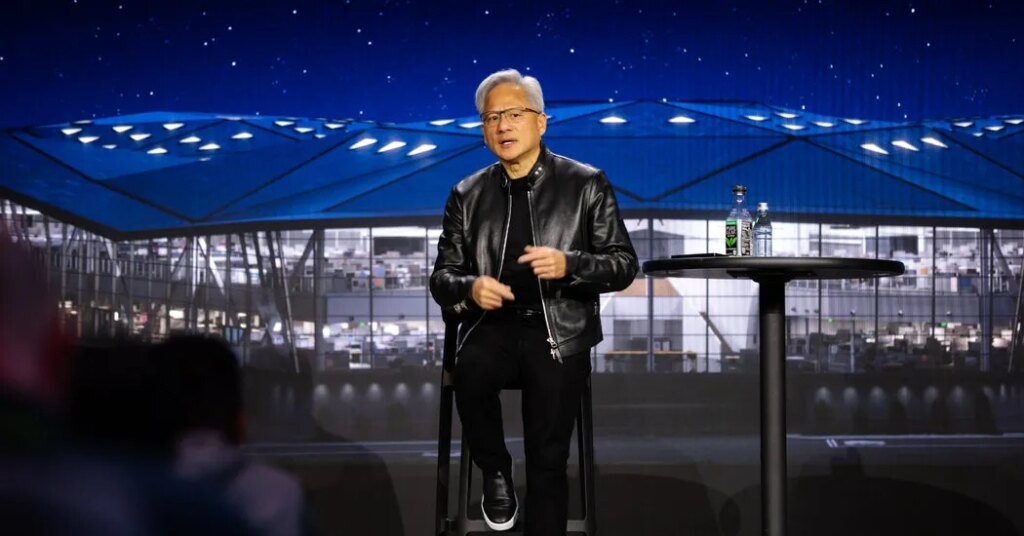
The Republican leaders of three influential House committees on Thursday asked Jensen Huang, the chief executive of Nvidia, to voluntarily appear for a closed-door briefing on his interactions with an executive at a Singapore-based company, who American officials determined was funneling information to Chinese intelligence.
The request came from Brian Mast, chairman of the House Committee on Foreign Affairs; John Moolenaar, who leads the House Select Committee on the Chinese Communist Party; and Rick Crawford, who leads the select committee on intelligence.
The New York Times reported last week that Mr. Huang had a close relationship with Alice Huang, a top executive at Megaspeed, a company that the U.S. government suspected of helping China evade U.S. prohibitions and gain access to Nvidia’s A.I. chips.
The House leaders asked Mr. Huang to appear on Nov. 18 and discuss his interactions with Ms. Huang as well as Nvidia’s security policies for guarding against espionage by a foreign adversary.
“It is vital Congress determines the extent to which U.S. national security has been placed at risk,” they wrote.
John Rizzo, a spokesman for Nvidia, declined to comment on whether Mr. Huang would appear. “Our chief executive has an outstanding security team that accompanies him where needed,” Mr. Rizzo said in a statement.
The request represented a shift for Republican congressional leaders, who have largely followed President Trump’s lead in taking a hands-off approach to the technology industry. Mr. Huang has developed a close relationship with Mr. Trump over the last two years, and the two often speak about technology issues.
The move by the three Republicans also followed a midterm election where voters made clear that they were concerned about the tech industry’s impact on their lives, from A.I.’s potential to eliminate jobs to the construction of giant data centers in their communities.
Anti-tech sentiment largely favored largely favored Democratic candidates, and the move by the Republicans on Thursday was an early indication that they not want to cede that politically potent issue to Democrats.
American spy agencies learned of the relationship through surveillance of Ms. Huang, raising alarms inside the federal government because of the possibility that she could be gleaning vital trade or national security information from Mr. Huang.
In April 2025, Mr. Moolenaar and the House Select Committee on the Chinese Communist Party, which focuses on national security threats from Beijing, opened an investigation into Nvidia’s sale of chips in Asia.
But in the months that followed, the Trump administration rolled back restrictions on Nvidia’s chip sales to China.
Mr. Huang later joined Mr. Trump on the president’s first diplomatic trip to the Middle East, where the president spoke of a major chip sale to the United Arab Emirates and Saudi Arabia. Nvidia also donated more than $20 million to the White House ballroom and promised to invest $500 billion in U.S. manufacturing.
In June, Mr. Huang declined a request to appear before the Senate from Elizabeth Warren, a Democrat from Massachusetts and the ranking member of the Senate Banking Committee, which oversees rules about chip sales abroad.
Last week, Ms. Warren renewed her call for testimony after The Times reported on Mr. Huang’s relationship with Ms. Huang.
In 2025, Megaspeed, a little-known company, emerged to buy billions of dollars in A.I. chips. Ms. Huang, who is a Chinese citizen, was listed as its managing director for its first eight months before removing herself from that role in corporate paperwork. The company later installed a director from Singapore, who is based in Shanghai.
Megaspeed’s sister company in Malaysia bought at least $4.8 billion of advanced A.I. equipment containing Nvidia chips and technology from June 2024 to February 2026, according to trade records obtained from ImportGenius, a trade platform.
The U.S. government has been investigating Megaspeed since late 2024, when a Commerce Department official visited its data center in Malaysia and found the site to be suspicious. The Nvidia equipment was still packed in boxes, suggesting it was being shipped in or out rather than installed there.
Nvidia has said that it complies with the law and that there is no evidence of its chips being smuggled to China. In a statement last week, Mr. Rizzo said Mr. Huang’s “interactions with Ms. Huang are not unusual or unexpected.” He added, “Meetings with customers are part of a C.E.O.’s job; Jensen talks with thousands of customer executives every year.”
The post House G.O.P. Leaders Ask Nvidia’s Huang to Speak in Closed-Door Briefing appeared first on New York Times.