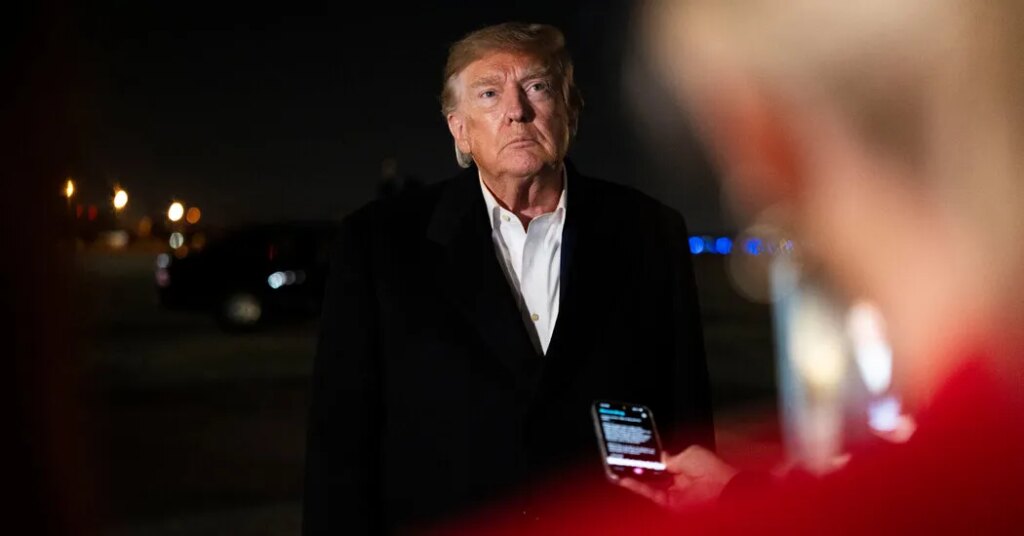
Over the course of his life, Donald J. Trump has readily embraced many identities: A hotel developer. A reality television star. A president. A firebrand.
Now, at 80 years old, he is confronting one he would rather not: a lame duck.
In the hours after voters put a check on the expansive power he has flexed in his second term, giving Democrats control of both the House and the Senate, Mr. Trump seemed to be cycling through the stages of grief. He denied that a blue wave across the country had been his fault, or a direct result of his decision to go to war with Iran. (The vice president explicitly said otherwise.) He accepted the election results. And, as he absorbed the waning power he will have in his final two years in office, he bargained, saying he’d work with Democrats while clinging to his veto Sharpie.
“I’ll get along probably with the Democrats, unless they want to be destructive,” Mr. Trump told reporters on Wednesday, standing in front of a steel beam that was being put into place as part of his cherished White House ballroom project.
He noted that he had “the power to veto,” before turning to a topic he seemed much more eager to discuss: his renovation projects.
Whether Mr. Trump adopts a pragmatic deal-making posture remains to be seen — one ally described the president as “dazed” after the rout on Tuesday.
After his loss in the 2020 presidential race, the last major political setback Mr. Trump confronted, he retreated to Mar-a-Lago, where he nursed his anger and then planned a defiant return. Once back in the White House, Mr. Trump had no use for compromise.
After a period spent as a political pariah and criminal defendant, Mr. Trump liked to say that he had gone from hunted to hunter. In his second term, his administration has tracked down his political enemies, unleashed a violent immigration crackdown and started a war that has made life more expensive for Americans. He didn’t need Congress to do any of it.
But on Tuesday, that dynamic flipped again. Democrats are vowing to investigate government abuses, alleged corruption by the president’s associates and the heavy-handed tactics of Immigration and Customs Enforcement. House lawmakers plan to scrutinize top officials involved in the administration’s immigration agenda, including the White House deputy chief of staff Stephen Miller; Tom Homan, Mr. Trump’s border czar; and the homeland security secretary, Markwayne Mullin, according to a person with knowledge of the discussions.
“LAWYER UP,” Representative Robert Garcia, the California Democrat poised to lead the House Oversight Committee, wrote on social media.
The political pressure could make for an unpredictable two years for both Mr. Trump and the country, according to people who have observed firsthand his volatile personality and his refusal to acknowledge mistakes.
“When you look at things like his ability to do executive orders and grant pardons and all of these things, he’s going to still be doing enormous damage,” said Sarah Matthews, a former White House deputy press secretary who resigned after the attack on the Capitol on Jan. 6, 2021. “And it’s just going to get even more chaotic and dangerous in these next two years.”
Political rivals believe that Mr. Trump, who has asserted his dominance over the Republican Party for the better part of the last decade, will also do everything to maintain his grip on a party that he effectively reshaped in his image.
“Donald Trump needs attention like most people need oxygen,” said former Gov. Chris Christie of New Jersey, a Republican who is considering another presidential run in 2028. “He can’t do without it, and he’s now going to experience for the first time in his political career being a lame duck. So what he’ll need to do is to act out even more than he normally does in order to divert you from the 2028 race.”
Mr. Trump has so far been vague about how he wants to spend the next two years, telling the podcaster and former top F.B.I. official Dan Bongino in an interview on Tuesday that he has “many, many things in the hopper.”
He did not elaborate and instead pivoted into a standard part of his stump speech: “You know, right now we have more factories and plants being built in the United States than at any time ever before, and that means the Roaring Twenties, that means every — there’s never been anything like it.” (Manufacturing has actually slowed since 2024, according to the National Association of Manufacturers.)
He suggested in interviews that he might seek to join forces with his political opponents on the debt ceiling and immigration enforcement — two thorny policy issues that have bedeviled past administrations.
And he repeatedly invoked his ability to veto legislation, implicitly underscoring how much he will be on defense in his last two years in office.
In his first public appearance after Election Day, Mr. Trump stood before reporters at the White House on Wednesday and talked not about any lessons learned, or the path forward for the Republican Party. Instead, he mused about his ballroom project and his own future, particularly the subject of impeachment.
“I think it would destroy the Democrat Party if they did that — impeachment for no reason,” Mr. Trump said. “What, for having a successful country? Our country is more successful now than at any time in history.”
He paused, turning his focus back on the ballroom construction.
“Watch the beam go up,” he said. “Now envision chandeliers all over.”
Several top aides had already been planning for what Mr. Trump could accomplish through executive power alone if Republicans lost one or both chambers of Congress. Those involved include Mr. Miller; Russell T. Vought, the White House budget director; and members of the White House legislative affairs staff, according to a White House official, who spoke on the condition of anonymity to describe internal discussions. The president would receive a “menu of options” soon, the person said.
A hushed conversation of what comes next for Mr. Trump’s presidency and those around him played out on Tuesday night inside the White House, where Mr. Trump gathered aides and cabinet members in the East Room for what turned into a morose watch party. As the president watched the returns and fielded phone calls, some of the people around him quietly discussed whether Mr. Trump would keep in place members of his cabinet or his chief of staff, Susie Wiles, according to two people who attended.
The White House did not respond to a request for comment.
Administration officials and Mr. Trump’s allies said the president and his staff were girding themselves for both congressional investigations and high turnover for the remainder of his time in office.
Some expressed anxiety that there had been little guidance for staff about what to do if they got pulled into investigations, other than a briefing earlier this year advising them generally how to respond to congressional oversight.
As the political conversation turns to the next cycle, Mr. Trump indicated that he was not ready to name a political heir or back a candidate to succeed him in 2028. Asked by Martha MacCallum of Fox News late Tuesday evening whether he wanted a Republican primary to determine the 2028 presidential nominee, the president said, “I think it’s going to end up being somewhat of that.”
By Wednesday morning, Vice President JD Vance had posted a lengthy message on social media placing blame for Republican losses on the decision to go to war with Iran, an apparent effort to separate himself from Mr. Trump.
Several people close to the president say they believe that he is unlikely to endorse Mr. Vance — or anyone else — anytime soon. Mr. Trump is an entertainer above all, they say, and he will want to stay in the spotlight.
Zolan Kanno-Youngs contributed reporting from Washington.
The post Trump Wrestles With New Reality: A Lame Duck With Two Years Left to Fight appeared first on New York Times.