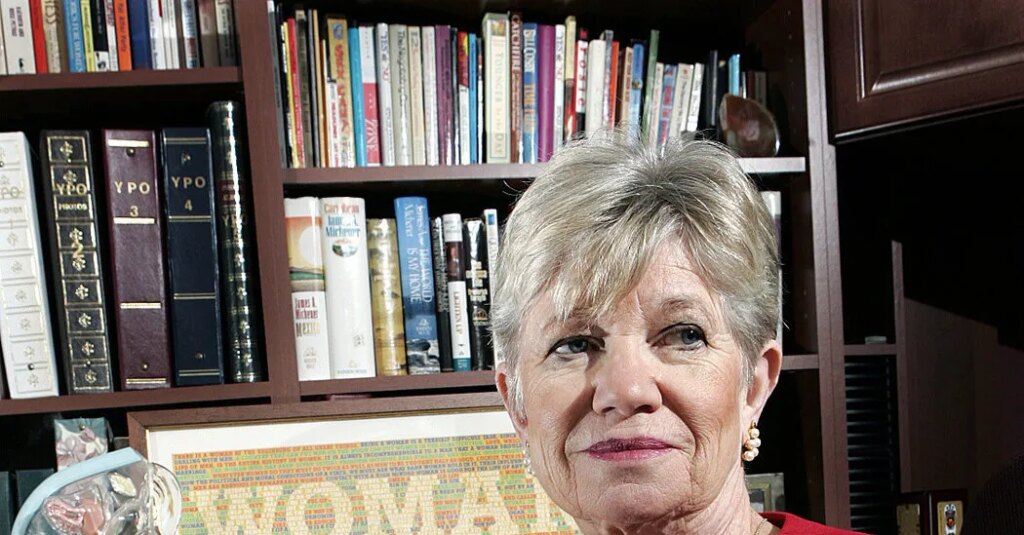
Beverly Whipple, a nurse, psychologist and sex educator whose 1982 book about the G-spot encouraged a generation of women to search for their erogenous zones, died on Monday at her home in Voorhees, N.J. She was 85.
Her husband, Jim Whipple, said her death was from complications of an illness consistent with Alzheimer’s disease.
Dr. Whipple’s book “The G Spot: And Other Recent Discoveries About Human Sexuality,” which she wrote with Alice K. Ladas and John D. Perry, was a New York Times best seller. It examined the concept of female sexual pleasure, and specifically the idea of the G-spot, a sensitive area on the upper vaginal wall. The book has been translated into 19 languages and has sold more than a million copies.
Dr. Whipple’s plain language and accepting attitude about sexual tastes and orientations informed, amused and shocked global audiences.
In 1981, on “The Phil Donahue Show,” Dr. Whipple inserted her finger into a plastic replica of female genitalia, pressing on what she said was a sensitive area. “It’s not easy to find on yourself, but a partner can find it quite easily,” she said.
Spectators in the studio giggled. Dr. Whipple appeared unfazed.
Later in the show, Mr. Donahue asked an older audience member if she had ever expected to discuss this subject on television. “No, I didn’t,” the woman replied. “If my mother was alive, she’d drop dead.”
Dr. Whipple’s study of female eroticism began in the 1970s, while she was teaching nursing students and providing counseling to women in New Jersey. Several of her clients confided that they worried about occasionally urinating during intercourse. Seeking answers in the medical literature, Dr. Whipple unearthed a 1950 article by Ernst Gräfenberg, a German doctor, documenting women’s ability to ejaculate. The same article mentioned an especially sensitive area in the vagina.
Seeking to confirm his findings, Dr. Whipple, along with Dr. Perry, a sexologist and psychologist, recruited 400 women from New Jersey and Vermont for a study. At a 1980 meeting of the American Association of Sexuality Educators, Counselors and Therapists, Dr. Whipple reported that all of the volunteers seemed to have an erogenous area on their vaginal walls somewhere between “11 o’clock and 1 o’clock.” Many of the participants, she added, had released a fluid that was not urine; it was similar to male ejaculate.
A colleague suggested that she call the area the Whipple Tickle. She refused because at the time there was a fictional Mr. Whipple who featured in a popular television advertisement for Charmin toilet paper.
Instead, Dr. Whipple and Dr. Perry called it the Gräfenberg spot, after the earlier researcher. That moniker was later shortened to G-spot. (Dr. Gräfenberg wasn’t the first person to study the area; Regnier de Graaf, a 17th-century Dutch anatomist, wrote about the same vaginal erogenous zone.)
After the “The G Spot” was published, Dr. Whipple appeared on more than 300 television and radio programs, podcasts and videos, and gave more than 800 talks in the United States and abroad. She also wrote more than 100 scientific articles and book chapters. In 2013, Cosmopolitan included her on its list of “10 Sexual Revolutionaries You Should Know.”
While the book propelled her and her collaborators into the public eye, not all the reviews were positive. The Washington Post wrote that “instead of defending this astounding revelation with hard-core scientific data, they chose an inordinate number of soft-core testimonials.”
In later years, Dr. Whipple downplayed the term G-spot, opting instead to use the phrase “clitourethrovaginal complex.” Along with most experts, she no longer talked about a “spot,” but instead promoted the idea that erogenous areas may vary among women and could include the clitoris, urethra and vagina.
Beverly Hoehne was born on June 30, 1941, in Jersey City, N.J., and grew up in nearby Secaucus. Her father, Howard Hoehne, was a vice president of Bankers Trust. Her mother, Beatrice (Bodei) Hoehne, was a nurse.
Beverly attended Weehawken High School and earned a bachelor’s degree in nursing from Wagner College on Staten Island.
After she graduated, in 1962, she married Mr. Whipple. In addition to him, she is survived by two children, Allen and Susan Whipple; five grandchildren; and one great-grandchild.
Her first job after graduation was teaching nursing at West Jersey Hospital in Camden, N.J. In 1975, when administrators refused to let her include lessons on sexuality, she quit and started a sex education course at Gloucester County College (now Rowan College of South Jersey) in Sewell, N.J.
That experience piqued her interest in female sexuality. She went on to earn three degrees from Rutgers University: a master’s degree in counseling, a master’s in nursing and a doctorate in psychobiology.
Her doctoral research, under the direction of Barry Komisaruk, a psychology professor and sex researcher, investigated the neurophysiology of female orgasms, focusing on the way sexual stimulation can dull pain response. The research showed that some women with severe spinal cord injuries are capable of experiencing orgasm, demonstrating that sensations could bypass the spinal cord and travel along the vagus nerve, which runs from the genitalia to the brain.
“Her interest in being able to research sex and make it a legitimate place for scientific study legitimized pleasure as a healthy force for wellness and for research,” Nan Wise, a Rutgers University neuroscientist and sex therapist who trained under Dr. Whipple, said in an interview.
Dr. Whipple wrote several other books on female sexuality, including “Safe Encounters: How Women Can Say Yes to Pleasure and No to Unsafe Sex” (1989), written with Gina Ogden; “The Science of Orgasm” (2006), written with Dr. Komisaruk and Carlos Beyer-Flores; and “The Orgasm Answer Guide” (2009), written with Dr. Komisaruk, Dr. Beyer-Flores and Sara Nasserzadeh.
Reflecting on her career, Dr. Whipple said she never intended to make women anxious about finding their G-spots.
“When you are searching for something as a goal,” she said in a 2018 episode of the Netflix documentary series “Explained” focusing on the female orgasm, “you are going to miss a lot of pleasure on the way.”
The post Beverly Whipple Has Died. She Introduced the G-Spot to the Mainstream. appeared first on New York Times.