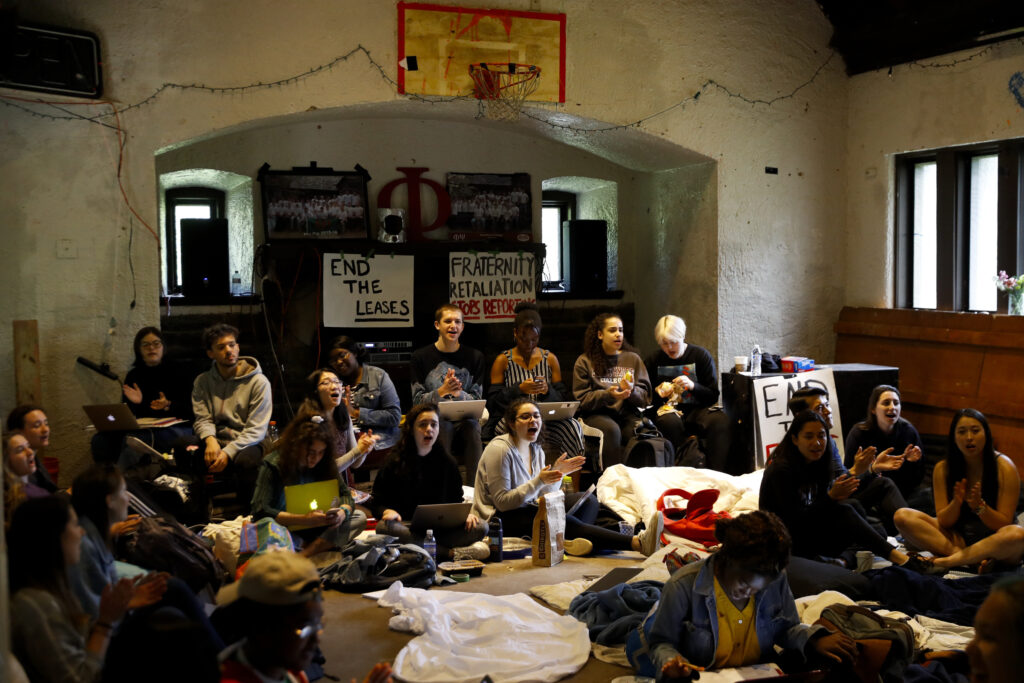
For years, rapes and other sexual assault reports accumulated at Swarthmore College in Pennsylvania.
There were so many complaints that Philadelphia magazine titled a 2014 story about the elite liberal arts school “Rape Happens Here.” Then the issue hit a breaking point.
In 2019, leaked documents from Phi Psi fraternity at Swarthmore captured members referencing a date rape drug and calling an upstairs bedroom of a frat house the “rape attic.”
Protests erupted including a four-day sit-in at the fraternity until the chapter voted to disband. The only other fraternity on campus, Delta Upsilon, agreed to shut down that same night. Swarthmore’s president soon announced a ban on fraternities and sororities on campus that remains in effect today.
Since then, the average number of sexual assaults reported each year has declined at the campus, but the rate of reported sexual crimes per student remains higher at Swarthmore than at most other U.S. colleges, federal data shows.
“People think that because it’s a small liberal arts college that doesn’t have frats, that there’s a certain element of safety or insulation from these problems,” said Patricia Quimby-Moro, a junior who founded a student group to help survivors deal with sexual violence at Swarthmore. “But they still definitely happen.”
A national debate has unfolded over what colleges should do to prevent and respond to sexual violence since a woman filed a lawsuit in September alleging she was plied with drugs and alcohol and gang-raped at a Cornell University fraternity. Some students and faculty at colleges across the country have responded by proposing schools curtail Greek life.
Swarthmore’s experience suggests efforts to end sexual assaults on campus must go far beyond banning or suspending frats.
Colleges need a comprehensive approach that deters heavy drinking and drugs, bolsters education about sexual violence, and encourages bystanders to intervene and survivors to report assaults, experts and advocates say.
“Eliminating fraternities could help,” said Julia O’Connor, assistant professor at the University of Utah College of Social Work, whose research focuses on the prevention of sexual and domestic violence. “But it is unlikely to eliminate or substantially reduce sexual assault on its own.”
Nowhere has the debate been as intense as Cornell, where faculty are taking a no-confidence vote on President Michael Kotlikoff over how he has handled the alleged gang rape that was reported at Chi Phi fraternity in 2024.
Last month, Cornell banned social events at fraternities for the rest of this academic year after outrage over the alleged gang rape. The school said the “measures will provide time for a thorough review of fraternity life at Cornell to determine whether and how it can safely continue.” Cornell also pledged to expand broader programs on campus to address sexual assaults, as well as alcohol and drug abuse.
While outright bans on fraternities are rare, more than a dozen other universities have tried to crack down on Greek life after reports of hazing or sexual assaults in recent years, including Northwestern University, the University of Southern California and the University of Utah.
Michael Topper, an assistant professor of economics at California State Polytechnic University at Pomona, studied over 40 moratoriums on social events at frats involving alcohol from 2014 to 2019.
Topper found both alcohol violations and sexual assaults dropped on weekends during the suspensions. But the numbers bounced back up after the suspensions ended.
“It’s kind of like putting a Band-Aid over it,” Topper said. “We don’t really see any change in behavior after the moratorium is over.”
Some advocates for Greek organizations, however, argue it’s unfair to solely blame fraternities for sexual assaults.
The North American Interfraternity Conference, which represents fraternities with more than 6,000 chapters, said it recently completed an analysis of federal crime data that found schools with fraternities have similar rates of sexual assaults as schools that do not have Greek organizations.
“There is no correlation,” said Jud Horras, president of the interfraternity conference.
But some academics say both alcohol and fraternity culture matter.
“There is research evidence linking fraternity membership to the perpetration of sexual violence,” said O’Connor, the University of Utah scholar.
O’Connor pointed to studies, including one by researchers at Clemson University in 2013 that found fraternity membership is associated with higher-risk drinking, which in turn can lead to higher sexual aggression.
Another study of smaller colleges found schools had higher rates of sexual assaults on average when they had fraternities and fewer restrictions on drinking.
“Alcohol policy was the strongest significant factor. Greek life was a close second,” said Jason Wollschleger, a professor of sociology at Whitworth University who co-authored the study on smaller colleges.
Wollschleger said it’s “pretty safe” to guess that eliminating Greek life would reduce sexual assaults on college campuses, especially if it’s combined with restrictions on alcohol.
Some academics also warn that cutting ties to fraternities can leave the administration, students and families in the dark when the organizations continue to exist as private clubs off campus.
“It makes it very difficult to manage them,” said Dennis Gregory, an associate professor emeritus of higher education at Old Dominion University, who oversaw student affairs at two universities. And when sexual assaults happen at unrecognized fraternities, Gregory noted those crimes typically aren’t included in the university’s public statistics.
Wesleyan University took an unusual approach in 2014 after a survey found students felt “less safe” at fraternities than other parts of campus, and students and faculty pushed the school to make changes.
The Connecticut school ordered all residential fraternities on campus to admit women within three years or give up their chapter houses. The university said at the time that it hoped the change would create a “more inclusive, equitable and safer campus.”
One fraternity, Psi Upsilon, agreed to admit women. Another gave up its housing. And the school shut down a third after a student was seriously injured.
Since then, the number of reported sexual assaults at Wesleyan dropped from 45 in 2014 to zero in 2025. But the school also made other changes during that time to reduce sexual assaults, including revising its sexual assault and alcohol policies, expanding programs to teach students about sexual violence, bolstering support for survivors and improving its handling of reports.
“The changes that were made have improved the campus climate for women and for everyone,” the university said in an email.
Stevan Veldkamp, executive director of the Timothy J. Piazza Center for Fraternity and Sorority Research at Pennsylvania State University, said schools can’t end sexual violence just by eliminating Greek life.
“Campuses that appear to make the strongest progress tend to take a comprehensive, systems-based approach rather than relying on a single policy or program,” he said.
Veldkamp said campuses need to use a range of measures to reduce attacks, including better reporting and support systems, ongoing prevention training, efforts to curb high-risk drinking and broader changes to campus culture.
“Fraternities receive particular attention because they often host a disproportionate share of social events where alcohol is present and large numbers of students gather,” he said.
But Veldkamp suspects that eliminating fraternities would just shift the problems to other places on campus. “It’s displacement rather than prevention,” he said.
That may help explain why sexual assaults remain an issue on Swarthmore’s campus.
The school said 4.7 percent of its students reported they were touched sexually without consent in the past 12 months, according to data collected as part of the National College Health Assessment in spring 2025. That’s similar to the national figure of 4.9 percent, even though the school had a higher rate of reported sex offenses per student than most other colleges over the past several years, according to data collected by the Education Department. Experts caution that the data does not always tell the whole story about safety or dangers because not every assault is reported while students at some schools may be more likely to report incidents.
Quimby-Moro, who said she was sexually assaulted in high school, founded the Swarthmore Survivors Collective at the college last year to help support fellow students.
Digging through the school archives, she discovered that Swarthmore once had a Survivors Week. She and classmates revived that tradition last spring, holding a movie screening, an open mic night and creating a clothesline for students to hang ribbons with messages and colors signifying their connection to sexual assaults. So many people hung ribbons that the line sagged in the middle.
Quimby-Moro said sexual assaults are especially difficult on a small campus like Swarthmore, where it can be hard for students to avoid the person who assaulted them if they aren’t expelled.
The school, considered one of the “Little Ivies,” has just under 1,700 students.
“It goes without saying that even one incident of sexual assault is too many,” said Andy Hirsch, a Swarthmore spokesman. “Our top priority is always the health, safety, and well-being of our campus community.”
Hirsch said the decision to ban fraternities in 2019 was based on a recommendation from a task force, which was underway long before the frat documents were published.
The school said it has also taken a number of other steps to address assaults, including increasing education about consent and boundaries during student orientation, trying to make it easier to report an incident, hiring a “restorative practitioner” to help resolve complaints about sexual assaults and planning to hire a new staff member to support survivors of sexual violence.
Quimby-Moro said she is glad to see people at Swarthmore and other schools talking more about sexual assault in the wake of rape allegations at Cornell.
She said she just hopes it leads to permanent changes that help schools deter assaults and support survivors.
The post Some colleges reined in frats after rapes. Experts urge a bigger fix. appeared first on Washington Post.