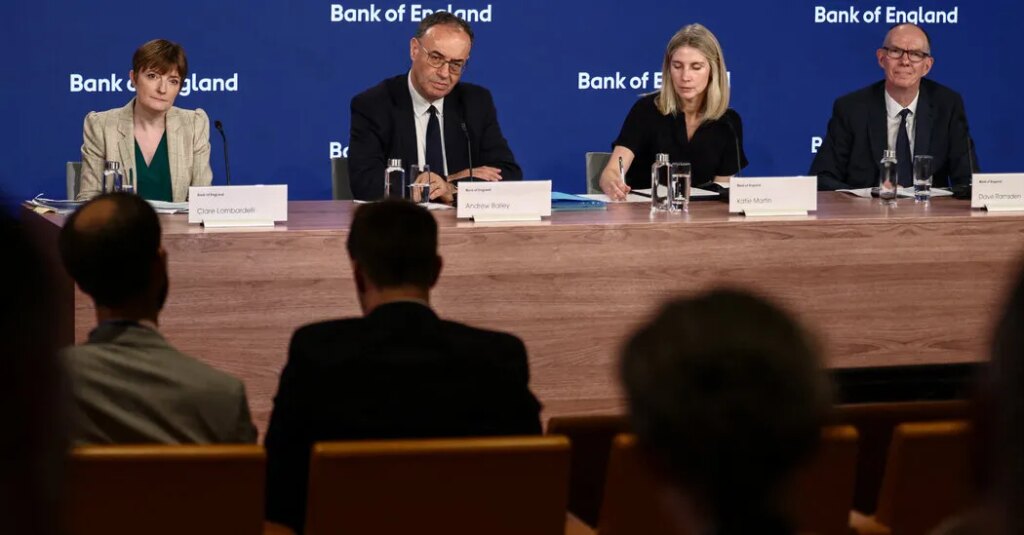
The Bank of England raised interest rates on Thursday, for the first time in more than three years, as policymakers said they needed to take action against inflation caused by the war in the Middle East.
Officials lifted the British central bank’s key rate by a quarter point to 4 percent, as they forecast that inflation would climb to about 5 percent next year, far exceeding the bank’s 2 percent target. The bank joined a swath of global policymakers, including those at the Federal Reserve, European Central Bank and Bank of Japan, who have raised interest rates this year in response to resurgent inflation, driven by higher energy prices. The war in Iran, now in its ninth month, has been the critical driver of higher prices.
Andrew Bailey, the governor of the central bank, has warned for months that the longer the war in the Middle East lasted, the greater the probability that the bank would need to act to keep inflation in check. That moment arrived this week. But it also came at a moment of deep uncertainty about the course of the war. Oil prices dropped sharply on Wednesday after Vice President JD Vance blamed the Republican wipeout in the U.S. midterm elections squarely on the war with Iran.
This week’s rate increase “shouldn’t be seen as the first in an inevitable long sequence of hikes,” Mr. Bailey said in a statement. “But, unless the conflict in the Middle East is resolved, neither does it seem likely to be the last increase.”
Inflation in Britain ran at 3.5 percent in the year to September, the highest rate in nearly a year. After peaking near 5 percent in the second quarter of next year, inflation is not expected to return to the central bank’s target until 2028.
In minutes from this week’s policy meeting, several members of the nine-person rate-setting committee, including Mr. Bailey, said that they could see the case for another rate increase.
The big concern is that higher energy prices could become deeply embedded in the economy, with businesses raising a broad range of prices and workers demanding higher wages. That could lead to a spiral of accelerating inflation that would be hard to control. So far, policymakers said, there has been little evidence that this was happening. But as energy prices have remained relatively high for much of the year, they are growing more worried that this process could start to take hold. That is why they raised interest rates, they argued.
The latest outlook represents a sharp reversal from what the central bank had previously expected this year. The Bank of England lowered interest rates to 3.75 percent at the end of last year, the last in a series of cuts from a peak rate of 5.25 percent in mid-2024. Policymakers had expected inflation in Britain to keep falling, ultimately reaching the 2 percent target this past spring. Instead, the war in Iran pushed energy prices to multiyear highs, hitting household bills and prices at the pump.
British policymakers had held off raising interest rates for much of the year because they argued that rates were already acting as a restraint on the economy and the labor market was showing signs of weakness. Both of those developments could limit how much inflation would become entrenched in the economy.
Britain’s economy has performed better than many economists expected this year, which strengthened the case for higher interest rates. The economy is forecast to grow 1.6 percent this year, the Bank of England said, half a percentage point faster than the bank’s projection about three months ago.
But a slowdown is expected in the years ahead, limiting the ability of the economy to deal with higher rates.
Rising energy prices are starting to bite. The average household energy bill could rise by 25 percent in January, the central bank forecast. At the same time, pressures on living standards are worsening. Inflation-adjusted disposable income per person, one measure of living standards, is set to drop over the next two years, the Office for Budget Responsibility said recently. After some recovery, the independent forecaster said, disposable income will be only 1 percent higher in 2030 than it was a decade earlier, before the Covid-19 pandemic.
The post Bank of England Raises Rates as Iran War Pushes Up Prices appeared first on New York Times.