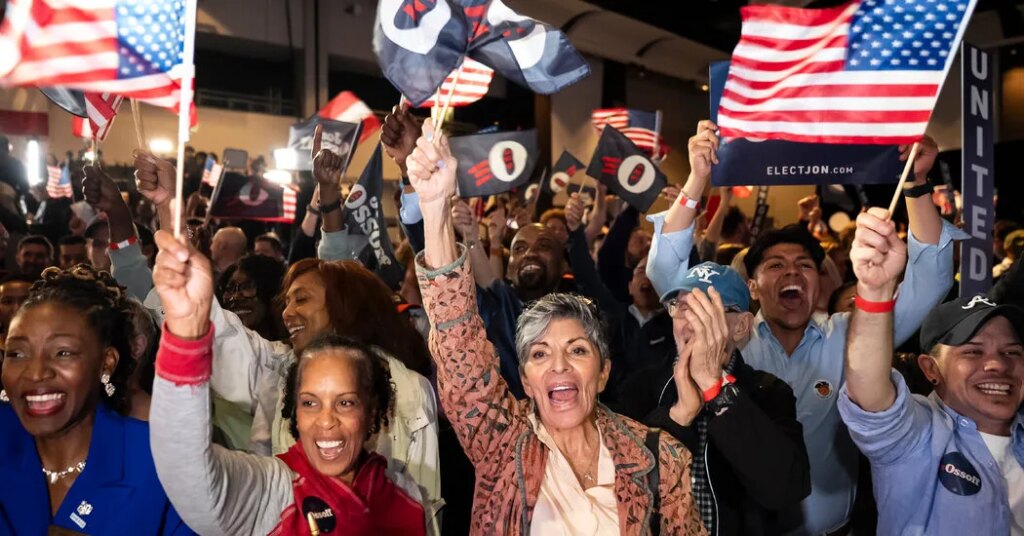
A new wall of blue states emerged from the midterm election map. It was not along the edges of the Great Lakes but along the Atlantic Ocean, from Virginia to Georgia.
Democrats won competitive races in North Carolina, South Carolina and Georgia on Tuesday, gaining ground across the South.
In North Carolina, Roy Cooper, the popular former governor, won the Senate race by nearly 20 percentage points, a resounding victory that appeared to make waves down-ballot, helping flip control of the state’s congressional delegation and State House.
In Georgia, Senator Jon Ossoff won re-election by 18 points, helping to lift Keisha Lance Bottoms, who became the nation’s first elected female Black governor. Democrats won every statewide race in Georgia and flipped the State House.
Even in South Carolina, which had hardly been on the battleground Senate map, Annie Andrews, a pediatrician, upset Senator Darline Graham, the interim Republican incumbent, by more than four points. Democrats also flipped a House seat and 10 state legislative seats in a traditionally Republican state.
And Democrats’ power in the South could expand even further: The Mississippi Senate race remained too close to call on Thursday, with the Democratic nominee, Scott Colom, a district attorney, leading Senator Cindy Hyde-Smith, the Republican incumbent, by a razor-thin margin.
Democratic Senate nominees in the South benefited from the national mood punishing President Trump and his party over high prices and the unpopular war in Iran. They also harnessed anger from Black voters over redistricting efforts that diluted some Black representation in Congress.
The winning nominees made key decisions at pivotal campaign moments that contributed to their victories. Here are some of them:
-
In North Carolina, Mr. Cooper knew that voters knew him and mostly liked him. But he also knew that Republicans would spend vast sums to defend the Senate seat in North Carolina, a state that Mr. Trump won three times. So he raised money knowing that national Republican political groups would be able to outspend Democratic ones.
His campaign went on television early, reminding voters who he was and defining Michael Whatley, his Republican rival, who was little-known to most voters, as a Washington lobbyist for energy companies. When Mr. Whatley’s campaign attacked the former governor as soft on crime, Mr. Cooper’s team pushed back with fact-checking ads — and tied Mr. Whatley to a convicted sex offender who held roles with the state Republican Party.
Mr. Cooper wanted a short and direct campaign slogan that could cut across party lines and demographic groups, and he found it: “Make Stuff Cost Less.”
By the time October arrived, Mr. Cooper was so consistently ahead that Republicans pulled their advertising money from the state. Then, so did Democrats, allowing them to spend in competitive races elsewhere.
-
In Georgia, Mr. Ossoff laid the foundation to win a second term during his first. He built a robust constituent services operation. He maintained strong relationships with Black communities and churches. He befriended local Republican officials, including mayors and county commissioners, and tried to fulfill their federal needs. Some of them later endorsed him.
The senator’s fund-raising prowess helped scare off potential opponents. When Representative Mike Collins won the Republican primary, Mr. Ossoff tagged him as a bigot, an attack that resurfaced following several news reports connecting his aides and his son-in-law to white nationalism and racism. (Mr. Collins said in a debate last month that he had “condemned racism, antisemitism, hate.”)
Mr. Ossoff’s message was an aggressive critique against President Trump and his administration — not only on tariffs and the war in Iran but also on corruption. When he started delivering it, some Democrats worried he might be going too far. By the end of the campaign, corruption was a motivating issue for many voters.
-
In South Carolina, Ms. Andrews’s original opponent, Lindsey Graham, died in July. That gave her an opening to run not against a four-term incumbent but against his sister, an inexperienced candidate.
Ms. Andrews campaigned with well-known Black Democrats, such as Representative James Clyburn of South Carolina and Senator Raphael Warnock of Georgia. She gave interviews to conservative media outlets. She held town hall-style events in rural and Republican parts of the state. She leaned into a message of rejecting family dynasties in politics.
Ms. Andrews saw a way to win over independents and Republicans after Representative Ralph Norman lost to Ms. Graham in a bitter Republican primary. Mr. Norman’s son, Warren, said he was leaning toward voting for Ms. Andrews. They spoke; in her final rallies, she referred to the support she was getting from her “new friend” — Warren Norman.
Democrats in the South hope that their wins will persuade national Democratic leaders to run year-round organizing and voter registration in states that had previously been seen as unwinnable.
Back in April, some Democratic donors laughed when Mr. Warnock, who campaigned for candidates across the South, suggested they consider investing in Mississippi, according to an audio recording of a private fund-raiser obtained by The New York Times.
In an interview on Wednesday, Mr. Warnock said that he hoped donors would now see “a multiracial coalition” rising in the region. Democratic wins in Georgia, he noted, came after a decade of work organizing, educating and registering voters.
“It felt like it happened all of a sudden,” he said. “It wasn’t sudden.”
“We know the formula,” he added. “We need to enact it in Mississippi, in South Carolina, in North Carolina, in Florida, in Texas.”
The post How Democrats Won Across the South appeared first on New York Times.