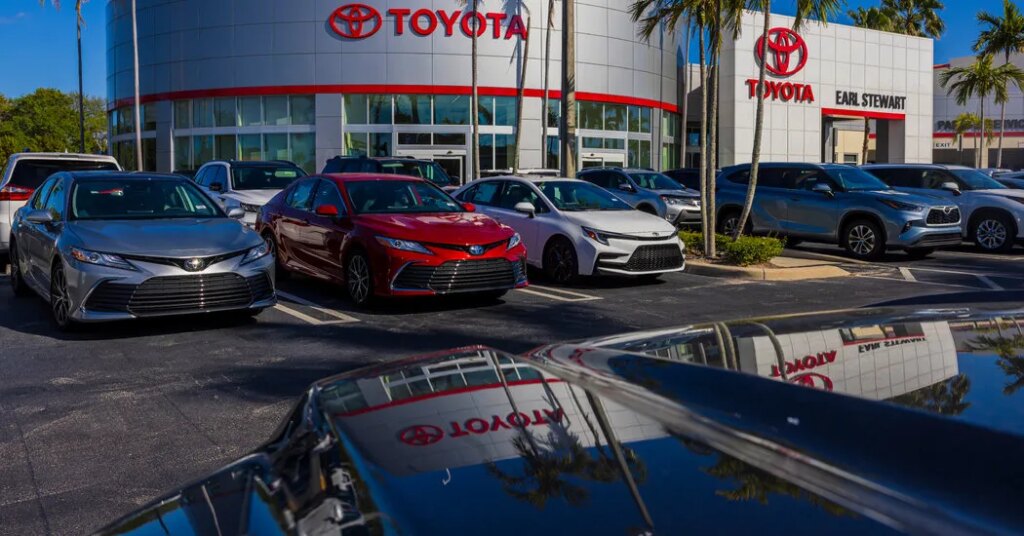
Rising gasoline prices are steering American car buyers toward hybrid vehicles, delivering a windfall for their biggest producer, Toyota Motor.
Toyota said on Thursday that it expected its operating profit to rise to $24.7 billion for the current year through March, up 15 percent from its previous forecast. The automaker also reported higher earnings between April and September, buoyed by rising hybrid sales in the United States.
The results pushed Toyota’s shares up more than 16 percent in Tokyo on Thursday. It was the company’s biggest daily gain in nearly 40 years.
Toyota’s strong earnings underscore how the company’s once contrarian bet on hybrid vehicles is paying off, as high gas prices from the war in the Middle East push American drivers toward more fuel-efficient cars — just not fully electric ones.
In the third quarter, total hybrid vehicle sales in the United States rose 28 percent from the same period a year prior. Sales of electric vehicles declined 40 percent, as the Trump administration’s elimination of federal tax credits continued to sap demand.
For now, in the United States, “inventories of hybrid vehicles are extremely tight — essentially, they sell like hot cakes even without discounting,” said Sanshiro Fukao, an executive fellow at the Itochu Research Institute. “That dynamic is very strong, and is by far the biggest driver behind Toyota’s strong earnings,” he said.
Toyota said on Thursday that it sold 2.36 million hybrid vehicles during the April-through-September period, an 8 percent increase from the same period a year earlier. The profit it makes from the vehicles has also been bolstered by the weakness of the yen, which inflates the value of its overseas earnings.
In the early 2020s, when much of the automotive industry moved rapidly to focus on electric vehicles, Toyota stood behind its wager that hybrid demand would endure. At the time, rivals such as Honda Motor, which pledged to phase out gasoline engines entirely by 2040, became darlings of investors and other groups that were bullish on all things E.V.
Now, the shift in the market has set many automakers back. Honda posted the first annual net loss in its seven-decade history in May, after taking on billions in restructuring charges and write-downs related to a retrenchment of its E.V. strategy. Volkswagen said in September that it would cut roughly 50,000 additional jobs in the face of costs related to E.V.s and rising competition in China.
Toyota is not immune to the challenges faced by its competitors. Chinese automakers have begun flooding global markets with inexpensive electric cars, and foreign automakers are being squeezed in China, the world’s biggest auto market. Toyota’s sales in the country fell by a quarter during the April-through-September period, reaching their lowest level in nearly a decade.
The question now is whether the tide in the U.S. electric vehicle market could turn once more. With Democrats regaining control of both the Senate and the House in this week’s midterm elections, a renewed legislative push for pro-E.V. policies has become far more likely, Mr. Fukao said.
“Toyota’s current stellar earnings could be considered quite short-term,” Mr. Fukao said. “While hybrids currently account for strong sales, the looming question of how the Japanese auto industry will fare once we have to compete on battery E.V.s again could undeniably become a major challenge.”
The post High Gas Prices Boost Sales for Hybrid Giant Toyota, Sending Stock Soaring appeared first on New York Times.