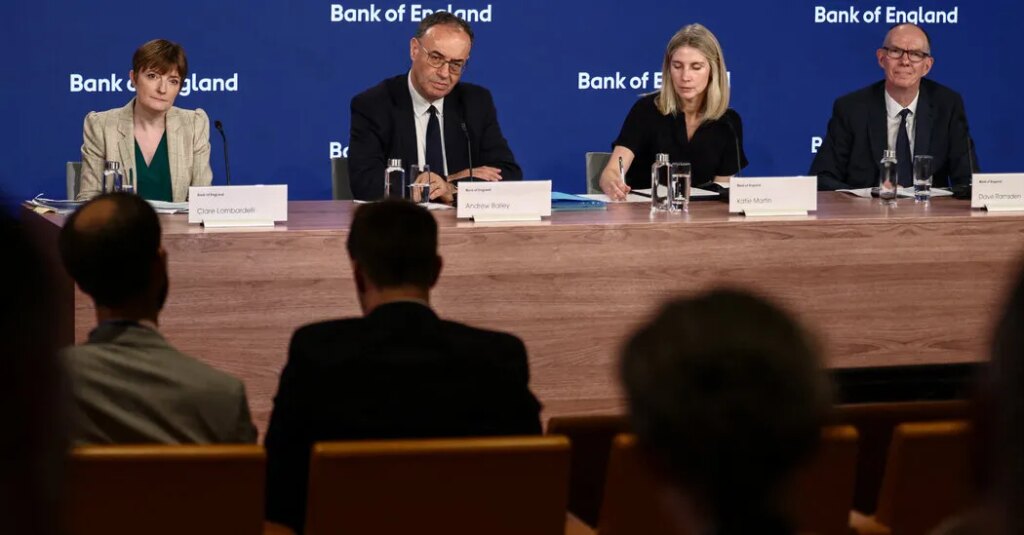
The Bank of England raised interest rates on Thursday, for the first time in more than three years, as policymakers said they needed to take action against inflation caused by the war in the Middle East.
Officials lifted the British central bank’s key rate by a quarter point to 4 percent, as they forecast that inflation would climb to about 5 percent next year, far exceeding the bank’s 2 percent target. The bank joined a swath of global policymakers, including those at the Federal Reserve, European Central Bank and Bank of Japan, who have raised interest rates this year in response to resurgent inflation, driven by higher energy prices. The war in Iran, now in its ninth month, has been the critical driver of higher prices.
Andrew Bailey, the governor of the central bank, has warned for months that the longer the war in the Middle East lasted, the greater the probability that the bank would need to act to keep inflation in check. That moment arrived this week. But it also came at a moment of deep uncertainty about the course of the war. Oil prices dropped sharply on Wednesday after Vice President JD Vance blamed the Republican wipeout in the U.S. midterm elections squarely on the war with Iran.
This week’s rate increase “shouldn’t be seen as the first in an inevitable long sequence of hikes,” Mr. Bailey said in a statement. “But, unless the conflict in the Middle East is resolved, neither does it seem likely to be the last increase.”
Inflation in Britain ran at 3.5 percent in the year to September, the highest rate in nearly a year. After peaking near 5 percent in the second quarter of next year, inflation is not expected to return to the central bank’s target until 2028.
The post Bank of England Raises Rates for First Time in Three Years appeared first on New York Times.