In the 1940s, the biologist Niko Tinbergen observed that the oystercatcher bird chose to incubate only her largest eggs. He guessed that this behavior was instinctive: the larger the egg, the healthier the chick. To test his hypothesis, Tinbergen presented a mother oystercatcher with a plaster egg several times larger than a real egg. The mother bird was fooled, and though she could barely clamber atop it, she kept trying — tragically neglecting her eggs.
It turns out that any animal can be fooled by cues that trigger its evolutionary instincts. But only people use these cues to trick each other. We create artificially enhanced diversions that, like Tinbergen’s fake oystercatcher egg, exploit our reward systems, making us feel good in the moment but leaving us worse off in the future. Is there hope? Only if we understand how radically we have reshaped our habitat and how it manipulates us in turn.
Consider Doritos. What starts out as raw corn is processed into an irresistible snack by industrial machinery that dries, pulverizes, rehydrates, extrudes and deep-fries it — then adds salt, sugar and artificial flavorings and colorings. Most of us know that food products engineered for immediate pleasure rather than long-term nourishment should be no more than an occasional indulgence. But because instinct tells us that fat, sugar and salt mean escaping starvation and death, ultraprocessed foods now account for the majority of calories in the American diet.
Our media diet is no different. “Much of the digital content that ensnares our attention in the current moment is also ultraprocessed,” the computer scientist and contributing New York Times Opinion writer Cal Newport has observed of the endless array of warp-speed, action-packed, hyperedited and hyperpersonalized videos that social media serves us. “What is a TikTok video,” he asks, “if not a digital Dorito?”
Since its invention, social media has commanded an increasing share of our waking hours, while time spent socializing with friends in person has fallen. More and more, we stay home, conducting the activities of daily life — including work, exercise, entertainment and worship — in solitude rather than in the presence of other people. We are gradually going silent, too; people spoke nearly a third fewer words in 2019 than they did just 15 years before.
Cosmetic surgery co-opts our reproductive instincts by artificially exaggerating the signs of health and youth — full lips, smooth skin and large eyes. Our obsession with these exaggerated traits has advanced alongside the procedures that make them possible. And social media fans the flames, giving rise, most recently, to the subculture of “looksmaxxing,” which encourages young men to take steroids, smash and remodel their jaws and otherwise transform themselves into the likeness of Superman.
Online gambling exploits the instinct for pursuing valuable but uncertain rewards, a drive that once helped our ancestors survive by hunting and foraging. Unlike the casino — first established in 1638 in Venice as a controlled setting for games of chance — apps such as FanDuel, DraftKings and BetMGM have turned gambling into a 24/7 temptation made even more alluring by loyalty programs, status tiers and celebrity endorsements.
And now, A.I. has become the most powerful ultraprocessing technology of all. A.I. deep fakes not only are indistinguishable from real human faces but are also rated as more trustworthy in controlled laboratory studies. A.I.-generated writing can be perceived as “more human” than human writing. And A.I.-generated medical advice has been rated as significantly more empathetic than responses from human physicians.
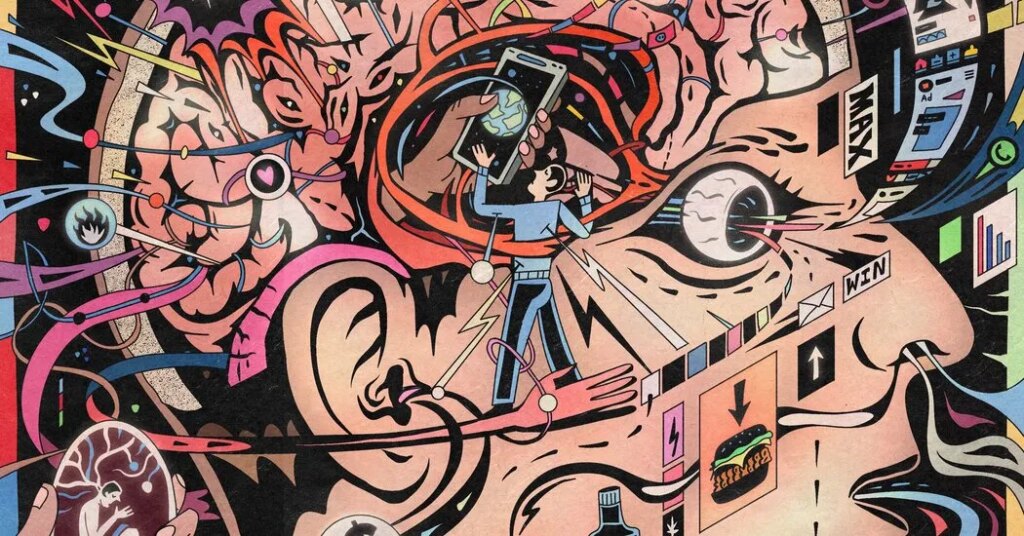
It’s not just our food, then, that’s ultraprocessed. Altogether, these developments have warped our environment so significantly that we live in what could be called an “ultraprocessed world.”
If, by design, the modern world doesn’t bring out our best, what can we do? Noticing how ultraprocessed stimuli grab our attention and shape our behavior is a first step.
Next, we can make those temptations less convenient. We have the power to redesign our microhabitat — in particular, the objects we keep close enough to see and reach. We can purge our pantries of irresistible snacks, or, at least, stash them on a very high shelf. We can charge our phones anywhere but the night stand when we go to bed. We can delete any apps that, for us, feel addictive. And we can embrace technologies developed to diminish the influence of ultraprocessed stimuli — not just app blockers like One Sec or Opal but also GLP-1s. Fight fire with fire.
But there are limits to individual agency. Changing our shared habitat requires collective action. We can support soda taxes and school cellphone bans. We can prohibit social media algorithms that hijack attention, particularly that of younger users. On gambling apps, we should ban microbets — wagers on plays during a live game that especially encourage compulsive betting. And, as I hope is obvious, we can regulate the development and release of frontier A.I. models.
A half-century ago, the philosopher Robert Nozick proposed the following thought experiment. Imagine a future in which psychologists “could stimulate your brain so that you would think and feel you were writing a great novel, or making a friend, or reading an interesting book.” All the while, “you would be floating in a tank, with electrodes attached to your brain. Should you plug into this machine for life, preprogramming your life’s experiences?”
Nozick thought that few of us would choose to plug in. It is our nature, he said, to “want to do certain things, and not just have the experience of doing them.” We want to “be a certain sort of person,” Nozick said, not some “indeterminate blob” floating in a tank.
Were Nozick alive today, he might change his mind about what most people would choose. Because we don’t have to imagine the experience machine — we’re living in it already. The question, then, is not whether we choose to plug in but rather how intentional we are about unplugging. As a species, Homo sapiens — literally “wise man” — has made some foolish choices, but it’s not too late to reshape our world, individually and collectively, for the better.
Angela Duckworth is a professor of psychology at the University of Pennsylvania and the author of the book “Situated: Find the People and Places That Bring Out Your Best.”
The Times is committed to publishing a diversity of letters to the editor. We’d like to hear what you think about this or any of our articles. Here are some tips. And here’s our email: [email protected].
Follow the New York Times Opinion section on Facebook, Instagram, TikTok, Bluesky, WhatsApp and Threads.
The post We Live in an Ultraprocessed World appeared first on New York Times.